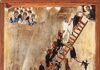

The Beheading of Saint John the Baptist
Herod had sent and seized John and bound him in prison for the sake of Herodias, his brother Philip’s wife, because he had married her. For John said to Herod, “It is not lawful for you to have your brother’s wife.” And Herodias had a grudge against him and wanted to kill him. But she could not, for Herod feared John, knowing that he was a righteous and holy man, and kept him safe. When he heard him, he was much perplexed; and yet he heard him gladly. But an opportunity came when Herod on his birthday gave a banquet for his courtiers and officers and the leading men of Galilee. For when Herodias’ daughter came in and danced, she pleased Herod and his guests; and the king said to the girl, “Ask me for whatever you wish, and I will grant it.” And he vowed to her, “Whatever you ask me, I will give you, even half of my kingdom.” And she went out and said to her mother, “What shall I ask?”
And she said, “The head of John the baptizer.” And she came in immediately with haste to the king, and asked, saying, “I want you to give me at once the head of John the Baptist on a platter.” And the king was exceedingly sorry; but because of his oaths and his guests he did not want to break his word to her. And immediately the king sent a soldier of the guard and gave orders to bring his head. He went and beheaded him in the prison, and brought his head on a platter, and gave it to the girl; and the girl gave it to her mother. When his disciples heard of it, they came and took his body, and laid it in a tomb (Mark 6:17-29).
The Gospels also tell us that John had withdrawn into the desert, where he practised austerity and fasting and called people to repentance. He was deeply zealous for the Law, showed no partiality and spared no one when it came to making the truth known and defending what belongs to God. When he learned that Herod had become attached to Herodias, his brother Philip’s wife, and had taken her as his wife while his brother was still alive, and that he had done much evil and become a stumbling block and a scandal to the people, he came out of his solitude to rebuke Herod for this conduct, which went against God’s laws.
So a shameless woman took revenge on the one of whom Christ the Lord said that he was more than a prophet, and that among those born of women none greater had arisen. His death took place around the year 31.