
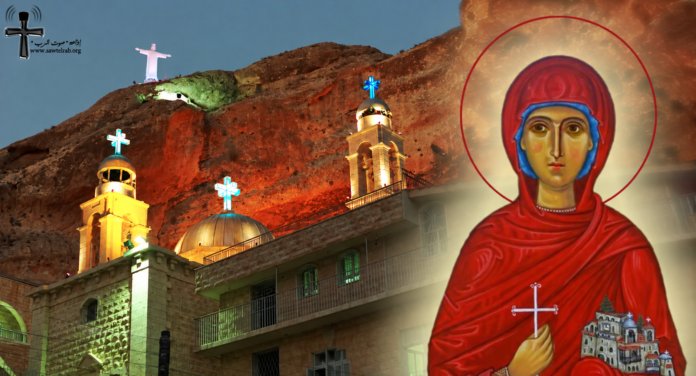
Life of Saint Thecla – Saint Takla
(First among Women Martyrs and Equal to the Apostles)
Saint Thecla was a disciple of Saint Paul the Apostle and is considered the first woman martyr of Christianity, just as Saint Stephen is regarded as the first martyr. She endured many sufferings that could have caused her death, although her blood was not shed. Many Fathers of the Church saw in her an image of the virgin Church, adorned with every virtue, after the Most Holy Virgin Mary. Thus, when they praised a great saint, some called her “the new Thecla.”
Her youth:
She grew up in Iconium and was known for her remarkable beauty, her good character, her wealth, and her learning. Her father, one of the city’s notables, ensured that she received a solid education. She studied philosophy and mastered poetry. She was eloquent and bold, while remaining modest and dignified.
Many young men sought her hand in marriage, and around the year 45 A.D., her parents chose for her a wealthy young man named Thamyris, the son of a notable.
When Saints Paul and Barnabas passed through the city of Iconium during their first missionary journey (Acts 13–15), Thecla was sitting near a window on the upper floor of her home. Seeing Saint Paul and hearing his words, she was drawn by the Spirit of God to the Gospel. She met the Apostle Paul, listened to his teaching, professed her faith, and was then baptized.
Through these encounters, she felt a deep desire to consecrate her life to the Lord in virginity. She began to set aside unnecessary adornments, no longer caring for jewelry or pearls. She also turned away from feasts and banquets, which deeply troubled her mother.
At first, her mother tried to persuade her gently. She urged her to return to her former life, to marry and have children who could support her in her old age. But the saint firmly affirmed her desire to preserve her virginity for the Lord. Her mother then began to threaten her.
She turned to Thamyris and asked him to help convince her daughter to marry. He flattered Thecla, thinking that he could draw her heart back to worldly pleasures, but Thecla remained steadfast in her choice of virginity.
Her care for Paul in prison:
Her mother considered her daughter’s refusal to marry a disgrace, while Thamyris felt that Thecla had wounded his pride. His love for her then turned into deep hatred.
Seeking revenge, he stirred up the governor against his teacher, Paul the Apostle, who was thrown into prison.
The saint remembered the words of the Apostle Paul: “The word of God is not bound” (2 Tim 2:9). She therefore slipped into the prison to remain near her teacher, listen to his Gospel teaching, and provide for his needs with her own money.
Saint John Chrysostom said of this: “Saint Thecla, at the beginning of her conversion, offered her jewelry to help Paul the Apostle, while you, who are old in the faith and proud of the Christian name, do not help Christ with anything you give to the poor.”
The Apostle was flogged and expelled from the city, while his disciple was arrested.
In the midst of the furnace:
Her mother and Thamyris both rose up against her. The judge tried to convince her to deny her faith in Christ and to submit to what he considered the law of nature by marrying, but she firmly refused.
A blazing furnace was lit before her. Without fear, she prayed to God and courageously walked into the flames herself. A violent wind arose, with lightning and thunder. Heavy rain began to fall and extinguished the flames. Thecla was unharmed, while some of the people standing around her were struck.
As everyone fled, she left the city and joined Saint Paul, whom she accompanied to Antioch.
Her sufferings in Antioch:
In Antioch, a prominent man of the city named Alexander was captivated by her beauty. One day, when he met her in the street, he tried to force himself upon her. She escaped him and rebuked him before the crowd, even tearing his garment and throwing his head covering into the mud.
Seeking revenge, Alexander denounced her to the governor, who condemned her to be thrown to wild beasts.
Crowds gathered to witness the suffering of the young woman. But when the governor ordered the beasts to be released, they rushed toward Thecla, lay at her feet, and licked them. The governor thought that the animals were not hungry and ordered that the ordeal be repeated the following day.
When the same scene took place again, the crowd began to demand Thecla’s release, although some still called for her death, accusing her of being a sorceress.
Thecla was again thrown into prison. On the third day, she was tied to two furious bulls. In great suffering, she asked the Lord to receive her soul. But suddenly, her bonds broke, and the bulls rushed at the executioners, knocking them down and killing them.
She was also thrown into a pit filled with venomous snakes, but she suffered no harm. Finally, the governor ordered her release, especially because many noble women, both Christian and pagan, were outraged by Alexander’s behavior toward her. A noblewoman named Tryphena then welcomed her into her home.
In the mountains of Qalamoun:
Saint Thecla went to Saint Paul in Myra, Lycia, and told him all that God had accomplished for her. Paul glorified God and encouraged her. She then assisted him in evangelizing pagan women.
Her journeys:
She returned to Iconium and discovered that her fiancé had died, while her mother continued to reject her. She evangelized some pagan women, then left for Syria, where she preached among women. Many embraced the faith through her.
She later settled in a cave in Seleucia, where she lived a peaceful and contemplative life for twenty-seven years. Crowds came to her to hear her words and ask for her prayers.
Her dormition:
According to tradition, doctors rose up against her because the sick were no longer going to them, but instead were coming to the saint to ask for her prayers. They then persuaded a group of wicked men to attack her.
When they arrived, they found her praying. She was not troubled, but lifted her eyes toward heaven. Then the rock split open before her, and Thecla entered it to join her heavenly Bridegroom.
Some manuscripts report that she found within the rock a passage that led her to Rome, where she fell asleep in the Lord and was buried beside her teacher, the Apostle Paul.
May her prayers be with us.