Meditation for the Fourth Sunday of Lent: Sunday of Saint John Climacus (Mark 9:17-31)
“This kind cannot be driven out by anything but prayer and fasting.”
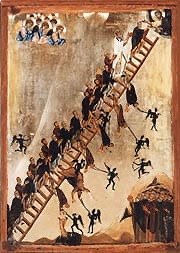
On the fourth Sunday of Lent, the holy Church has set the commemoration of Saint John Climacus, author of The Ladder of Divine Ascent (the ladder of virtues). In it she presents to us the monastic and ascetic model.
That is why she reads us the Gospel passage that affirms the necessity and unique place of the ascetic virtues, fasting and prayer, in the life of the believing Christian.
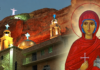
After keeping doctrinal commemorations on the first and second Sundays of Lent – of Orthodoxy, of Saint Gregory Palamas and of the holy relics – that is, of right belief and right vision, the Church sets up the Cross as the means of bringing vision and belief down into the realm of action. Then, on this Sunday, we live with two models of action in prayer, fasting and true repentance: the examples of Saints John Climacus and Mary of Egypt.
Prayer and fasting may seem to be monastic arts that are not for everyone, even though the Church affirms that they are for every Christian. While monastic communities practise these two virtues in a particular way, the Christian, wherever he is, must not throw away these two weapons or give up their grace. For the Gospel text is clear and affirms that our ongoing war “against the spiritual hosts of wickedness in the heavenly places”, as the Apostle Paul says, can only reach a victorious end through fasting and prayer.
So if some practices are impossible for a Christian who does not live in a monastic setting, he must find suitable ways for himself, so as not to become any less of a fighter in this spiritual war. This requires a deep and conscious understanding of fasting and prayer, to master these two arts to the level of a professional, even if by different means. The bond the Gospel insists on, the marriage it makes between fasting and prayer, rests on the psychosomatic make-up of the human being. Man worships God with his whole being, and so the two pillars of the spiritual life are prayer and fasting. Prayer is “the fasting of the mind”, just as fasting is “the prayer of the body”.
Prayer, as Saint John Climacus defines it, is “intimacy with God”, that is, fixing the mind in contemplation of God and meditation on the divine Word. That is why the enemy of prayer is the thoughts that steal its clarity. Many thoughts and the imagination are tasty dishes, even if they deceive the human mind. Cutting off these thoughts is harder than amputating limbs.
Here the believer practises the “fasting of thoughts” when he knows that his mind lives only on heavenly bread, that is, on understanding the divine Word, so that he puts aside every earthly thought, when we choose good Lenten thoughts for our minds and live on them alone. That is why the exercise of prayer leads us to weaken carnal thoughts, and then the mind fasts from certain thoughts by choosing good ones. In the same way, fasting is “the prayer of the body”.
As Saint Gregory Palamas says, Scripture speaks of “the blood of murdered Abel crying out to God”; likewise “the fasting and weary members cry out boldly, together with the spirit, to the Lord”. A person can pray with the members of his body; through fasting, then, he places his members and his body too in a state of constant prayer.
Through fasting, a person chooses the foods that suit him, not from a carnal mindset but because man lives by the word that comes from the mouth of God.
Through fasting, a person declares to himself, through the hunger of his body, that he lives not for himself but for God. He makes known to himself his riches, his desire and his goal. Through the body we become poor in spirit, and hunger for Christ, the true food and living drink. For a hungry person, the body becomes an alarm clock that goes with him and reminds him of the purpose of his life and of God’s presence in it. So hunger is a silent prayer of the body.
Just as the mind prays with words, the body prays with voluntary hunger. Hunger is the prayer of the body, as words are the prayer of the mind. And in prayer, too, we fast from thoughts and declare with our minds that we hunger for the divine Word, turning away from any other, because the Lord is the living food and the true manna of the human mind. A person who has fortified his mind with prayer and his body with fasting is like the house from which the demons have been driven out: it becomes clean, and becomes a house of God and a temple of the Spirit. That is why the struggle to journey towards Pascha and to behold God must rest on these two virtues: prayer as the fasting of the mind, and fasting as the prayer of the body. Amen.
Fr. Gerard Abi Saab