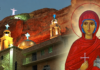

Saint George
April 23 is the feast of the holy great martyr George the Victorious (280-303).
The name George (Gerges, Jirjis) means “farmer” or “tiller of the soil”.
The life of Saint George
Saint George was born in Lydda, in Palestine, around 280, to Christian parents who were wealthy and well known. He joined the army at seventeen. The Emperor Diocletian liked him, brought him into the imperial guard, promoted him and made him commander of a thousand men (a tribune). He became famous in war for his victories, so that he was called “the Victorious” (“the Trophy-bearer”).
When the emperor began persecuting and torturing Christians, ordering that they be forced to worship idols and that anyone who refused be put to death at once, George was angered. He went before the emperor, openly declared himself a Christian and passionately defended the Christians and their beliefs.
The emperor tried to turn him from his Christian faith with tempting promises, with promotion to the highest ranks and by showering him with money, but he refused it all firmly and persistently.
The emperor was enraged and ordered the soldiers to torture him. They took him to a dark prison and began tormenting him: they tied his feet with ropes, put a huge stone on his chest and beat him with whips and spears until he lost consciousness, then left him lying there. But he kept praying. The next day they brought him before the emperor, hoping the torture had curbed his zeal, but he appeared even firmer, stronger and bolder. So the king had him tortured again: he was placed on a wheel covered with nails, which was spun violently; his body was torn, his face disfigured, and blood poured like springs from all his limbs. But he endured it with wonderful patience, and he heard a voice from heaven say to him: “George, do not be afraid, for I am with you.” His courage was strengthened, and he came out of that hellish machine as if nothing had happened: his wounds were healed and the flow of blood had stopped. They took him to the emperor, who was astonished to see him sound in body and full of strength. Furious, the emperor ordered his soldiers to take him back to prison and subject him to other kinds of torture. They whipped him until his flesh was torn to pieces, poured quicklime on his body and a mixture of tar and sulphur on his wounds to eat away and dissolve his flesh. He suffered beyond human endurance, but the Lord Christ helped him bear the horror of those tortures, and he stayed alive.
The next morning, when the soldiers opened the prison door, they saw the saint standing in prayer, his face shining like the sun, without any sign of torture. They took him to the emperor, who accused him of sorcery and brought in a skilled magician famous for his powers. The magician put deadly drugs into a cup of water that would kill anyone who drank it on the spot, recited some devilish spells over it and told the saint to drink it. The saint took it, made the sign of the cross over it and drank it; it did him no harm, and he stood there smiling. Then the magician took a second cup, filled it with even stronger poisons, recited even more evil spells over it, and asked that the saint be tied up so that he could not make the sign of the cross over the cup as he had the first time. But the saint, trusting in the power of the cross, moved his head up, then down, then to the left, then to the right, saying each time: “Shall I drink the cup from here, or from here, or from here, or from here?” So by bowing his head in the four directions he made the sign of the cross, and then he drank the cup, and it did him no harm at all.
This fulfilled the words of Christ: “These signs will accompany those who believe… they will pick up serpents, and if they drink any deadly thing, it will not hurt them” (Mark 16:17-18).
When the emperor despaired of forcing George to deny Christ, he had a great wheel made, fitted with sickles, rings and sharp swords, and ordered his soldiers to put George inside it and turn it to crush him. When the saint saw this terrible wheel, he prayed to the Lord to deliver him from this cruel ordeal. They put him in the dreadful machine: his bones were crushed, his flesh torn apart and all his limbs separated, until he was nothing but a shapeless mass. Then the emperor cried out to the members of his council: “Where is George’s God now? Why has he not come to save him from my hand?”
Then he ordered his soldiers to throw George’s remains into a deep pit where his supporters could not reach them. But during the night the Lord Christ came down into the pit with his angels, raised the saint from the dead and restored him to life, whole in body. In the morning he walked in before the emperor and his aides, and they were all astounded. The emperor said: “Is this George, or someone who looks like him?” Then the prince Anatolius rebuked the emperor for his ingratitude and the darkness of his heart, and he and all his soldiers declared their faith in the Lord Jesus Christ. The emperor was furious and ordered them all to be killed, and they died as martyrs. When all the emperor’s attempts to make the saint deny his faith had failed, he summoned him and began to flatter and cajole him with enticing promises to change his mind and renounce his faith. This time Saint George pretended that he would return to worshipping idols and asked the emperor to allow him to go to the temple and see the gods. The emperor was delighted and wanted to make it a public ceremony, so he gathered his commanders, the nobles of his court and crowds of people to watch George offer sacrifice to the god Apollo.
When George arrived, he went up to the statue of Apollo, made the sign of the cross over himself and said to the idol: “Do you want me to offer you sacrifices as if you were the God of heaven and earth?” A voice came from inside the idol: “I am not a god; the God you worship, George, is the true God.” At once the idol fell to the ground, and all the other idols fell with it and were smashed. The emperor then ordered George to be beheaded. The fame of his wonderful martyrdom and rare courage spread throughout the empire, and that is why he is called “the Great Martyr”. From that day on his name grew ever greater in every land, East and West, and his miracles multiplied, so that peoples and individuals vied with one another in honouring him, seeking his intercession, building churches in his name and naming their children after him. He is one of the saints closest to the hearts of the faithful.
Troparion of Saint George
As deliverer of captives and defender of the poor, healer of the sick and champion of kings, O victorious great martyr George, intercede with Christ God for the salvation of our souls.