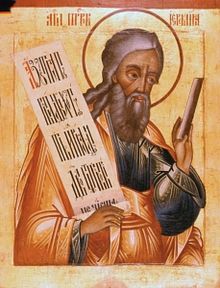
The Commemoration of the Prophet Jeremiah
He is the second of the four major prophets. He was born in Judea, and his father Hilkiah was a priest. God sanctified him in his mother’s womb, as Saint Augustine says, based on the first chapter of his prophecy:
“Now the word of the Lord came to me saying, ‘Before I formed you in the womb I knew you, and before you were born I consecrated you; I appointed you a prophet to the nations'” (Jeremiah 1:4-5).
God called him when he was a young man of no more than fifteen. Afraid of the weight of this demanding call, he said:
“Ah, Lord God! Behold, I do not know how to speak, for I am only a youth.”
The Lord said to him:
“Do not say, ‘I am only a youth’; for to all to whom I send you you shall go, and whatever I command you you shall speak. Be not afraid of them, for I am with you to deliver you, says the Lord” (Jeremiah 1:6-8).
He prophesied before, during and after the deportations. His prophecy was fulfilled in the destruction of Jerusalem, and he mourned and wept over it in his famous Lamentations with great tenderness and deep feeling. He witnessed the terrible events that befell the kingdom of Judah and the evil and sins committed by the people, and Jeremiah rose up to rebuke them and warn them of disaster:
“Be appalled, O heavens, at this, be shocked, be utterly desolate, says the Lord, for my people have committed two evils: they have forsaken me, the fountain of living waters, and hewed out cisterns for themselves, broken cisterns, that can hold no water” (Jeremiah 2:12-13).
The false prophets rose up against him, running down his words, deceiving the kings and leaders and stirring them up against him. But he did not fear kings, nor was he afraid of anyone, great or small, in defending the truth and warning with the word of God. He paid no attention to those false prophets, but rebuked them, saying:
“Woe to the shepherds who destroy and scatter the sheep of my pasture! says the Lord. (…) Behold, I will attend to you for your evil doings, says the Lord” (Jeremiah 23:1-2).
The people turned against him, called him a traitor and tried to kill him. He went into hiding with his disciple Baruch, whom he had charged with reading the scroll of his prophecies to them.
The king of Babylon came back and besieged Jerusalem in the reign of King Zedekiah, who had rebelled against him. He tightened the siege until many died of hunger and some even ate one another. Zedekiah was taken captive and the people were carried off to Babylon. The Chaldeans burned the king’s house and the houses of the people with fire, and broke down the walls of Jerusalem.
Jeremiah remained in his homeland, where he wrote his magnificent Lamentations. He sent letters to those in exile, prophesying that they would return to Jerusalem after seventy years, and he also prophesied the reign of the Messiah, the son of David.
Those whom the Babylonians had left behind wanted to flee to Egypt. Jeremiah opposed them, but they would not listen to him and forced him to go with them. There he resumed his prophesying and warned them of God’s wrath, and, according to tradition, they fell on him and stoned him, and he died a martyr for proclaiming the word of truth.
This happened some years after the fall of Jerusalem in 586 BC. All his prophecies have been fulfilled; his book has fifty-two chapters.