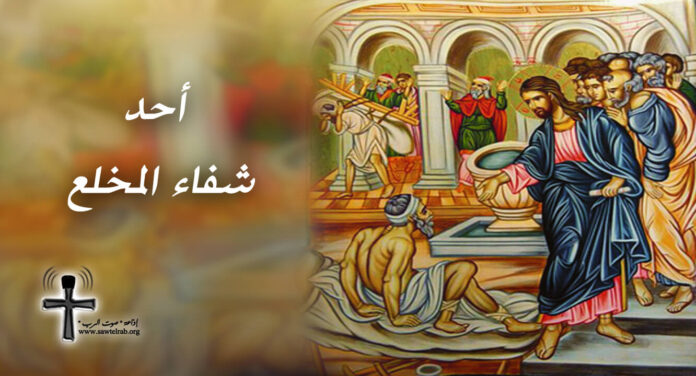
Meditation for the Sunday of the Paralytic – John 5:1-15
During this Paschal season, the Church reads the account of the healing at the pool of Bethesda (the “house of mercy”) because of what it symbolizes: the font of Baptism.
In earlier times, Baptism was linked to Easter. The period of Great Lent was devoted to preaching and preparation, and the catechumens were baptized on Holy Saturday, passing from the old life to the new and celebrating an eternal Pascha.
Two things stand out in the text. The first is the groaning of humanity, weighed down today by the weakness of corruption; the human being created in the beginning between corruption and incorruption, that is, corruptible by nature and incorruptible by grace. The paralytic’s cry, “Sir”, represents the sigh of fallen humanity in its sub-natural state.
The second thing, clearly visible in the text, is the survey of the solutions offered to lift this painful reality and to still this human sigh. Three parties appear before this challenge. The first is the other person, our neighbour, and the paralytic sums up his experience with them: “I have no man…”. The second is the religious authorities, who are supposed to bring religious answers of salvation; the text shows that they too fail. As for the last, the one who could say to the paralytic “Take up your pallet, and walk…”, and whose word became deed and life, it is God.
First there is human action, whose capabilities keep growing. Human reason is a precious divine gift, a reflection of the image of God in us. Some believe that human efforts are increasingly successful in treating pain and disease. Others hold the opposite view: that through civilization and progress humanity has shortened its average lifespan and brought new, deadly diseases upon itself through its own inventions. Whatever the case, human efforts, whether they succeed or do harm, do no more than shorten or lengthen the average human lifespan. When human effort succeeds in confronting decay, it succeeds only in postponing it. Human abilities have removed much suffering, but they have always failed before death. They have delayed and prolonged, but they have neither abolished nor dispelled.
A quick look at our complex societies today shows how much each person shares every aspect of life with others. Homes are no longer separate as they once were: each of us is a “neighbour” to many, and a single building today holds what a whole village once did. At work, too, there are no longer solitary tasks or private trades: the simplest jobs require human cooperation. The world of specialization requires many parties to work together to accomplish anything. And yet we notice that the more connected people become, the lonelier they are. In the end, the paralytic’s words ring true: “Sir, I have no man…”. Human civilizations, inventions and progress are a divine desire before they are a human necessity, but none of this is a final solution, only a temporary one. The human word in the face of the question remains human: it moves things along, but it does not solve the problem.
Then there is the action of the religious authorities. At first sight, hope seems to rest with them, since civilization has not achieved the goal. But the Gospel text immediately reveals the failure of this second party too, when it remains merely human. Religion fails when it becomes a matter of the letter. Faced with the miracle, the religious authorities fixed on the breach of the letter of the Law and did not notice the victory of life over death. They turned religion into mere commentary, when at its root it is a channel of life.
When the religious word is confined to the letter, it remains human, and even deceptive. For the secular human word at least offers a passing comfort in the face of suffering, whereas the religious word in such a case becomes destructive, because it turns into an illusory philosophy of mere words.
Religion is not a contemplative philosophy of life. It is not the passing on of information or the imposing of duties; religion is an answer to human suffering. It must be living, that is, it must be life. Otherwise religion truly becomes the “opium of the people”. The irreligious and inhuman conduct of some believers exposes the many cases where the religious word kills instead of giving life, and unmasks it when it is itself worn out instead of healing what is worn.
And third, there is the action of God. He said, “Let it be,” and it was. He spoke, and life stirred in place of corruption. When the word of God meets a person, it changes and transforms them, and that is the proof of the life within it.
God’s word and action are, already now, a share in incorruption: they are life and a pledge of eternal life. That is why the word of God overturns the other two parties. Those who have opposed Christ and opposed the faith throughout the ages are either the atheists or the Pharisees among the religious. That is the summary of history in the face of Christ’s Resurrection. And what holds for the history of humanity and of societies holds also for personal life: God’s life-giving word is also death to the old world and the old self. When the divine word meets the human will, together they bring forth life at once.
Amen.
Fr. Gerard Abi Saab