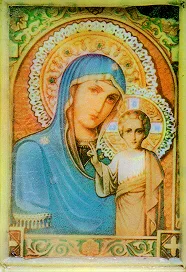
Since November 22, 1982, a modest house in the Christian neighbourhood of Soufanieh, Damascus, has been the setting of a phenomenon through which its residents say they have experienced graces reminiscent of those known by the first Christians.
Damascus holds a special place in the history of Christianity. One of the events most closely associated with the city is the conversion of Saint Paul (Acts 9:3–6).
The city still contains the chapel of Saint Ananias, one of Christ’s early disciples, traditionally counted among the seventy-two disciples mentioned in the Gospel of Luke. Ananias was sent to lay hands on Saul of Tarsus so that he might regain his sight (Acts 9:10–19).
Damascus is also home, within the Umayyad Mosque, to the shrine traditionally associated with Saint John the Baptist. Nearby, in the village of Maaloula, Aramaic, the language associated with the time of Christ, has long remained part of the local linguistic heritage.
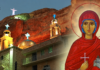
It is in this same Damascus that a series of extraordinary and unexplained events has been reported: oil flowing from a reproduction of an icon of the Virgin Mary—which we will refer to throughout this text simply as “the icon”—and oil appearing on the face and hands of Myrna Nazzour.
Myrna was a simple and level-headed young woman of eighteen, married only a few months, who was said to have experienced the Passion of Christ through the stigmata of the Crucifixion and to have seen the Virgin Mary during states of ecstasy.
The first reported event took place on November 22, 1982.
That day, Myrna was praying with members of her family while visiting her sick sister-in-law when she was overcome by a strange and indescribable sensation. Her whole body began to tremble, as though a force were flowing out of her, in her own words.
For the first time, oil then appeared on her hands.
The second event began in the home of Myrna and Nicolas in Soufanieh on November 27, 1982, the anniversary of the apparition of the Virgin Mary to Saint Catherine Labouré in 1830 on the Rue du Bac in Paris.
That day, oil began to flow from a small reproduction of the icon of Our Lady of Kazan, measuring approximately 6 × 8 cm (2.4 × 3.15 inches).
Nicolas had purchased this reproduction in Sofia, Bulgaria, at the Alexander Nevsky Church in July 1980.
Little by little, the reported flow of oil from the icon came to follow the rhythm of the liturgical cycle and continued until 1990.
During those years, it ceased only once: from November 26, 1985, until the evening of November 26, 1986.
Yet, according to the account, the atmosphere of peace and prayer in the house remained unchanged.
Throughout that entire year, not a single drop of oil was reported to have flowed, and no apparition took place.
This period is linked in the source to part of a message attributed to Christ and dated November 26, 1985:
“And if my absence lasts long and the light is hidden from you, do not be afraid:
it is for my glory.”
Source: soufanieh.com