


The Life of Saint Carlo Acutis
(1991-2006)
Carlo Acutis was born in London on 3 May 1991. His parents, Andrea Acutis and Antonia Salzano, raised him in the faith and in a committed Christian life. They moved to Milan, Italy, four months after their son was born.
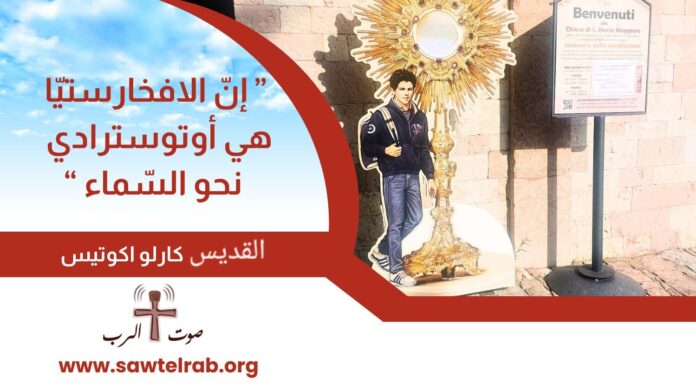
At the age of seven he made his First Communion at a monastery of Ambrosian nuns near Milan. He was in love with the Eucharist, which he called “my highway to heaven”. He went to Mass every day, prayed the Rosary, spent time in adoration before the Blessed Sacrament and received the sacrament of Penance, going to confession at least once a week.
Carlo went to school in Milan and completed his education at the Jesuit high school (Istituto Leone XIII). He was highly skilled with computers and the internet, and he created a digital exhibition on the Eucharistic miracles of the world.
Pope Francis, in his exhortation to the young people of the world (Christus Vivit), held him up as a model of youthful holiness in the digital age.
He took as his models Saint Francis of Assisi, Saint Dominic Savio, Saints Francisco and Jacinta Marto, Saint Bernadette Soubirous and other saints.
In 2006 Carlo was diagnosed with leukaemia. He offered his sufferings for Pope Benedict XVI and for the universal Church, saying: “I offer all the suffering I will have to endure for the Lord, for the Pope and for the Church.” He left this earth for heaven on 12 October 2006, the same year he fell ill, at the age of fifteen, in Monza, Italy. As he had wished, he was buried in Assisi.
The Archdiocese of Milan opened the diocesan inquiry into his life on 15 February 2013; it concluded in 2016.
Pope Francis recognized his heroic virtues and declared him Venerable on 5 July 2018.
The medical board of the Congregation for the Causes of Saints later gave a favourable opinion on a healing attributed to Carlo Acutis’s intercession: that of a child in Brazil suffering from a rare congenital malformation of the pancreas. Pope Francis approved this miracle in February 2020.
In 2019 his body was exhumed and transferred; it is not incorrupt, but was found in a normal state of transformation and was then prepared for veneration by the faithful. On 1 October 2020 the tomb of the Venerable Carlo Acutis was opened to the public in preparation for his beatification, which took place on 10 October 2020 in Assisi.
Many events were organized in the Diocese of Assisi to accompany the beatification, such as Eucharistic adoration, “a great initiative to prepare for the beatification”, according to Antonia Salzano, Carlo’s mother. She added: “Eucharistic adoration is a moment of grace in which everyone can deepen their faith following Carlo’s example. It is true that Carlo will become Blessed, but all of us are called to be saints; Carlo is a point of reference for anyone who wants to put the Gospel at the centre of their life.”
She also said:
“I expected to attend my son Carlo’s graduation or wedding,
but Jesus has honoured me by letting me see my son raised to the altars of the holy Church…
How beautiful to be able to say that on Sundays I pray in a church of Saint Carlo, my son! What a feeling!”
Among Blessed Carlo’s famous sayings about the Eucharist: “When we face the sun, we get a tan… but when we stand before Jesus in the Eucharist, we become saints.”
The Miracles That Led to the Canonization of Carlo Acutis
The canonization of Carlo Acutis rests on two miracles recognized by the Vatican:
the first is the healing of a Brazilian boy, Mattheus Vianna, from a congenital defect of the pancreas in 2013; the second is the healing of a student from Costa Rica.
The second miracle concerns Valeria Valverde, a 21-year-old woman from Costa Rica who suffered a severe head injury in a bicycle accident while studying in Florence in 2022. After emergency surgery in which part of her skull was opened to relieve the pressure on her brain, her family was told that her condition was critical and that she might not survive.
Six days after the accident, her mother made a pilgrimage to the tomb of Blessed Carlo Acutis in Assisi, where she prayed for her daughter’s healing and left a written note. That same day Valeria began breathing on her own, and the next day she was able to move her arms and speak again.
Ten days after her mother’s pilgrimage, Valeria left intensive care, with tests showing that the brain haemorrhage had completely disappeared; she needed only one week of physiotherapy after leaving hospital. Pope Francis recognized this miracle on 23 May 2024.
Pope Leo XIV proclaimed him a saint on 7 September 2025.
Prepared by Rita of the Sawt el Rab team


 Carlo Acutis was born in London on 3 May 1991. His parents, Andrea Acutis and Antonia Salzano, raised him in the faith and in a committed…)