The raising of the widow of Nain’s son
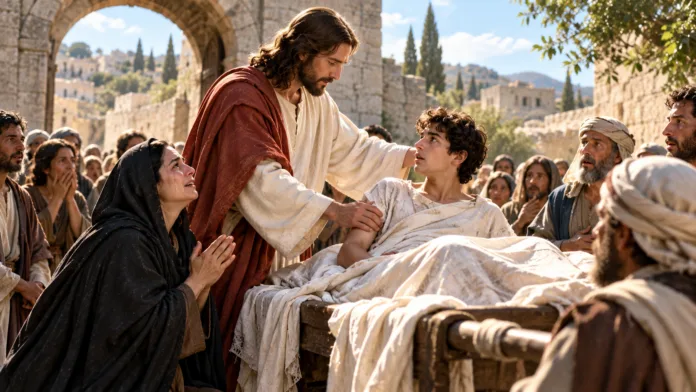
In today’s Gospel we heard about a miracle Jesus performed in a town called Nain: a widowed mother walking behind the body of her only son, drowning in an ocean of sorrow, pain, despair and tears. The Gospel tells us that when Jesus saw her, he had compassion on her. Here we see Jesus immersed in an ocean of consolation, compassion and love for people, carrying their burdens, with an endless desire to wipe the tears from their eyes. But caring about others, carrying people’s burdens and having compassion on them do not end as mere feelings.
Here we ask ourselves: how do we turn these feelings into actions? We might say people’s problems are bigger than our means. But I ask myself: what means did Mother Teresa of Calcutta have? We lack two things: first, knowing that our means, however small, are still great, like the widow’s mite; and second, deciding and having the will to turn our feelings into actions. Scripture says: “The desire of the sluggard kills him.” Jesus was not lazy: he went up to the bier, touched it and said: “Young man, I say to you, arise.” At once life came back into the young man and he began to speak. Maybe he said: “Why are you carrying me? What’s going on?” And we too ask ourselves, after a crisis, a fall, a coma, a recovery, a car accident: what happened? Who protected me? Who healed me? Who saved me? But most of the time we are unaware that at every moment the Lord is lifting us out of all kinds of danger of death.
The reason is clear: Jesus does everything for us because he loves people. He loves each of us personally: “I say to you, arise. I say to you: I am with you, do not be afraid.” To this widow he said two little words: “Do not weep.” And to you and me he says today: “Don’t cry.” I know you are tired. I know your worries weigh on your shoulders like mountains and that there is a deep wound inside you. I know you are treated unfairly, confused and despairing of life. I know you are young, that the pressures of school and university wear you down, and that people’s and your parents’ lack of understanding hurts you. I know the habits that control you have made you a captive and that your addiction locks you behind the bars of bitter pain. I know you have left your homeland and your longing for it burns you. I know that worry about your children and their future has robbed you of your joy and peace. I know your illness has broken your dignity and changed your face and your heart. I know old age is a hard, narrow and dark tunnel. I know, I know, I know… Jesus knows our weakness, and it was not only the widow of Nain’s only son whom he commanded to overcome death: he commanded us too, and he will command us through his death on the cross, out of love for us, so that we may be children of the resurrection.
We must rely on the word of Jesus, who said to each of us: “I am the resurrection and the life; whoever believes in me, though he die, yet shall he live.” We are always waiting for a miracle, and we forget that a miracle is a sign, and the sign is the word of the Lord by which he heals us. A verse of the Gospel is no less powerful than the sign that is a miracle. Signs and miracles are teaching, a word that points to the meaning of the Gospel and its message, not only to God’s greatness and power.
If today you are on the way up or on the way down, in joy or in sorrow, in weakness or in strength, in failure or in success, Jesus tells you in today’s Gospel: don’t cry, don’t worry, don’t be afraid, don’t be sad, don’t give up, don’t despair, don’t lose faith; I am beside you, I am with you, I am yours, I love you, I save you, I heal you, I strengthen you, I wipe away your tears; only believe, and everything is possible for the one who believes. Amen.
Homily by Bishop Ibrahim Ibrahim