Saint Charbel, a Sign of God’s Presence among His People
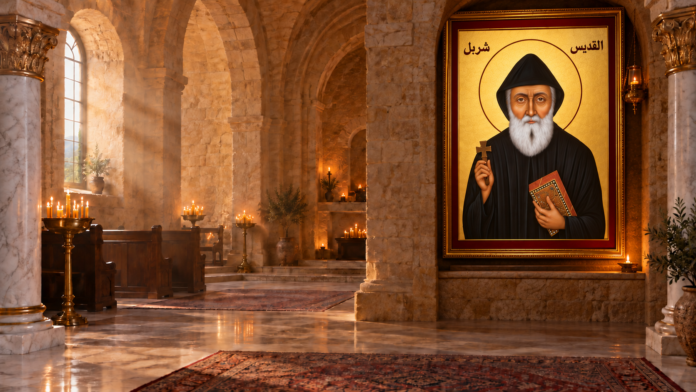
On the feast of Christ’s birth on earth and Saint Charbel’s birth into heaven, here is an icon of the hermit of Annaya, with a new composition and vision, reflecting the presence of this monk, intoxicated with God, in the life of the Lebanese people and at the heart of the universal Church.
“The earth was without form and void, and darkness was upon the face of the deep… And God said, ‘Let there be light’; and there was light” (Genesis 1:1-4).
Against a gold background, a reflection of the light at the beginning of creation, God’s eternal light, Saint Charbel, a new creation, shines as a spark of light in a world lost in the back alleys of life, worn out by digging for an illusory happiness by the light of lamps running out of oil, and which has chosen the road home.
Saint Charbel is first of all a monk. He hid himself from the world in the black of a radiant habit, so that black is no longer black: it is a veil that hides the light of heart, mind and speech. The light falling on the man of God does not come from outside, as the natural rules of painting would have it; living light pours out from within the saint, like his Master, who wraps himself in light as in a garment.
Saint Charbel is secondly a priest. With his right hand he blesses the assembly of the faithful and holds up before their eyes the cross of the Redeemer, the pride of the Church and the sign of her victory over injustice and death. With his left hand he holds the Word of life, the Good News, tightly to his chest. He has found his precious pearl, his eternal joy that no one can take from him.
There is a striking contrast between a humble wooden cross and a Gospel book whose cover is studded with the most precious jewels and pearls. The cover shines with gold, silver and pearls, reflecting the place of the Word of the Lord in Saint Charbel’s life: a Gospel from which he draws light and guidance for his journey toward the Kingdom.
He was a monk who owned nothing and used only the humblest and simplest things, yet here he stands as a teacher, like the bishops and doctors of the early Church: Basil, Gregory the Theologian and John Chrysostom. He did not leave writings and sermons as so many did, but he surpassed them in teaching and guidance through his resounding silence, kneeling on his mat of reeds, conversing in the stillness of the night with the God of the universe, and lifting his eyes now and then to his mother Mary, the most beautiful and sweetest of creatures.
Thirdly, Saint Charbel is a hermit at prayer. Feelings are absent from his face: there is no trace of worldly sadness or joy. His face bears some features of God and some of the dust of the earth. His large, fixed eyes gaze far into the expanses of eternal light, worlds far and near, closer to him than he is to himself. Eyes that know neither drowsiness nor sleep, with a watchful spirit ready for long vigils, awaiting the Master’s return.
“You, therefore, must be perfect, as your heavenly Father is perfect.” Saint Charbel has lost his earthly weight and become the glorified man, an image of what we will become if we follow the way of the Lord.
Around his head is a halo, the symbol of perfection, the circle that has no beginning and no end.
“And I, when I am lifted up from the earth, will draw all men to myself” (John 12:32).
On the eve of the feast of Christ’s birth, Charbel’s soul rose up, a gift from earth to heaven.
The monk who lived unknown on earth left his hermitage for the horizons of light. He draws people to himself from every direction, crosses borders, denominations and religions, reflects the light of Christ on a world that has lost its faith, and brings people back to Christ’s Church, children born again through grace, repentance and faith. Charbel has come into our time as a living sign of the Lord’s presence among his people.
O Saint Charbel, intercede for us when hardships grow heavy.
Iconographer: Fr. Nidaa Ibrahim, director of the Salvatorian icon workshop.