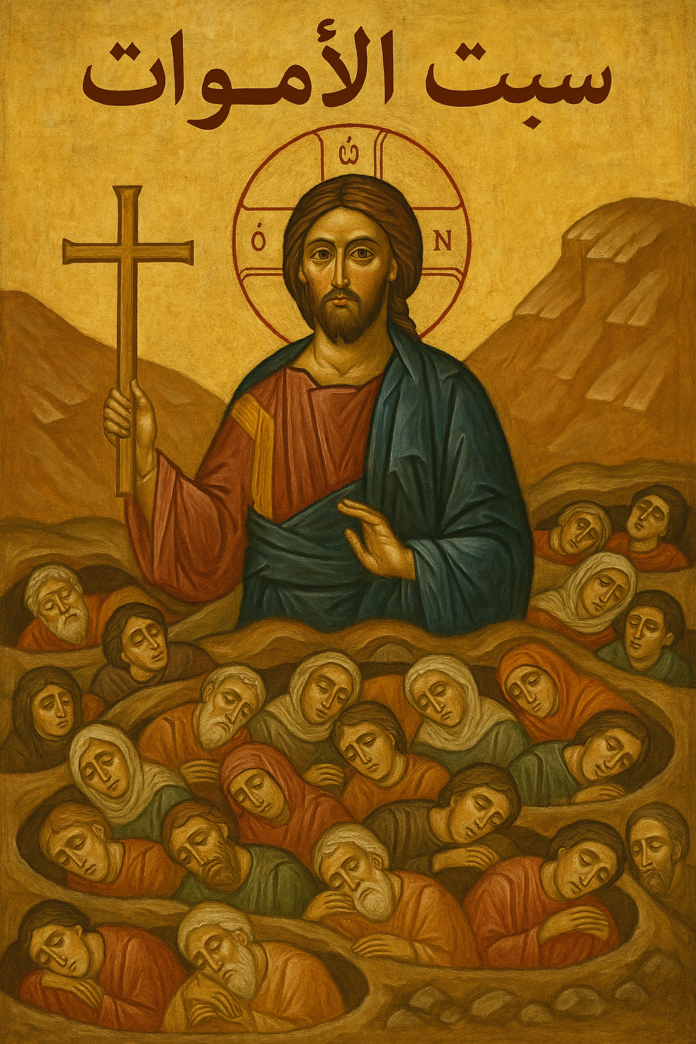
Why is there a Saturday of the Departed, and why do we celebrate the sacrifice of the Divine Liturgy for them?
We can pray for the departed, and above all remember them in the sacrifice of the Divine Liturgy, because the Liturgy is the culmination of all prayers and the summit of Christian communion.
If the Jews sought forgiveness of their sins and those of their dead through the blood of animals, how much more Christians through the blood of Christ!
Nothing equals the grace of the Divine Liturgy and the holy Gifts for the souls of the departed; nothing else can give the departed happiness and blessedness, not paradise, not Abraham’s bosom, not the absence of sorrow, pain and sighing, nothing more than this cup and this bread. Saint John Chrysostom stresses the benefit the departed receive above all from the divine Sacrifice: “If the sacrifices Job offered to God every day for his children had such power to obtain forgiveness of their sins, how can we doubt what the divine Sacrifice can do for the departed, when we have the Body and Blood of Christ poured out to cleanse the whole world?” And he goes on: “When the whole people stands with the priests, hands raised in prayer, to accomplish the awesome divine Sacrifice, how could we fail to win God’s mercy for the departed by praying for them? Trusting in God’s mercy, we must pray and plead for them and remember them with the martyrs, the confessors and the priests.” Saint Symeon of Thessalonica also affirms the necessity and benefit of the divine Sacrifice for the departed.
He shows this through the many miracles he witnessed or received written accounts of. That is why the Church insists and teaches that the families of the departed should not leave before the end of the Liturgy, right after the memorial prayers, because Communion and thanksgiving are the most important part. Habits like this go against the very meaning of prayer for the dead. They come from ignorance of the depth of our faith and from forgetting that in Christianity there is no individual salvation and no private prayer: there is one Church, of which each person, living or departed, is a member; she prays for him and carries his petitions, and he prays in her and with her.
So when the families of the departed stay away from Communion, which is the very heart of the memorial, they contradict its meaning. Saint Ephrem the Syrian, shortly before his death, said in farewell to his disciples: “Take care, my brothers: when the day of my memorial comes, do not sin against the holy Gifts, but approach them with reverence and humility, with fitting dignity, in purity and watchfulness, lest I appear more condemned because of your unseemly behaviour.” For in the Divine Liturgy the whole Church, the one Body of Christ, the living and the departed, shares in a close-knit unity, in which the grieving are comforted and the departed find rest.
Prayers for the departed can also be offered at any time outside the Divine Liturgy, through a special service called the “Trisagion”. The Church of Christ received from the very prescriptions of the Apostles (Apostolic Constitutions, Book VIII, chapter 42) the custom of holding memorials for the departed on the third, ninth and fortieth days, and so on. The choice of these days has no metaphysical explanation: it comes, first, from practical reasons, as a shortened form of the forty Liturgies that used to be celebrated for the souls of the departed, as is still done in monasteries today;
and second, these days are multiples of the number three, dear to Christians as the number of the Trinity and of the third day, the day of Christ’s resurrection. Besides these days connected with each death, the Church has set two Saturdays in the year on which we keep a memorial and feast for the departed: the Saturday before Meatfare Sunday and the Saturday before Pentecost. Every Saturday of the week is also dedicated liturgically to the departed, following the weekly liturgical cycle in which each day has its own theme: Monday the angels, Tuesday Saint John the Baptist, Wednesday the Cross, Thursday the Apostles, and Friday the Cross again. The custom arose of celebrating the Sacrifice for the dead every Saturday, with the bereaved attending the Liturgy and receiving Communion while praying for the departed,
especially on the two Saturdays mentioned above. Over time the Saturdays of the departed multiplied: to the first two were added the Saturday of Cheesefare and the Saturday of the first week of Lent. It is of course preferable for memorials always to be held on a Saturday (the day dedicated to the departed) and not on a Sunday (the day of the Resurrection). For the same reason, the Church forbids memorials on the great feasts and seasons, such as Christmas, Easter and the Ascension, from Lazarus Saturday to Thomas Sunday (Holy Week and Bright Week), as well as on Pentecost and the feast of the Dormition.
Fr. Gerard Abi Saab