The Life of Father Bechara Abou Mourad
Zahleh, the birthplace of men and saints
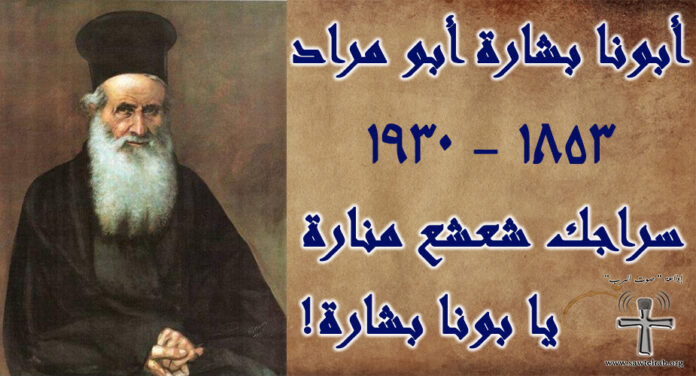
His name was Salim Jabbour Abou Mourad, and he was born in Zahleh, “the bride of the Bekaa”, in 1853, in an old house in the quarter of Mar Elias of the Salvatorians, named after the Salvatorian Fathers who have served it in succession and still do. His father, Jabbour Abou Mourad, was a farmer of comfortable means, and his mother, Elisabeth Al-Qashsh, was a virtuous and devout woman who worked to plant the seeds of piety and virtue in her children’s hearts from their earliest years. About this period of young Salim’s life, Father Constantine Bacha, historian of the Salvatorian Order and of the Melkite Greek Catholic Church and biographer of Father Bechara, wrote: “He was then seven years old, and had spent those years at home with his mother, until he was filled with the milk of her piety. She taught him to pray at home with her and got him used to attending the liturgical services at church, taking him with her. So much so that (according to his brother-in-law and companion Youssef Abdallah), when playtime came for the children, he would slip away from his schoolmates and go into the church to pray, without anyone knowing, unless one of them happened to go in or came looking for him; then he would leave and go home or back to school” (Fr. Constantine Bacha, The Life of Father Bechara Abou Mourad the Salvatorian).
Salim grew up with fine qualities and showed a strong inclination to prayer, solitude, sacrifice and a spirit of mortification, which increased his desire to consecrate himself completely to the Lord in religious life. He saw in the Fathers of the Monastery of the Holy Saviour a living model of virtue, and he resolved to enter the monastery as soon as he had his parents’ consent. Father Bacha wrote of this period: “He began to speak frankly and courageously to his mother, asking for her blessing to become a monk, and he spoke to his father about it too. But he got nowhere with them (…). At the same time, he never stopped begging his mother to help him obtain his father’s permission to go to the Monastery of the Holy Saviour. He stayed at home like this for a long time, speaking to no one, so that to his family he seemed out of his mind, with no concern but the Monastery of the Holy Saviour and the religious life, as his sister Saadeh told us. His mother’s heart, pious and sincere in its love for him, was moved, and she spoke to his father about letting him go to the monastery. She convinced him, with what God put in her heart and on her tongue, that religious life is a call from God, and that it would be wrong for us to keep our son from obeying God if he is calling him. And because of the respect and esteem he had for her, on account of her piety and good sense, he agreed with her to allow their son to go to the Monastery of the Holy Saviour to test himself in religious life: if he succeeded, God’s will would be done in him; if not, it would be better for him to come back home. Salim was overjoyed, because his wish had been granted: he had his parents’ consent, which he considered a blessing and a pledge of success in this life and the next” (Fr. Constantine Bacha).
To the Monastery of the Holy Saviour
Salim arrived at the Monastery of the Holy Saviour in Joun, in the Chouf, on the evening of September 7, 1874, at the age of twenty-one. He received the novice’s habit straight away, on September 19 of that year, and was given the name Bechara. For those who don’t know, the novitiate is the first stage for a candidate to religious life: he spends two years in prayer, meditation, complete withdrawal, manual work and spiritual conferences, in order to learn about religious life and the history and spirituality of the Order. For Brother Bechara this period was a spiritual paradise in which he soared in the realms of the Spirit and in conversation with the Lord, in an atmosphere of silence, solitude and hidden holiness provided by the Monastery of Our Lady of the Dormition, tucked away among the oaks and pines of the Bisri valley on the bank of the Awali river. After two years, on November 4, 1876, he made his three religious vows of poverty, chastity and obedience. That day was an outpouring of inner joy for him, as his wish came true: to be dedicated to the Lord and wholly consecrated to his service.
After his vows came the period of study at the Salvatorian seminary near the Monastery of the Holy Saviour. He was taught by Fathers known for their piety and virtue, and studied philosophy, theology, Arabic and French. Brother Bechara was a wonderful example of a zealous, devout religious, so much so that his superiors put him in charge of caring for his fellow brothers, seeing him as a good example. When the time for priesthood approached, his superiors had difficulty persuading him to be ordained deacon and then priest, because he considered himself unworthy of the great dignity of the priesthood: “When some of the superiors pressed him on this, he usually answered with silence, or would say to them: ‘I came into religious life only to save my soul, not to be ordained'” (Fr. Constantine Bacha).
After several attempts they succeeded in persuading him, with the argument that as a priest he could offer the sacrifice for the repose of the souls of his two brothers, Youssef and Mourad, who had died in the prime of life. Deacon Bechara was ordained a priest on the day after Christmas, December 26, 1883. He took as the motto of his priesthood a verse from the prophet Ezekiel: “I have made you a watchman for this people; every soul that is lost because of you, I will require at your hand” (cf. Ezekiel 3:17-18). This motto reflected Father Bechara’s zeal for the salvation of souls, a zeal that stayed with him all his life. His Mass was extraordinarily devout, as one of his brothers, Father Boutros Khiryati, a Salvatorian, testified: “Soon after this good priest’s ordination, he began offering the divine sacrifice with a recollection unique of its kind. We saw him as a heavenly angel rather than an earthly man. He stood motionless on the altar step with his hands raised to heaven and his eyes fixed on high, speaking with the one he loved and addressing the angels of heaven and the inhabitants of the divine court, reciting the prayers of the Liturgy with unequalled devotion. These prayers were like a burning arrow that pierced the heart of everyone present. (…) We have never seen such rare devotion except in this man, and it affected us deeply. During Mass we saw him as if raised above the ground. And when we received Holy Communion from his holy hand, we hardly felt we were earthly beings, so great was the recollection that filled us at that moment” (Fr. Constantine Bacha).
Off to Deir el-Qamar and its valleys
The first task entrusted to him was the care of the seminarians at the school of the Monastery of the Holy Saviour. For eight years he worked on his own sanctification and on forming the students entrusted to him. He was a father, brother and friend to them, and a living icon of perseverance in prayer, worship of God and self-denying mortification. How he loved this work, because it kept him close to the church and the tabernacle, where he spent hours prostrate, forgetting himself in continuous contemplation and deep conversation with God. But God had other plans for him: this priest’s piety must not be shut up within the monastery walls, because the light of his lamp had to be set on the lampstand so that everyone could see it and be enlightened.
On November 8, 1891, Father Bechara was ordered to move to Deir el-Qamar, and he simply “took up his bed and walked”. In Deir el-Qamar he was first assigned for one year as a teacher at the bishop’s school, and then as parish priest for the villages in the valleys of Deir el-Qamar: Serjbal, Wadi Benhlieh, Bnwiti, Wadi ed-Deir, Wadi Deir Dourit… His ministry also reached other villages, from Moukhtara in the mountains down to Damour on the coast. It is hard to sum up in a few lines thirty-one years of demanding and devoted service. Suffice it to say that his memory is still alive today in the minds and hearts of the people of that region, even though he died in 1930. If Saint Charbel became holy in the hermitage, Father Bechara became holy in pastoral service, a service that knew no weariness or fatigue, and that neither heat nor cold, winter nor snow, storm nor scorching heat could hold back.
Two features marked his long ministry. The first was his faithfulness to his priestly motto, the salvation of souls, and his care to bring them close to God through the sacraments of Penance and the Anointing of the Sick, so that it was said that none of his parishioners died without receiving the last sacraments and being in a state of grace. How many hours he spent in the confessional, without a break, stopped by neither hunger nor fatigue! Here is a testimony from Father Bacha himself: “In 1893 I went to Deir el-Qamar to visit Father Bechara Abou Mourad (…), and I asked him to hear my confession; he took me straight to the confessional. I had barely finished my confession when I saw people coming into the church to confess to him without stopping. He stayed in the confessional from about seven in the morning until about four hours after nightfall, hearing the confessions of everyone who came to him, men and women, boys and girls, from our own community and from the Maronites (…). We stayed there for a while until the festival lights went out and we went to bed, and Father Bechara was still in the confessional. He had not left the church to have supper, to drink a glass of water or to rest” (Fr. Constantine Bacha).
The second feature was his care for the poor and the help he gave them. “Even before, he often denied himself certain foods in order to give them to the first poor person he met. But during the war years (1914-1918) he made a rule for himself on this that he never departed from: he gave the poor most of the bread he was given for his own basic needs (…). As this went on for several years, hunger wore him out, his body became very thin and his complexion changed (…). When he reached this state, without having told anyone, Father Meletius Khoury (…) called in Dr. Soleiman Mashaqa to see him and prescribe suitable treatment. When the doctor examined him, he declared that he was suffering from the disease of hunger and that the only cure was to eat enough” (Fr. Constantine Bacha).
In short, throughout his priestly ministry Father Bechara was a man who let himself be “eaten”. Because of all his toil, labour, work and prayer, his strength began to fail, his eyesight began to fade, and heart attacks struck him from time to time. So on December 4, 1922, he was ordered to move from Deir el-Qamar to Sidon; he was then sixty-nine. The purpose of the move was to spare him the strain of travelling and to look after his health, in the hope that the mild climate of the coast would be easier on his old age than the harsh mountain cold. In Sidon the warrior did not rest or let the weight of the years bother him; he kept on struggling, fasting, praying, serving, preaching and hearing confessions, especially of schoolchildren and the confraternities of the region. Bishop Augustine Boustany, Maronite Bishop of Sidon, gave a precious testimony about this period: “The weight of the years did not weaken his resolve on this difficult path; on the contrary, in this last stage of his life we saw him more active and more determined, like the brave soldier who sees the dawn of the day of victory gleaming before him and grows even bolder in facing dangers, knowing that his head will soon be crowned with glory and splendour. So the man of God climbed the steps of divine love until he reached the summit of the mountain of holiness, in a good old age laden with the finest works and fragrant with the highest virtues” (Fr. Constantine Bacha).
Back to the Monastery of the Holy Saviour: the warrior’s rest
On February 26, 1923, Father Bechara was moved for good to the Monastery of the Holy Saviour for his final rest, returning to the monastery his soul had longed for. He had left it as a young man and came back as a venerable old man, his head crowned with white hair and his heart with the purity of his life. He chose a room in the monastery near the church so that he could stay close to his divine Beloved; his excuse was that he wanted to keep watch over the oil in the lamp before the Blessed Sacrament. And he himself became a living lamp whose soul enlightened all the residents of the monastery and its visitors, who came in large numbers and made his room a place of pilgrimage for prayer and blessing. Indeed, Father Bechara had won the respect of everyone, not only Christians but also Muslims and Druze, who did not hesitate to come to this “holy priest” for his blessing, his help and his prayers.
Father Bechara’s illness grew worse and his strength failed: “When his illness became severe on February 3 and violent attacks came one after another, all his brother monks grew anxious about him and stayed constantly in his room. On his bed he was a perfect example of beautiful patience and a sight of the piety of the saints. His room became like a church, where the full Divine Office was prayed at its proper times (…). Despite all his strength of soul, endurance and patience in his pain, he once had to say to Father Antoine Kiwork, who was alone with him in his room: ‘I feel my heart is like a flame of fire.’ The Father answered him: ‘That is because your heart is burning with the love of God’ (…). And he said to the Fathers of the council: ‘When I die, don’t tell anyone of my death, in case people think I am someone important and worthy of respect, when I am the greatest of sinners'” (Fr. Constantine Bacha).
“Precious in the sight of the Lord is the death of his saints”
On the morning of the Saturday of the Dead, February 22, 1930, the hour came for him to meet his Lord, and his pure and righteous soul flew up to heaven, amid the grief of his brother monks and all who had known him. The authorities of the Order immediately decided that he would be buried not with the other monks but in a tomb of his own, because of the holiness of his life and his heroic virtues. The south wall of the church of the Monastery of the Holy Saviour was opened, his body was laid in it, and a plaque was fixed over his tomb bearing the inscription: “Here rests, in the hope of the final resurrection, the Servant of God Father Bechara Abou Mourad the Salvatorian, model of the highest religious life and the most sublime priestly perfection.”
Since then his tomb has become a place of pilgrimage for the faithful and a refuge for all who seek help, and several healings through Father Bechara’s intercession have been recorded in the tomb’s register. Convinced of the holiness of his life, the authorities of the Order submitted his cause to the Congregation for the Causes of Saints in Rome, so that he might be declared Venerable, then Blessed and Saint, on the altars of the universal Church. All the necessary canonical procedures were carried out locally, the testimonies were gathered, and a file was put together and submitted to the specialist theologians of the competent Vatican offices for study.
In 2005 the Salvatorian Order marked the 75th anniversary of Father Bechara’s death, and on that occasion its authorities decided to produce a major film about his life.
“If this priest perseveres in these works and defeats the devil with this weapon, the weapon of the cross and prayer, he will surely be beatified as a saint.” So said Bishop Basil Hajjar, Melkite Bishop of Sidon and Deir el-Qamar, of Father Bechara while he was still alive. What he said has come true: Father Bechara has defeated the devil, and we wait for the Church to proclaim his holiness, if the Lord wills. As for us, we are proud of him, another saint from Lebanon, and for all of Lebanon.
Some graces attributed to him
– Mr. Youssef Khalil Abou Safi, born in Sidon in 1903, died in 2001, used to tell the details of his healing from typhoid, which was widespread after the Great War and killed many people. In 1922 Youssef fell ill and was close to death. When the doctors had given up hope of curing him, Father Bechara happened to come in, as he usually did, to visit the sick man. He blessed him, blessed some water and gave it to him to drink, then blessed a cross and placed it on his chest, and the sick man was healed that same night. When the doctor heard of it, he said: “Truly Abouna Bechara is a saint.” In his old age Youssef Abou Safi was happy whenever a priest asked him to come along to parish evenings, so that he could speak with deep emotion about knowing Father Bechara, whom he had accompanied in his youth in Sidon and at the Monastery of the Holy Saviour. He kept the cross as a relic he was proud of, the most beautiful heirloom to leave to his grandchildren. When Father Bechara died, it was he who took on the task of preparing his tomb in the wall of the church of the Monastery of the Holy Saviour.
– On May 6, 1929, after weeks of drought and heat in the Iqlim al-Kharroub region, Father Bechara happened to pass by the Superior General on his way to the church. After kissing his hand as usual, the Superior General said to him: “Go in and tell Jesus to send rain, out of pity for the children.” He answered: “I am a sinner, Father General.” The superior replied: “I don’t care; go in, obedience sanctifies intentions.” After an hour of prayer the weather changed, thunder rolled, and rain fell in unusual abundance.
– Near the Monastery of the Holy Saviour there is a small village whose people work on the monastery’s land, and some of the women work at the sisters’ convent. One of them, named Warda Rahhal, washed the monks’ clothes. She suffered from a serious disease in her eyes that caused her great pain. One day she picked out Father Bechara’s clothes to wash, saying to herself: “This priest is a saint; he must heal me.” With great faith she took some of the washing water and washed her face, especially her eyes. The next day she was healed and left aside all the medicines she had.
– A young man from Deir el-Qamar came to visit Father Bechara’s tomb and told us that when his mother had her first son, Father Bechara, who was then parish priest of Deir el-Qamar, came to pray over the mother and the newborn baby. He said to my mother: “God bless you, you will have seven boys.” My mother cried out: “Please, Abouna, I want a girl too!” After a short silence he answered her: “Granted, and a girl too.” The young man went on: “I am the seventh boy, and my little sister got married recently. All of us in Deir el-Qamar and the area consider Father Bechara a holy priest, and we come to receive his blessing at his tomb.”
– On December 16, 2001, the Bursar General of the Salvatorian Order passed through Cairo (Egypt) to inspect the Order’s property there. He visited a young couple who had tried for years with doctors to have children, without success. The priest gave the wife a picture of Father Bechara that he had in his pocket and asked her to seek his intercession with God for what she wanted. She did so. Four months later the Bursar General returned to Egypt on another visit and was surprised when the lady greeted him with the happy news that she was expecting twins!
– Mr. Joseph Semaan suffered from severe back pain that kept him from lifting, bending and moving easily. After the necessary tests, the doctors ordered surgery. One day in 1998, while visiting relatives, he came across a leaflet about Father Bechara Abou Mourad describing miracles worked through the intercession of the Servant of God. He asked his wife to read it aloud with her hand on his back, and he prayed to Father Bechara while he was driving. As soon as she finished reading, he felt a burning flame pass through his back, followed by a shiver. When he got home he found that he was healed, bending normally without any pain. Later medical tests showed that he no longer needed an operation and was completely healed.
Pray with “Abouna Bechara”
“O Abouna Bechara… O our departed one, most righteous elder, devout monk, pious and venerable priest, you were good in life and in death. Blessed are you! Do not forget us, our righteous Father! Intercede for us before your Lord. Remember your mother, the Order, in your high abode, and remember each of your sons and brothers.
And we will keep your memory in turn, and never forget your majestic, venerable bearing, your good white hair, your face radiant with the light of the Holy Spirit, your pleasing character, your rare piety and exemplary devotion, your attractive recollection, your gentle and moving guidance, your sweet words, your prostrations and genuflections, your fasting, prayer and tears, and your life filled with the virtues of the martyrs, the holy Fathers and the righteous, good ascetics.
(…) You remained a prisoner of the body for eighty-two years. Today fly away to your paradise as a bird flies from its cage; enjoy the eternal light and taste the sweetness of lasting bliss, after tasting so much of the bitterness of this passing life (…). Remain in heaven, for you remained steadfast in righteousness and piety in the Lord’s service on earth. See, today he gives you the highest reward and calls to you: ‘Well done, good and faithful servant; you have been faithful over a little, I will set you over much; enter into the joy of your master.'”
From the eulogy given by Father Nicolas Abou Hanna, Salvatorian, at Father Bechara’s funeral in the church of the Monastery of the Holy Saviour, February 23, 1930.
Prayer for the beatification of Father Bechara Abou Mourad
O generous Saviour, who never cease to pour out your abundant graces on your priests, who are your own inheritance, for their sanctification and for the good of your people, we humbly ask you to deign to glorify your faithful servant, Father Bechara Abou Mourad, who walked before you in religious and priestly perfection and served you in righteousness all the days of his life. Show your power in him, O Lord, if it pleases you, so that he may shine like a bright star in the sky of our Eastern Church, resplendent with the glory of her saints, and all may know that the fountain of holiness never runs dry in your holy Church. Be pleased to crown the head of your faithful priest with the crown of the blessed, so that we may take him as a model of perfection, imitating his virtues, and your holy name may be glorified, Father, Son and Holy Spirit. Amen.
Nicolas Nabaa,
Bishop of Sidon, Deir el-Qamar and their dependencies