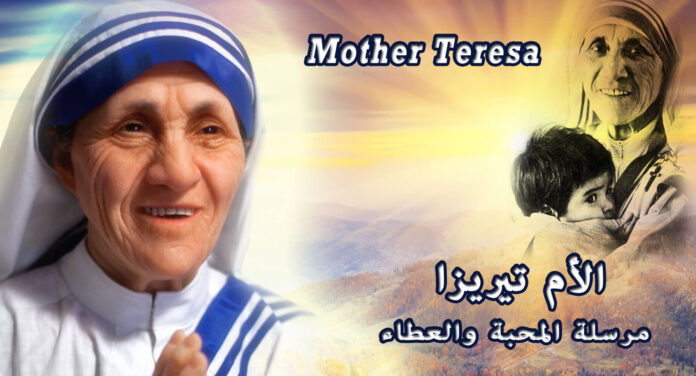
Mother Teresa was the nun of Albanian origin who received the Nobel Peace Prize in 1979. She died in Calcutta on 5 September 1997 after a long illness.
Her birth name was Anjezë (Agnes) Gonxha Bojaxhiu. She was born on 26 August 1910 in Skopje into a very devout Albanian family. In her early years she attended a parish run by the Jesuits. Her father died when she was eight, and her faith grew even stronger. In 1928 she was sent to Dublin, Ireland, to train for religious life with the Loreto Sisters, and in 1929 she was sent to Bengal, where she worked in a Loreto community.
In 1931 Agnes made her first vows and took the name Sister Teresa; in 1937 she made her final vows and became Mother Teresa.
In 1948 Mother Teresa devoted herself to caring for neglected children. She then set aside her congregation’s habit and put on the white cotton Indian sari with a blue border for which she later became known. She took medical training with an American congregation devoted to medical care and nursing. At first she relied on herself alone; then other women came to help her, and in 1950 she founded her congregation, the Missionaries of Charity, which cared for homeless children and the elderly.
In 1957 she also began caring for people with leprosy, and as her work grew she founded the Missionaries of Charity Brothers in 1963. At the age of seventy-five she went to Ethiopia to help the victims of famine and displacement. Even so, Mother Teresa’s great work did not escape criticism: her teams were said to lack medical training, some practices did not meet medical standards, such as reusing needles without sterilizing them, and the number of people cared for was often questioned. Mother Teresa’s answer to some of these criticisms was that God does not ask us to be successful, but to be faithful.
Mother Teresa never cared about money; she insisted on personal help and involvement. In 2016 Pope Francis raised Mother Teresa to sainthood in a ceremony at the Vatican.
The mission of her congregation, as Mother Teresa described it when she received the Nobel Peace Prize in 1979, was to care for “the hungry, the naked, the homeless, the crippled, the blind, the lepers, all those people who feel unwanted, unloved, uncared for throughout society, people that have become a burden to society and are shunned by everyone.” In 1965 Pope Paul VI gave her permission to expand her work throughout the world, not just in India. The number of her sisters kept growing, and her houses spread to most of the world’s poor or war-torn countries: from famine-threatened Ethiopia to the closed Black townships of South Africa, and to her ancestral Albania after the fall of communism. One of her best-known actions was during the Israeli invasion of Lebanon in 1982, when she obtained a temporary ceasefire so that rescue workers could save thirty-seven sick children trapped in a hospital. But Mother Teresa’s health began to decline from 1985, partly because of her age, partly because of the conditions of the sick among whom she worked, and partly because she spent most of her time travelling the world to raise money and aid for the poor, without taking enough care of her own health.