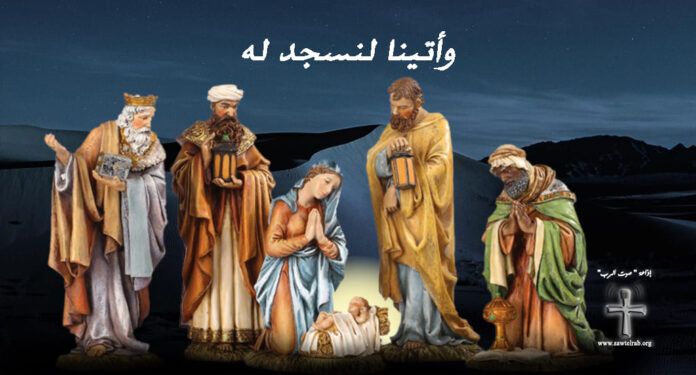
“And we have come to worship him!”
The word “Magi” comes from the Persian magu, meaning a priest or a scholar learned in astronomy.
In the Old Testament we find the title “Rab-mag”, chief of the magi, in Jeremiah 39:3 and 13, and in the New Testament the Magi appear in Matthew 2:1. The Greek word used is μάγοι (magoi), rendered in Arabic as “majous”, and English translations render it as “wise men”.
This means the Magi were wise and learned men who served at the courts of kings and emperors as great advisers. Yet they obeyed the message they recognized in the star, made sacrifices and took the risk of a long journey. They are said to have come from Persia, today’s Iran, to Jerusalem.
So they travelled difficult roads to be with the newborn child, the great King. The Magi asked: “Where is he who has been born king of the Jews?” (Matthew 2:2). From this question we know they firmly believed that the King of the Jews had been born: their question was that of people who were sure, not doubters. What they wanted was to see him with their own eyes.
They believed in his birth with their minds and their hearts, and their faith was alive. They were people who left their homes, their status, wealth and comfort, and came to Bethlehem in search of him: “Now when Jesus was born in Bethlehem of Judea in the days of King Herod, wise men from the East came to Jerusalem, asking, ‘Where is the child who has been born king of the Jews? For we saw his star in the East and have come to worship him.’ When King Herod heard this, he was troubled, and all Jerusalem with him. He gathered all the chief priests and scribes of the people and asked them where the Christ was to be born. They told him, ‘In Bethlehem of Judea, for so it is written by the prophet: And you, Bethlehem, in the land of Judah, are by no means least among the rulers of Judah; for from you shall come a ruler who will shepherd my people Israel.’ Then Herod secretly called the wise men and learned from them exactly when the star had appeared. He sent them to Bethlehem, saying, ‘Go and search diligently for the child, and when you have found him, bring me word, so that I too may come and worship him.’ After hearing the king, they set out.
And there, ahead of them, went the star they had seen in the East, until it stopped over the place where the child was. When they saw the star, they rejoiced with exceedingly great joy. They entered the house and saw the child with Mary his mother, and they fell down and worshipped him. Then, opening their treasures, they offered him gifts of gold, frankincense and myrrh. And being warned in a dream not to return to Herod, they went back to their own country by another road. When they had gone, an angel of the Lord appeared to Joseph in a dream and said, ‘Get up, take the child and his mother, and flee to Egypt, and stay there until I tell you; for Herod is about to search for the child, to destroy him.’ So Joseph got up, took the child and his mother by night, and went to Egypt, and remained there until the death of Herod. This was to fulfil what the Lord had spoken by the prophet: Out of Egypt I have called my son” (Matthew 2:1-15).
The Magi knew their goal even before they set out: they wanted to find the newborn King and give him the worship, homage and precious gifts that were his due.
The gifts the Magi offered carry essential symbolism:
– Gold symbolizes Christ’s glory and kingship. It is a gift given to kings and a symbol of wealth: so the gift of gold is perfectly fitting for the Lord of glory. God deserves that we offer him the most precious things we have.
– Frankincense symbolizes Christ’s divinity, God made flesh. Frankincense was usually given to the priest to offer up to God, so this gift points to the priesthood and divinity of the Lord Jesus. The Lord Jesus is God, to whom we offer the incense that symbolizes people’s worship of their Lord, Creator and God. Frankincense is the sap of a tree that dries and hardens until it is used as incense in the worship of God. And the sap of our hearts is love for God and prayer to his holy person: he deserves the best that can come from our hearts and minds, that is, that we worship him in spirit and in truth.
– Myrrh symbolizes Christ’s humanity: the Lord Jesus came in human form to die on the cross for our sins. This points to something that was fulfilled later, when the Lord Jesus Christ died on the cross to redeem all humanity and atone for the sins of the world.
Grant us, Lord, to be wise like the Magi in our adoration, worship and prayer to the newborn Child. Grant that we, like them, may understand that we are in the presence of God made flesh, the God who created man and who can also take human form out of love for him. Grant us, like them, wisdom in our gifts and precious offerings to the divine King. Grant us also the wisdom of the Magi in obeying God’s revelation and not returning to King Herod, who was plotting to kill the newborn Child: obeying God was greater and more important to them than obeying an earthly king. Grant us, Jesus, to seek you and accept you as our Saviour. The world’s riches, the world’s religions and all the world’s pleasures are worthless compared with knowing the true God, made flesh in the person of the newborn Child, Jesus Christ. God wants us to come to Jesus, the King of life, and to bow before him in reverence, offering him our hearts so that he may dwell in them, be in the midst of our families and be the source of joy in our lives; then we will live in true peace and security that no one can take from us.