“Baʿouth” is a Syriac word commonly explained here as “resurrection” (strictly, it means “supplication”). Baʿouth Monday is Resurrection Monday, the Monday after Resurrection Sunday, or Easter Sunday; on this day the Church celebrates the full Resurrection service, as on the feast itself. The Baʿouth prayer is the Vespers held on the evening of the feast. All the services of Easter week are Paschal, and their order differs from the usual order of Vespers. Another distinctive feature of the Baʿouth prayer is the reading of the passage from the Gospel of John (20:19-31)
about the Lord appearing to the disciples on the day of the Resurrection:
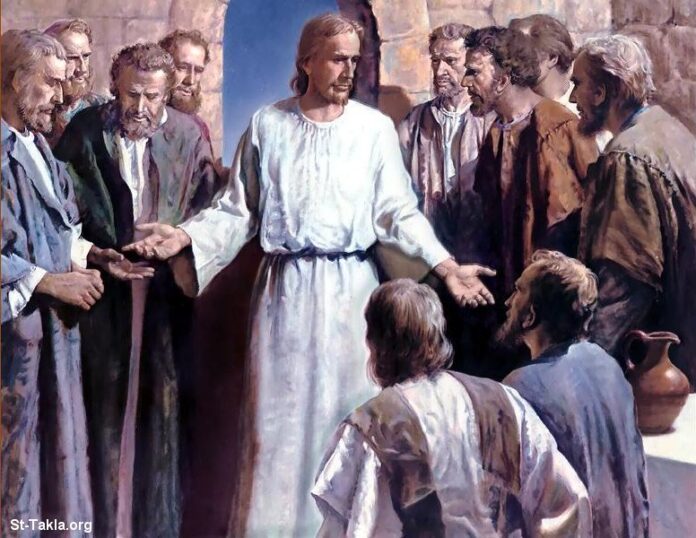
On the evening of that day, the first day of the week, when the doors of the place where the disciples were gathered were locked for fear of the Jews, Jesus came and stood among them and said: “Peace be with you!”
When he had said this, he showed them his hands and his side. Then the disciples rejoiced when they saw the Lord.
Jesus said to them again: “Peace be with you! As the Father has sent me, so I send you.”
When he had said this, he breathed on them and said to them: “Receive the Holy Spirit.
If you forgive the sins of any, they are forgiven them; if you retain the sins of any, they are retained.”
But Thomas, one of the Twelve, called the Twin, was not with them when Jesus came.
So the other disciples told him: “We have seen the Lord!” But he said to them: “Unless I see the mark of the nails in his hands, and put my finger in the mark of the nails, and put my hand in his side, I will not believe.”
Eight days later his disciples were again inside, and Thomas was with them. Although the doors were locked, Jesus came and stood among them and said: “Peace be with you!”
Then he said to Thomas: “Put your finger here and see my hands; reach out your hand and put it in my side. Do not doubt, but believe.”
Thomas answered him: “My Lord and my God!”
Jesus said to him: “Have you believed because you have seen me? Blessed are those who have not seen and yet have believed.”
Jesus did many other signs in the presence of his disciples, which are not written in this book.
But these are written so that you may believe that Jesus is the Christ, the Son of God, and that believing you may have life in his name.
In the Byzantine and Antiochian Orthodox Churches, as well as the Greek, Slavic and Russian Orthodox Churches…, it is customary to read this Gospel in different languages, to show that Christ’s resurrection is proclaimed to all nations in their own languages. During the Baʿouth prayer, a procession goes around the church with the Gospel book and the icon of the feast, carried by the priest, while the choir sings Resurrection hymns; when the procession reaches the outer door, the priest stops and the faithful pass by to kiss the Gospel and the icon. So Baʿouth Monday is the second day of the glorious Resurrection, when the news of Christ’s resurrection spreads among the disciples and then among all nations… The Divine Liturgy is celebrated in the churches, and the Gospel is read in various languages of the world, symbolizing the spread of the Good News of the Resurrection, since the purpose of Baʿouth Monday is to carry the news of the Resurrection to all people. This service is rooted in Pentecost and the coming of the Holy Spirit upon the disciples to send them out to preach. It is worth noting that the Patriarch of Antioch and All the East used to invite the ambassadors of all Christian countries present in Lebanon or the Antiochian lands to celebrate Pascha, and he would read the Gospel in several languages so that the ambassadors could understand it and pass on this news of the Resurrection in turn.
Among the hymns sung at the Liturgy of Baʿouth Monday (called the Paschal stichera)
is this wonderful hymn:
Let God arise, let his enemies be scattered; let those who hate him flee from before his face.
Our Pascha, Christ the Redeemer, has been revealed to us today: a sacred Pascha, a new and holy Pascha, a mystical Pascha, a most venerable Pascha, a blameless Pascha, a great Pascha, a Pascha of the faithful, a Pascha that opens to us the gates of paradise, a Pascha that sanctifies all the faithful.
As smoke vanishes, so let them vanish; as wax melts before the fire.
Come from the vision, O women bearers of good tidings, and say to Zion: Receive from us the glad tidings of Christ’s resurrection; exult, dance and rejoice, O Jerusalem, at seeing Christ your King come forth from the tomb like a bridegroom.
So let sinners perish before the face of God, but let the righteous be glad, rejoice before God and delight in gladness.
The myrrh-bearing women, standing at deep dawn before the tomb of the Giver of life, found an angel sitting on the stone, who spoke to them thus: Why do you seek the Living among the dead? Why do you mourn the Incorrupt as if he were in corruption? Go and proclaim it to his disciples.
This is the day the Lord has made; let us rejoice and be glad in it.
Our Pascha, the Pascha of the Lord, has dawned on us today: a joyful Pascha, a most venerable Pascha, a Pascha in which we embrace one another with joy. O Pascha, ransom from sorrow! For today Christ has shone forth from the tomb as from a bridal chamber, and filled the women with joy, saying: Proclaim it to the apostles.
Prepared by Rita, of the Sawt el Rab team