A look at time at the start of this year
“And Jesus increased in wisdom and in stature, and in favour with God and man.”
Luke 2:20-21, 40-52
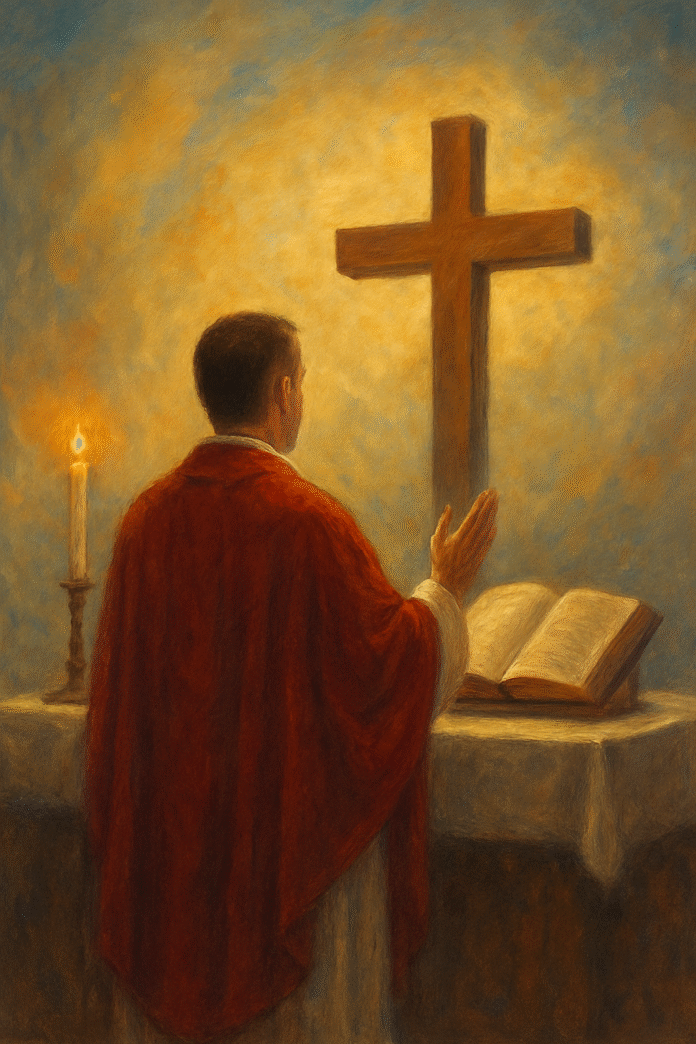
Today is the start of the year, and we begin it with prayer, lifting up our hands as a sacrifice of praise and thanksgiving, and as a sacrifice of petition, that it may be a time of salvation, in service and in the company of grace.
The Gospel text speaks clearly of Jesus entering into the very heart of time, he who is the divine Word above time. The One who has no limits becomes flesh, and the Eternal One begins.
He is circumcised on the eighth day according to human custom and named “Jesus”; yet this child, at the age of twelve, sits among the elderly teachers, all of whom listened to him amazed at his understanding and his answers.
Although God is above “our time”, he enters it and intervenes in it for our salvation and care. Scripture begins and ends with indications of time (Gen 1:1 and Rev 22:20): from creation until he comes soon, God moves “in haste”, so to speak, for mankind. “My Father is working still, and I am working,” the Lord Jesus answered the Jews who misunderstood the Sabbath rest.
Man is a being who lives in a particular place and time. These are the two elements that together define him; each on its own does not give the right picture. To speak about a person, or about anything that concerns their life, we must say “where” and “when” it happened. There is the “where” and the “when” to locate any matter in life: so there is place, and there is also time.
Place has three dimensions: length, width and depth, and things are located within these three dimensions. But since man is a living, that is, moving, being, the other element of his definition is change or development, what scientific language calls “speed”, that is, time. Most researchers consider that man lives in four dimensions: the three dimensions of space plus time as a fourth dimension for locating the realities of life. Nothing in a place can be known without specifying its past – its origin – and its future – its goal. Nothing is the same today as it will be tomorrow, and what is fitting now may not be fitting at any other moment. The things of life are not a frozen picture made to stay as it is: God made creation in motion, and you cannot know the mustard plant from its small seed without looking at its great tree! As for place, it is the senses that connect us to it, perceive it and deal with it. To sanctify place, respect it and give it the value it has in God’s eyes, the Church has given us fasting: the virtue that makes us treat place with chastity of spirit, give it its due and use it for its purpose. Chastity of sight, moderation in food, restraint in listening… all of these sanctify place. This is how the Christian treats the environment.
Time, however, cannot be perceived by the five senses: the eye cannot see yesterday, and the hand cannot grasp tomorrow. It is the human mind that grasps its movement, its succession and its speed. The virtue of the mind that the Church has set for us to deal chastely with time is prayer. Prayer is the chaste movement of the mind; in other words, every chaste movement of the mind is prayer. That is why it is not in vain that the Church has provided prayers for every moment of life: on rising, before and after meals, before and after study, before sleep; there is Matins, the Hours (the hours of the day), Vespers… It is not enough to pray like this all the time; we must pray in connection with our morning and our evening and with every movement and moment of our life’s time. This is how time is sanctified.
We must spread prayer like a net on which all our actions rest. We pray in the morning to set the start of the day in the stream of God’s favour, and we pray in the evening to give thanks and ask for a peaceful night. Prayer stamps the hours and time of life with holiness and sanctifies the work of our hands. “Make our steps firm to do your commandments”: this is how we pray at the start of the day.
There are two kinds of time: cosmic time and personal time. There are two kinds of history. There is general history, meaning the succession of days and years in the order of their cosmic movement; man seems to belong to this history.
And there is personal history, which is counted not by natural cosmic measures but by the number of direct experiences, that is, by the fruits of life’s time and its key moments. This is the time that belongs to man. In John’s Gospel, for example, we find several precise time references. These references are not scientific or cosmic in nature; they carry the history of personal knowledge and experience. That is why he says it was “the tenth hour” when he met Jesus for the first time. This number “ten” marks an hour in the history of his personal life: it gives us not just any time, but a turning point in the life of John the Evangelist. It was an hour of his personal history, and a very important one.
So from this understanding of time we understand what monastic literature says: every day on which we do not pray is a day lost from our lives. It is indeed a day of cosmic time, to which we inevitably belong, but it does not belong to us; it is not time in our personal history: it is lost time.
And because we pray little, we gain only a little time… (The original Arabic text breaks off here.)
Fr. Gerard Abi Saab