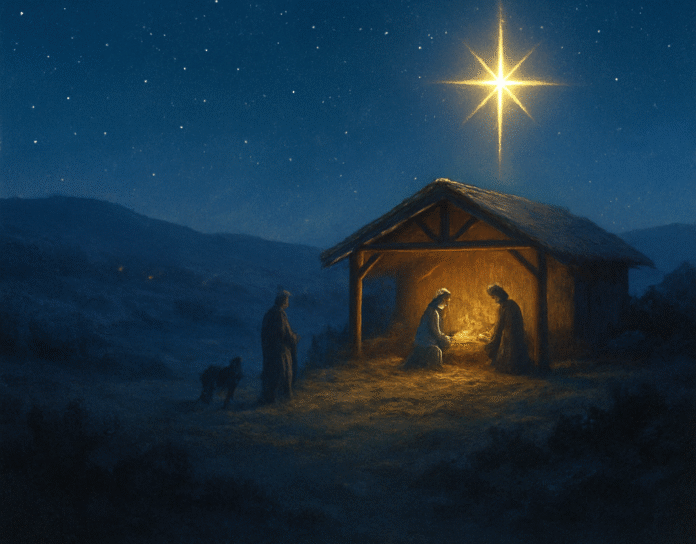
Christmas Homily of Bishop Ibrahim Ibrahim
Glory to God in the highest, and on earth peace, good will among men. We call these words “the song of the angels”. Of course no earthly writer wrote them, and no earthly choirs sang them that night; we repeated them afterwards. But perhaps we have never wondered who wrote these words. The angels themselves? God the Father? The Holy Spirit? It doesn’t matter, because we know these are words that came down from heaven and were sung by heavenly beings: the most beautiful song history has known and the most beautiful description of what happened at Christmas. For when Jesus was born, three new realities appeared to us earthly beings: the glory of God, peace on earth and joy among people. God’s glory and his surpassing greatness cannot be described or possessed; we humans see of this glory what God shows us and reveals to our eyes as he chooses, and what we see in Jesus Christ, the Son who came to dwell among us. But whenever we proclaim our faith in God’s glory, that glory is given to us, because we become his children. Isn’t this what we read in John’s Gospel: “To all who received him, who believed in his name, he gave power to become children of God; who were born, not of blood nor of the will of the flesh nor of the will of man, but of God” (Jn 1:12-13). If I have been given adoption as God’s child and God’s glory as my inheritance, I will no longer crave any other glory: not the glory of a civilization, a homeland, a party or an institution, however prominent. The Christian says: let others take such glories; for me, God’s glory and being his child are enough. And it is enough for us, as Saint Paul says, that Christ is not ashamed to call us brothers (Heb 2:11).
The angels continue their song: “and on earth peace”. So the prophecy of Isaiah, spoken about seven hundred years earlier, is fulfilled: “Behold, a virgin shall conceive and bear a son, and shall call his name Immanuel… Prince of Peace” (Is 7:14; 9:6). Christ was born to proclaim true peace to us; more than that, he himself became our peace by reconciling us with God: for in Christ God was reconciling the world to himself, not counting their trespasses against them, and entrusting to us the message of reconciliation (2 Cor 5:19). We are not talking here about man-made peace, like the Treaty of Versailles or Camp David, or a truce here or there, which is often a peace that does not last; we are talking about the reconciliation between us and God that came about at Christmas, since God became flesh to give us eternal life, forgiveness of sins and peace with him. What good is it if I have all the world’s peace and security, while inside me there are wars that do not exist even in the hearts of people whose countries are torn by war? The war may be inside me: I carry it and it goes with me wherever I go. And the same is true of peace. I am the battlefield and I am the place of peace, and it is up to me to choose. That is Christmas: choosing peace. At the end of the angels’ song we hear: “good will” or “joy among men”: Christmas is the feast of joy. In truth, the joy meant here is God’s joy in the people he has reconciled to himself through Jesus Christ, his Son made flesh. Through the Incarnation God is able to rejoice in us and be pleased with us, because we have believed in his Son, who put on our nature to sanctify it, purify it and restore its original beauty. It is the joy that follows reconciliation, the end of enmity and the coming of peace. But that does not stop us from saying that Christmas is also people’s joy in God, in the salvation that is coming, in the fulfilment of the promises and in receiving a new identity: the identity of joy. You cannot be a Christian without joy in you. But joy does not mean Montreal turning into Miami, or finding a medicine that stops ageing, or earning a living without effort, or having relationships without disappointment; and of course joy does not mean winning the lottery, even if we dream about it. Joy is finding strength in forgiveness and love in tears, reaping success from failure, and rising through humility and holiness. If you want to become joy, stop right now, without delay, playing the victim and seeing others as a threat. Some people, if they hear on the news that it’s raining in China, carry an umbrella in Montreal! You want to be joy? Don’t lose the people who love you. Stop complaining, and accept being told no. Not everything has to be the way you like it. Christmas is the feast of joy built on the rock of faith. There is no Christmas without joy and no Christian without joy. I wish you all a happy feast, and I thank Fr. Rabih, who assisted me at this Mass, and all who help him; I thank Sawt el Rab Radio for the live broadcast, the choir, the deacons, the altar servers and all the volunteers in their many services. I call down on you the blessings of the Saviour, and wish you a happy and blessed new year 2018.
Christ is born… Glorify him!
Bishop Ibrahim Ibrahim