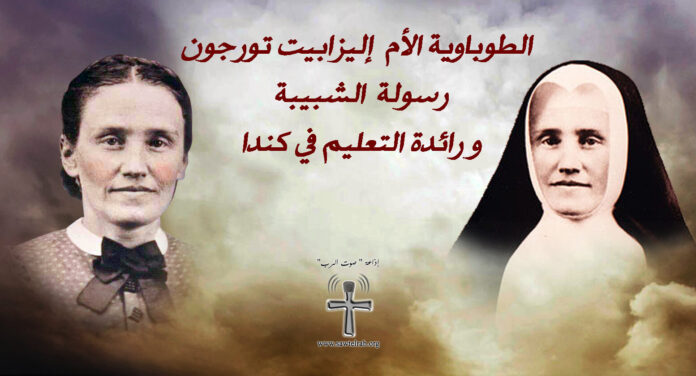
The Life of Blessed Élisabeth Turgeon, Apostle of Youth (1840-1881)
“Let the children come to me,” Jesus said to his disciples (Luke 18:16). For this reason, and for the children of the Diocese of Rimouski, God chose a woman full of love: Élisabeth Turgeon. A woman of fragile health, sharp intelligence and a wise and generous heart, she was born in Beaumont on February 7, 1840, and baptized the next day. Her parents, Louis-Marc Turgeon and Angèle Labrecque, gave their nine children the finest and strongest education, built on Christian principles and values.
Élisabeth was fifteen when her father died. She spent most of her time in prayer and adoration of the Blessed Sacrament. She helped her mother teach her younger sisters, and from then on she had a desire to teach and care for children.
Five years after her father’s death she entered the Normal School in Quebec City to become a teacher. She graduated in 1862, and then taught in Saint-Romuald and at Sainte-Anne-de-Beaupré.
On April 3, 1875, at the invitation of Bishop Jean Langevin of Rimouski, she joined a group of young women whom the bishop had gathered to train qualified teachers for the parish schools of the Diocese of Rimouski. The bishop had insisted, repeating his request three times, because at first her poor health kept her from coming; but he was completely confident that young Élisabeth was the right person to train and guide the young women, look after the children of the diocese and teach them the good Christian life.
Through the young women who joined the community and were sent to the parishes of Rimouski and the Gaspé, she brought schooling where there had been none, and she is regarded as a pioneer of education in eastern Quebec.
At first Bishop Jean Langevin was hesitant about making the young women a religious congregation with the vows of chastity, poverty and obedience, because they would be living outside a convent in small parishes, and there was no precedent in the history of religious orders for sisters teaching or evangelizing outside a large motherhouse. But Élisabeth saw it differently: religious life is a protection and a grace that helps young women live a holy common life with a single aim, Christian education, after the example of the apostles whom the Lord Jesus sent out two by two. Bishop Langevin visited the new superior of the Redemptorists at the shrine of Sainte-Anne-de-Beaupré. He told him that he had young women ready to teach, and that their leader thought it better to found a religious congregation rather than just an association. She had trained them to teach in the parish schools; the priests badly needed their help, and many parishes had written asking for teachers; but she felt it was better for them to take their religious vows before being sent out. Father Tielen told the bishop that there were similar congregations in Belgium whose mission was succeeding, and he praised Mother Élisabeth’s view. His words gave the bishop confidence; he asked to see Mother Élisabeth and set a date for the young women’s vows.
On September 12, 1879, together with twelve companions, Élisabeth consecrated herself to the Lord, made her religious vows and took the name Marie-Élisabeth. That same day she was appointed the first superior of the community. As he gave them their religious crosses, the bishop said to them: “Receive, my daughters, the cross of our Lord Jesus Christ with love, wear it on your breast with faith, and remember that it is through suffering and the cross that we reach the glory of heaven.” The congregation was called the Sisters of the Little Schools. So Mother Élisabeth’s dream came true: to send the sisters out two by two to run parish schools in very poor areas: Saint-Gabriel, Saint-Godefroi and Port-Daniel. She then opened a separate school in Rimouski to prepare the novices for teaching.
She kept on teaching and guiding the young women, with prayer and a calm smile never leaving her lips. She wrote to the sisters on mission and encouraged them to endure the bitter cold, hunger and fatigue, with words that soothed their hardships and gave them hope, reminding them of the greatness of the mission of teaching after the example of the perfect Teacher, Jesus Christ.
Mother Élisabeth had boundless tenderness and unshakeable trust in God. Her physical strength did not support her, but her faith in the Lord was stronger than the difficult circumstances and the harsh climate of the region.
Mother Marie-Élisabeth died on August 17, 1881, at the age of forty-one.
On November 10, 1989, the congregation submitted a request to open the cause for Élisabeth Turgeon’s canonization, because of the many healings attributed to her and her exemplary life. On November 15, 1990, it received the decree opening the diocesan inquiry, which then continued in Rome in 1994.
On October 11, 2013, Pope Francis recognized her heroic virtues by official decree, making her the first member of the faithful from the Diocese of Rimouski whose virtues have been recognized by the Vatican. This recognition comes before any beatification or canonization.
In September 2014 Pope Francis issued a decree recognizing a miracle attributed to her.
She was beatified on April 26, 2015, in Rimouski, Quebec, Canada. In the decree of beatification, Pope Francis gave Blessed Élisabeth Turgeon, foundress of the Sisters of Our Lady of the Holy Rosary, the title “Apostle of Youth”. She is the patroness of the Christian education of young people and children, and how much we need her intercession today!
In 1891 the congregation received the canonical name “Sisters of Our Lady of the Holy Rosary” in place of Sisters of the Little Schools.
The Catholic Church celebrates her every year on August 17, the day she entered her heavenly home. May her intercession be with us and with our young people. Amen.