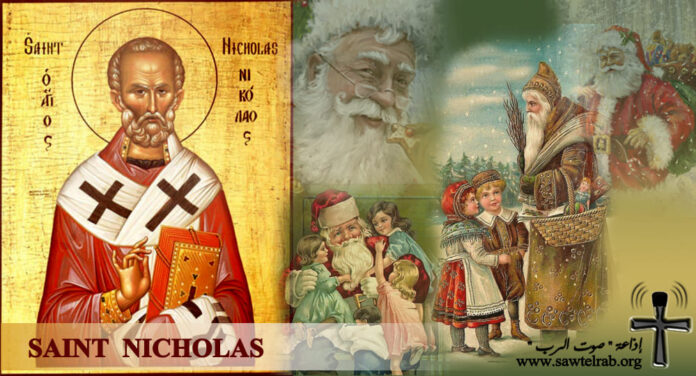
Who Is Saint Nicholas?
He was from the city of Myra; his father’s name was Epiphanius and his mother’s Nonna. Besides being wealthy, they had a deep fear of God.
They had no child to delight their eyes and inherit their wealth. When they were past the age of having children, God took pity on them and gave them this saint, who was filled with divine grace from childhood. When he was old enough to go to school, he showed such intelligence that it was clear the Holy Spirit was teaching him more than he learned from his teacher.
From his youth he absorbed all the teachings of the Church. He became a monk in a monastery whose abbot was his cousin, and lived a life of asceticism, spiritual struggle and virtue, so that he was ordained a priest at nineteen. God gave him the gift of working miracles and healing the sick, and the wonders he worked and the kindnesses and alms he gave are beyond description.
Here is one example. In Myra there was a rich man who had lost his fortune, until he lacked even basic food. He had three daughters who were past the usual age of marriage, and he had not married them off because of his poverty. The devil tempted him to send them into a shameful way of life. But the Lord revealed to Saint Nicholas what this man was planning. So he took a hundred dinars from his parents’ money, put it in a purse, slipped out at night without anyone noticing, and threw it through the window of the man’s house. The man was amazed to find the purse and overjoyed, and with this money he was able to marry off his eldest daughter.
On another night the saint did the same again, throwing a second purse through the window, and the man was able to marry off his second daughter.
But the man wanted to know who his benefactor was, so he stayed awake watching. The third time, as soon as he heard the purse fall, he went out to see who had thrown it, and recognized Saint Nicholas. He fell at his feet and thanked him warmly for saving his daughters from poverty. But the saint would not accept their thanks; he told them to thank God, who had put this idea into his heart.
When the Bishop of Myra died, an angel of the Lord appeared in a dream to the archbishop and told him that the one chosen for this office was Nicholas, describing his virtues. When he woke up he told the bishops what he had seen; they believed the vision and knew it came from the Lord Christ, and they took the saint and ordained him Bishop of Myra. Soon afterwards Diocletian became emperor and revived the worship of idols. When he arrested a group of believers and heard about this saint, he arrested him too and tortured him severely for several years, but the Lord Christ would raise him up unharmed from his torments. When Diocletian grew tired of him, he threw him into prison. From prison the saint wrote to his flock, encouraging them and strengthening them in the faith. He remained in prison until God destroyed Diocletian and raised up the righteous Emperor Constantine, who released the confessors from prison. The saint was among them, and he returned to his see.
It is said that, thanks to Saint Nicholas’s teaching, the see of Myra was the only one untouched by the heresy of Arius.
According to one tradition, when Saint Nicholas attended the Council of Nicaea he grew so heated against Arius that he slapped him in the face. The Fathers then decided to depose him and have him locked up, but the Lord Christ and the Virgin Mary appeared to him in prison and restored him to freedom and to his rank.
The saint took firm stands against the heretics and against paganism. Among the pagan temples he destroyed was the temple of Artemis, the main temple of the region, and the evil spirits fled before him.
One of the stories told about the saint’s care for his people is this: the governor Eustathius took a bribe to sentence three innocent men to death. At the time of the execution Saint Nicholas arrived, miraculously froze the executioner’s hand and had the men set free. Then he turned to Eustathius and moved him to confess his crime and repent. Three of the emperor’s officers, on their way to an official mission in Phrygia, witnessed this. When they returned to Constantinople, the Emperor Constantine sentenced them to death because of a false accusation by someone who envied them.
The officers remembered what they had seen in Myra, the power of its bishop’s love and justice, and prayed to God that through this bishop’s intercession they might escape death. That night Saint Nicholas appeared to Emperor Constantine and threatened him if he did not release the three innocent men.
In the morning the emperor summoned them for questioning, and when he heard that they had called upon Saint Nicholas, the very one who had appeared to him, he released them immediately and sent them with a letter to the saint, asking him not to threaten him but to pray for the peace of the world.
When he had completed his mission, he departed to the Lord in Myra and was buried in its cathedral. He was nearly eighty years old and had been a bishop for about forty years. The Church celebrates him on December 6.
After his death, the story of his holy life spread to many places, in Russia and Europe, especially Germany, Switzerland and the Netherlands, where people exchanged gifts in his name around Christmas. Truth gradually became mixed with legend. The name “Père Noël” came from French, meaning “Father Christmas”. Some thought that Father Christmas lived in Sweden, others in Finland, where a “Santa Claus Village” is promoted to tourists as his birthplace. When America was settled, immigrants brought their saints with them, among them Saint Nicholas, “Sinterklaas” to the Dutch, and the name evolved until it became “Santa Claus”.
In 1881 the American cartoonist Thomas Nast produced a famous drawing of Santa Claus as we know him today, with his long white beard and shiny black boots. Later, in the 1930s, Coca-Cola’s advertisements did much to spread the image of Santa in his handsome red suit. Since then, Santa Claus in his new outfit has become one of the best-loved figures for children all over the world. As his home changed, Santa gave up the donkey that carried his gifts and toys and took to a sleigh pulled by eight reindeer, those distinctive-looking animals.
The stories say that Santa puts the children’s presents in woollen stockings they hang above the fireplace in their homes. He slips down the chimney at night so the children won’t see him, and in the morning they are surprised by the gifts and are all the happier.