The Archangels
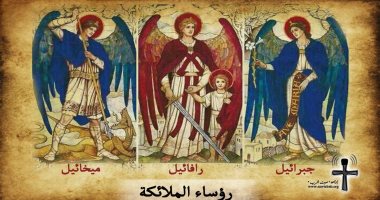
Michael: chief of the archangels. Gabriel: the angel who announces God’s wonderful works. Raphael: the one entrusted with the works of mercy that God does for humanity. (The Church celebrates them on September 29 each year.)
Michael
His name means “Who is like God?” or “Who is equal to God?” Since the earliest times the Church has shown him as a commander, holding in his right hand a spear with which he attacks Lucifer, the devil, and in his left hand a palm branch; above the spear there is a banner and a red cross. He is the one God sends to humanity to announce the decrees of his justice.
According to tradition, he appeared long ago to Abraham (Genesis 12), and to his servant Hagar in the desert to announce the birth of Ishmael (Genesis 16). He was sent to Lot to bring him out of Sodom (Genesis 19). When God commanded Abraham to offer him his son Isaac as a sacrifice, to test him, it was Michael who stepped in at the last, decisive moment to stop him from harming his son (Genesis 22). Michael also appeared to Jacob to save him from his brother Esau. It was he who went before the people of Israel as they came out of Egypt, “by day in a pillar of cloud to lead them along the way, and by night in a pillar of fire to give them light, that they might travel by day and by night” (Exodus 13:21).
It was he who blocked the path of Balaam, who wanted to curse Israel at the request of the kings of Moab: “The angel of the Lord took his stand in the way as his adversary. Now he was riding on the ass, and his two servants were with him” (Numbers 22:22). It was he who appeared to Joshua son of Nun near the walls of Jericho. Joshua lifted up his eyes and saw a man standing before him with his drawn sword in his hand. Joshua went to him and said, “Are you for us, or for our adversaries?” And he said, “No; but as commander of the army of the Lord I have now come.” And Joshua fell on his face to the earth, and worshipped, and said to him, “What does my lord bid his servant?” And the commander of the Lord’s army said to Joshua, “Put off your shoes from your feet; for the place where you stand is holy.” And Joshua did so (Joshua 5:13-15).
There are other passages as well where Michael appeared: to Gideon (Judges 6), and many times to the prophet Elijah; he stood in the midst of the furnace with the three holy young men in Babylon and sang God’s praises with them (Daniel 3); and he shut the mouths of the lions in the den where Daniel had been thrown (Daniel 6). Indeed, Michael’s works in the Old and New Testaments are countless. In the New Testament it was he who freed the apostles from prison (Acts 5:19) and appeared to Cornelius the centurion, telling him to send for Peter to baptize him (Acts 10). It was he who set the Apostle Peter free from prison, who struck King Herod so that he was eaten by worms because he did not give glory to God, and who appeared to the Apostle Paul to comfort him. It was he who explained to John the Evangelist God’s mysteries concerning the end of time in the Book of Revelation. He is also the one who leads the angels in the final battle against the Antichrist, the dragon and his angels, to cast him into hell for ever (Revelation 12). And on the Day of Judgment he will stand with the scales in his hand to weigh the deeds of all people.
Gabriel
Gabriel’s name means “man of God” or “strength of God”. If Michael is the sign of God’s justice, Gabriel is the sign of his tender compassion. The two complete each other, as the psalmist says: “Steadfast love and faithfulness will meet; righteousness and peace will kiss each other” (Psalm 85:10). God sends his archangel Gabriel to proclaim to people the wonders of his love and his care for their salvation.
According to tradition, he appeared to Daniel and announced to him the coming of the Messiah after a set number of years (Daniel 9). He also appeared to Manoah and his wife, the parents of Samson, in the Book of Judges. Manoah said to the angel of the Lord, “Pray, let us detain you, and prepare a kid for you.” And the angel of the Lord said to Manoah, “If you detain me, I will not eat of your food; but if you make ready a burnt offering, then offer it to the Lord.” And Manoah said to the angel of the Lord, “What is your name, so that, when your words come true, we may honour you?” And the angel of the Lord said to him, “Why do you ask my name, seeing it is wonderful?” (Judges 13:15-18). Tradition shows him holding in his right hand a lantern with a lighted candle, and in his left hand a mirror of green jasper. The mirror stands for God’s wisdom, a hidden mystery.
Gabriel was also God’s messenger announcing the good news of births from barren wombs, as with Christ’s grandparents, Joachim and Anne, and the parents of the Forerunner, Zechariah and Elizabeth. It was he who announced to the Mother of God the birth of the Saviour by the Holy Spirit. According to tradition, it was he who led the shepherds to the cave of Bethlehem, warned Joseph of Herod’s wicked plans against the divine Child and told him to go to Egypt. It was also he who came down from heaven on the day of the Resurrection, rolled back the stone of the tomb and sat on it. And it was he who reassured the myrrh-bearing women, Mary Magdalene and the other Mary, saying to them: “Do not be afraid; for I know that you seek Jesus who was crucified. He is not here; for he has risen, as he said” (Matthew 28:5-6).
Raphael
Raphael’s name means “God heals” or “God’s healing”. He is mentioned in the Book of Tobit: “Raphael was sent to heal the two of them: to scale away the white films of Tobit’s eyes; to give Sarah the daughter of Raguel in marriage to Tobias the son of Tobit, and to bind Asmodeus the evil demon” (Tobit 3:17). After the wedding he said to them: “I am Raphael, one of the seven holy angels who present the prayers of the saints and enter into the presence of the glory of the Holy One… Do not be afraid; you will be safe. But praise God for ever. For I did not come as a favour on my part, but by the will of our God. Therefore praise him for ever. All these days I merely appeared to you and did not eat or drink, but you were seeing a vision. And now give thanks to God, for I am ascending to him who sent me. Write in a book everything that has happened” (Tobit 12:15-20).
Tradition shows Raphael leading Tobias by his right hand, with Tobias carrying a fish he caught in the Tigris, and Raphael holding a jar of medicine in his left hand.
The ministry of the angels
The Apostle Paul says that all the angels are ministering spirits sent forth to serve, for the sake of those who are to obtain salvation (Hebrews 1:14).
God has set them as guardians and guides over every nation and people, to lead them toward what is right for them.
He commands them to guard those who trust in him, so that no evil may befall them and no scourge come near their dwelling (Psalm 91:10-11).
In heaven they always behold the face of God, singing to him the thrice-holy hymn and interceding with him for us.
They rejoice over one sinner who repents
(Isaiah 6:2-3; Matthew 18:10; Luke 15:7; Acts 12:15).
In short, they have served God for our good so much that the pages of Holy Scripture are full of their stories.
To honour these divine servants, our protectors and guardians, the Church has seen fit to establish a common solemn feast on this day, when we gather to celebrate and sing to them all, and especially to the archangels Michael, Gabriel and Raphael, whose names are mentioned in Holy Scripture.
The number of angels has no limit in Holy Scripture, as Daniel says: “A thousand thousands served him (God), and ten thousand times ten thousand stood before him” (Daniel 7:10).
Traditionally, the angels are divided into nine choirs, whose names are: Thrones, Cherubim, Seraphim, Dominions, Virtues, Powers, Principalities, Archangels and Angels.
According to an ancient Eastern tradition, there are seven archangels:
1. Michael: chief of the archangels.
2. Gabriel: the angel who announces God’s wonderful works.
3. Raphael: the one entrusted with the works of mercy that God does for humanity.
4. Suriel: the angel responsible for warning people with the word of God and helping them study it.
5. Sedakiel: the angel who expresses God’s faithfulness to his promises and their fulfilment.
6. Sarathiel: the angel with authority, who moves the angels to serve us and protect us.
7. Ananiel: the angel who brings us the works of God’s mercy toward humanity.