


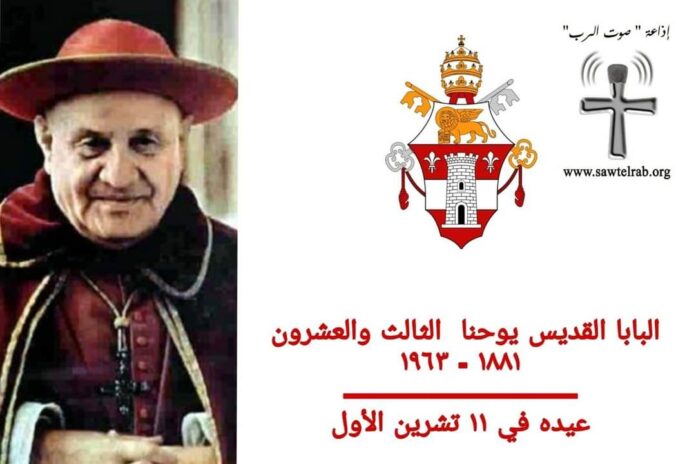
The Life of Saint Pope John XXIII
(1881-1963)
Angelo Giuseppe Roncalli was born on November 25, 1881, in Sotto il Monte, near Bergamo, into a family of simple farmers. He was ordained a priest in 1904. In 1925 Pope Pius XI appointed and consecrated him a bishop and sent him as Apostolic Visitor to Bulgaria. In 1934 Archbishop Roncalli became Apostolic Delegate to Turkey and Greece. In 1944 Pius XII sent him to Paris as Apostolic Nuncio. There he met General de Gaulle, then head of the government, and gave a speech before him on behalf of the diplomatic corps that attracted notice in every country. He worked there, as he put it, quietly and calmly, step by step. He stayed in France for eight years and visited nearly all of it, calming disputes and building trust. One of his sayings is: “I thank God that I did not complicate things, but untangled complicated things.” On a visit to Amiens he met a group of farmers who gathered around him, and he said to them: “You are children of the fields, and I too am a child of the fields; my parents are farmers like you.” His simplicity attracted attention when he represented the Holy See at UNESCO as its first permanent observer, and he made valuable contributions there. In January 1953 he was made a cardinal and received the cardinal’s biretta from the hands of President Auriol, a privilege and old tradition of France. The President said to him: “France is grateful to you and regrets your departure.” The cardinal answered humbly: “I hope people will say of me: he was a priest faithful to his priesthood, a man of peace, and on every occasion a sincere friend of France.” Along with the cardinal’s hat he received the title of Patriarch of Venice.
He then left Paris for Rome and went on retreat for a while at the Abbey of Praglia, before making his solemn entry into his diocese, where everyone welcomed him with enthusiasm. He governed his diocese with the vigilance of a shepherd attentive to every detail; he brought toys to sick children and visited them; he knew every priest in his diocese and loved them one by one. Although he had become, or almost become, a Venetian, he did not forget his home village or his family. He mourned three of his sisters and his brother Giovanni; he could see himself growing old, and thought he would die in Venice. He celebrated his fiftieth anniversary as a priest in his village in 1954. He travelled a great deal; the Pope asked him to consecrate the Basilica of Saint Pius X in Lourdes, and he did not hide his joy, especially as that was the centenary year of Our Lady’s apparitions to Bernadette. No one suspected that this cardinal with the sweet smile and kind heart would soon be head of the Church.
Pope Pius XII’s health declined greatly, and he passed to the heavenly dwellings in 1958.
Cardinal Roncalli spent some time resting in his village with his family, remembering his childhood and blessing the wedding of one of his nephews before returning to Venice. Shortly after his return he left with his secretary, Monsignor Loris Capovilla, for the conclave. During the conclave he had with him only a small suitcase, which was all he owned.
During the conclave, before the cardinals elected him, he said: “When we trample pride underfoot and put love in our hearts, we can accept what God asks of us and keep peace in our hearts.” When the voting was over, almost all the votes were his. He then said: “I will be called John, and I place myself under the protection of John the Baptist and John the Evangelist.” He also remembered that his father’s name was John. As Pope he remained the same ordinary, humble and simple man he had been before.
On the evening of his coronation, November 4, 1958, he told his secretary what was in his heart: “I am thinking of my village, Sotto il Monte, and of my father and mother.” At his coronation he began his homily with words from the Bible, spoken by Joseph when his brothers came to him after he had become Pharaoh’s minister: “I am Joseph, your brother.” He carried out his role as Bishop of Rome, visiting the sick in hospitals and talking with them with his gentle smile, touring the parishes in the villages, speaking with people and asking how they were. He visited prisoners in Rome’s jails, comforting them with kind words and encouraging them to begin a new, blameless life.
During his last illness, his niece Sister Anna, a missionary sister in Africa, came to see him. He said to her: “How kind of you to visit me. I thank your superiors and I bless you all… How beautiful the missions are!”
He wanted the Church to carry out its essential mission, as mother and teacher, and so he issued his encyclical Mater et Magistra (“Mother and Teacher”), which the whole world received with the greatest respect. In it he set out the features of the Church in all its dimensions and commitments, and the commitment of every person to his or her conscience.
His greatest wish was the unity of the Church, which he spoke of often, right up to his last encyclical, Pacem in Terris (“Peace on Earth”), which had a far-reaching echo. This encyclical earned him the lovely title “the Pope of Peace”, added to his other titles, “the Pope of Unity” and “the Pope of the Council”. For he had announced the Council on January 25, 1959, and he said to Christians separated from Rome: come, let us meet together; the way is open…
He received with love all the delegations of separated churches that came from every corner of the earth: Anglicans, Orthodox, Protestants, everyone.
He opened the Council himself on October 11, 1962, and followed the first session from his room on television, intervening only when necessary. Through it all he prayed to God the Holy Spirit to enlighten everyone and open their hearts to full unity, and then asked the intercession of the Blessed Virgin and Saint Joseph.
He received the International Balzan Prize for Peace, worth one million Swiss francs, which he devoted entirely to a foundation for victims of revolutions and wars. After that,
he developed cancer of the digestive system, which he bore with patience and joy. During his illness he said: “This bed is an altar, and an altar needs a victim: here I am.” He kept repeating: “May God’s will be done.” He said to his doctor, Dr. Gasbarrini: “Doctor, don’t worry too much about my illness; my bags are packed, and I’m ready to leave as soon as the train arrives.”
He welcomed his visitors cheerfully, and the smile never left his face. Having taught everyone how to live in love, he taught them how to die with joy, calm and peace with the Lord. When he entered his final agony, he said to his sister Assunta: “I will live through tonight.” And indeed he did. On the night of May 30 he asked to receive the last sacraments. Cardinal Cicognani gave him Holy Communion with this verse from the Psalms of David: “I was glad when they said to me, ‘Let us go to the house of the Lord!'” After receiving Communion he professed his faith calmly and solemnly, and then received the Anointing of the Sick. He died on June 3, 1963.
At his death, radio stations all over the world announced it with words of sorrow and respect. He was laid in the room that had witnessed his suffering; his body remained unchanged, so that anyone looking at him thought he was asleep. On his chest lay a simple cross he had bought on the day of his episcopal ordination; he had written in his will that this cross should be placed on his chest when he died. He was canonized by Pope Francis on April 27, 2014.
Prepared by Rita, of the Sawt el Rab team



 Angelo Giuseppe Roncalli was born on November 25, 1881, in Sotto il Monte, near Bergamo, into a family of simple farmers.)