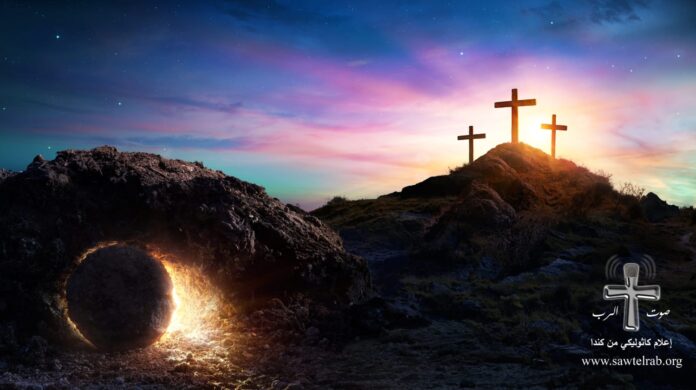
Holy Saturday
“The tomb of Christ”
On Holy Saturday the Church focuses our attention on the Lord’s tomb. This day is the most complex of the liturgical year, because it is pulled at once between the sorrow of the Passion and the joy of the Resurrection: the first continues the link with the season of the Passion, and the second connects directly to Easter. The service of Christ’s burial, held on Friday afternoon, already reaches into Holy Saturday. But the Saturday really begins with Matins, usually celebrated either on Friday evening or very early on Saturday, and known as the funeral service of Christ. A canon of nine odes is sung, followed by a procession that ends in the middle of the church around the bier holding the epitaphios. The funeral Lamentations are then sung:
(translation of the meaning)
O my Christ Jesus,
King of all,
what have you come to seek in Hades?
Is it not to set the human race free?
Stretched out on the wood,
you gathered all people together,
and by your pierced, life-giving side
you poured out forgiveness on all.
You, my God,
my joy and my gladness,
I cannot bear to see your burial:
my heart is torn like a mother’s.
Then the celebrant sprinkles the bier and the faithful with rose water, the Resurrection Evlogitaria and other hymns are sung, and after the Great Doxology a great procession takes place with the epitaphios, which at the end is brought back with the Gospel Book into the sanctuary, where they remain on the altar throughout Easter week. Then the prophecy of Ezekiel is read, describing his vision of the dry bones coming back to life, which applies at once to the people of Israel, to Christ risen from the dead and to the forgiven sinner. Then two passages from Paul’s letters are read, combined into a single reading.
The Epistle is followed by the last of the twelve Gospels read on the evening of Holy Thursday, in which we hear that the priests asked Pilate to have the tomb guarded, and this was done. Matins ends with a litany and the usual concluding prayers. This concludes the part of the Holy Saturday services relating to Christ’s Passion.
Before moving on to the second part, which belongs to the Easter season, let us pause for a moment before the Lord’s tomb. Two passages of Scripture will help us understand the message of Holy Saturday.
First, a text from the evangelist Luke: “The women who had come with him from Galilee… saw the tomb and how his body was laid. Then they returned and prepared spices and ointments. On the Sabbath they rested according to the commandment” (Luke 23:55-56). In every disciple’s life there are stages in which the Master seems to have gone away and stayed far from us. This, in a sense, is what the tomb stands for. They saw the tomb and knew where Jesus had been laid. We must do the same, even if it seems to us that Jesus no longer answers our requests. Even if he has become invisible, we must not doubt his presence. We must keep our gaze turned in his direction, if we cannot fix it on him directly. And the women did not sit idle: they worked and prepared spices to anoint Jesus’ body. They went on honouring him even after life had left his human body.
So even in the times when Jesus is silent and hidden, we must not stop making him the centre of our worship. Let us prepare the spices, the spices of our feelings and our deeds, to offer them now to the invisible Friend, and to offer them to him also when he lets us feel his presence again, for we are sure he will come back to us. But notice that the women’s preparations show no agitation. They keep the Law and rest on the Sabbath.
The time Jesus spends in the tomb is a time of secret, hidden, contemplative life near him and with him; it is a time of waiting and stillness. Holy Saturday is the feast of the mystics whom the world does not know and who want to be known by no one but Jesus. The peace of Holy Saturday is entirely directed toward the great event of Easter Sunday, toward the power and joy of the Resurrection. But we must keep this peace of waiting. And how much the outward preparations for Easter prevent many Christians from awaiting this feast in solitude, calm and silence! How much easier and simpler my spiritual life would become if I could convince myself well enough that I have died with Jesus and been buried with him! Then, before every temptation and everything that distracts me from the one thing necessary, I would simply say, “What’s the use? I am dead. I am in the tomb with my Lord.” Instead of arguing with life and struggling in it, I would place myself, first of all, outside it. And by this death to the world and to sin, I would be more alive than ever.
Today we sang, “We offer praise, O my Christ, to your burial”; we can now add, “Grant me to be with you in the tomb.” And now let us look at the second part of the Holy Saturday services, turned toward the Resurrection. Matins, explained above and usually celebrated on the evening of Good Friday, expresses the waiting and grief of Jesus’ friends, the disciples and the women, and shows that their attention was now focused on the tomb where Joseph had laid the Saviour’s body. But Vespers and the Liturgy celebrated on Holy Saturday morning anticipate Easter Sunday and bring us the first announcements of the Resurrection.
The hymns of Vespers proclaim Christ’s victory over Hades and death: “The Crucified One has emptied the tombs, and the power of death has vanished… Glory to your Cross, O Lord, and to your Resurrection.” Three passages from the Old Testament are read. The first tells the story of creation, because Christ’s resurrection will be, in a sense, a new creation. Then the account of the institution of the Mosaic Passover is read: the lamb, the doors marked with blood to keep death away, the unleavened bread, all elements of the old Passover that point to a better Passover, the Lord’s passing over to grant us immense grace.
So let us gird ourselves and get ready for this new Passover. The third reading is from the book of Daniel, the story of the three young men thrown into the furnace for refusing to worship the king’s statue, yet miraculously saved from death. They prefigure the victory of Christ risen from the dead, and their song of thanksgiving draws all nature into the praise of God: “Waters… fire and heat… dew and snow, ice and cold… earth, mountains and hills… bless the Lord…” In this way we involve the whole universe in the joy of the Resurrection.
The Epistle read at the Liturgy develops a theme Paul often returns to: “All of us who have been baptized into Christ Jesus were baptized into his death… so that, just as Christ was raised from the dead by the glory of the Father, we too might walk in newness of life” (Romans 6:3-4). The Gospel reading speaks of the Resurrection, which the Church lets us hear in this Easter season: it describes the women’s visit to the tomb, the angel’s announcement of the Resurrection, the meeting of the Jewish priests and finally Jesus’ appearance to the disciples gathered in Galilee (Matthew 28). But the closing blessing does not yet mention the Resurrection. Holy Saturday announces the Resurrection, but in a low voice. On this Saturday morning the news of the Resurrection keeps something secret and intimate about it. But soon the day will end, and the hour will come when the Church proclaims at the top of her voice that Jesus Christ is risen from the dead.
Father Gerard Abi Saab