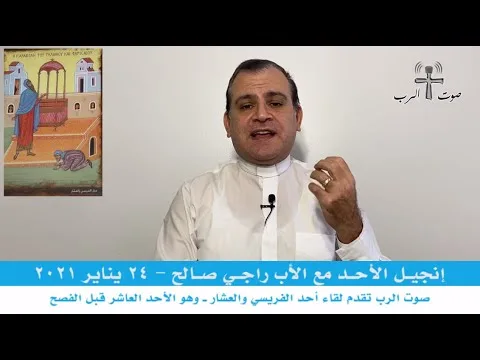
The Lord told this parable: “Two men went up into the Temple to pray, one a Pharisee and the other a tax collector.
The Pharisee, standing by himself, prayed thus: ‘God, I thank you that I am not like other men, extortioners, unjust, adulterers, or even like this tax collector.
I fast twice a week; I give tithes of all that I get.’
But the tax collector, standing far off, would not even lift up his eyes to heaven, but beat his breast, saying, ‘God, be merciful to me, a sinner!’
I tell you, this man went down to his house justified, rather than the other. For everyone who exalts himself will be humbled, but the one who humbles himself will be exalted.”
My dear brothers and sisters…
Today in our Melkite Church
Sunday 24 January 2021 is the Sunday of the Publican and the Pharisee, the tenth Sunday before Easter.
We also call it the Sunday of the opening of the Triodion,
which extends over the ten weeks before Easter, the glorious feast of the Resurrection.
The Triodion season, as I said, extends over the ten weeks before the celebration of the Resurrection.
It has three stages.
The first prepares for the fast and lasts one month: four Sundays
(the Sunday of the Publican and the Pharisee, followed by the Prodigal Son, then Meatfare Sunday and then Cheesefare Sunday).
The second is the holy forty-day Fast, which extends over five Sundays, and then the third and final stage:
Holy Week, which ends on the evening of holy and great Saturday.
The holy Church gives us this Gospel text, Luke 18:10-14, at the start of the Triodion
to call us, and press upon us, at the start of our journey toward the Resurrection, the humility of the tax collector, as today we meditate on the parable of the Pharisee and the tax collector.
The Pharisee’s attitude reminds us of each of our own situations. We need to enter into remorse and repentance for our sins.
That is why the Church urges us to prepare to meet the Lord,
and during the Great Entrance with the gifts at the Liturgy, we sing:
“Let us lay aside all earthly cares, that we may receive the King of all.”
This means being reconciled with others and forgiving them,
and not letting our minds and hearts be taken up with anything contrary to the mind of Christ;
not judging one another, but loving one another;
and not turning into judges like the Pharisee, nor having spiritual or material pride.
Everything done in pride becomes a cause for judgment.
God does not love sin or take pleasure in it, but he loves the person, even a sinner like the tax collector.
Humility is the foundation of faith and Christian love.
Because when we compare ourselves with others, we must also compare ourselves with God,
and then we become humble.
It is this prayer that opens our souls to receive God’s grace and mercy.
Two people pray to the same God, but there is a difference in how they know and understand this God.
For the Pharisee, prayer has one direction and one pole:
self-satisfaction and security, and the belief that he alone is justified and favoured.
We often act like this Pharisee:
so-and-so is embezzling money… so-and-so is having an affair with so-and-so’s wife… so-and-so is mixed up in…
The heart has no rest because of self-justification and judging others.
For him, holiness is the satisfying image he has of himself according to the rules he has set for himself and the religious rituals
(tithing, prayer, fasting).
He alone is the image of God’s love for humanity.
He has to put others down in order to be justified
(“I thank you that I am not like this…”).
He never said, “I am like…” or “I am with…”.
The tax collector, on the other hand, did not come to show God how special he is, but to tell God, “I am wretched and a sinner… have mercy on me.”
He doesn’t dare lift his eyes to heaven because deep down he feels unworthy of this divine love.
He doesn’t even dream of comparing himself with others, because he has compared himself with the goodness of God
and discovered his weakness.
Only this prayer opens the way of peace for us and places us directly before God.
Whoever humbles himself will be exalted.
This is the cross, the wisdom of the cross; this is the mind of Christ that we are called to follow so as to become open Gospels for everyone around us. This is our hope and our faith.
I wish you a blessed start to the Triodion,
and let us lay all our difficulties before the Lord,
hoping to behold his Resurrection and rise with him.
Amen.
Father Raji (Elie) Saleh – Our Lady of the Annunciation parish, West Montreal
Melkite Catholic Eparchy of Canada