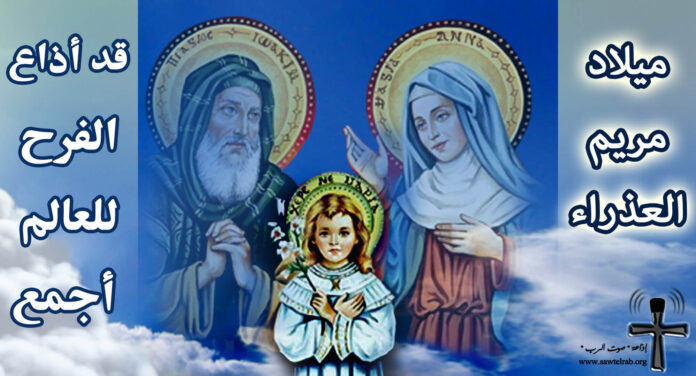
The Feast of the Nativity of the Virgin Mary
The birth of the Virgin Mary changed the face of an earth disfigured by sin and turned the tide of history. Through this birth God, the Lord and Creator, gave back to creation its original splendour and beauty. This birth was a slap in the face to a fallen humanity: sin and its consequences, such as hatred, loathing, lust and selfishness, could not rule over Mary, for she was conceived without original sin. She enjoyed in advance the saving graces of Christ the Redeemer.
And God the Father, by choosing the Virgin Mary as “mother” of his only Son, and through her wonderful birth, astonished the chosen people, and especially their leaders, who had wandered off into various philosophies far removed from his divine logic, and called them back to their authentic roots: “For your hardness of heart Moses allowed you to divorce your wives, but from the beginning it was not so” (Matthew 19:8).
God the Father chose the Virgin Mary from among the daughters of her people, she who was undefiled, who lived with the simplicity of a village girl and acted with the gentleness of God’s children. And when the time of waiting was over, “the angel Gabriel was sent from God to a city of Galilee named Nazareth, to a virgin betrothed to a man whose name was Joseph, of the house of David; and the virgin’s name was Mary. And he came to her and said, ‘Hail, full of grace, the Lord is with you!'” (Luke 1:26-28).
By his birth, unique of its kind, Christ turned our ideas upside down: he looked for a place to be born in a small town, not in palaces, and he chose a daughter of a humble home, not a queen or a princess: “And you, O Bethlehem, in the land of Judah, are by no means least among the rulers of Judah; for from you shall come a ruler who will govern my people Israel” (Matthew 2:6). And when the Lord of heaven and earth appeared to her, he did not impose his will on her; he proposed what he was about to do and waited for her consent: “Behold, I am the handmaid of the Lord; let it be to me according to your word.”
For love does not force or compel anyone; it draws people to itself. Love does not chain anyone; it sets them free from everything that enslaves them. Love does not work through noise and chaos; it creates in calm and silence.
The birth of the Virgin Mary also became the birth of a new mindset, because love leads to understanding and to full and true knowledge. When Mary heard the angel’s greeting and grasped the heart of his message and the divine will, she understood his proposal with complete clarity, in all its aspects and demands. And with full responsibility she gave her consent to God’s call, embraced it and committed herself to it, even though the child was “set for the fall and rising of many in Israel, and for a sign that is spoken against (and a sword will pierce through your own soul also), that thoughts out of many hearts may be revealed” (Luke 2:34-35).
The birth of the Virgin Mary became the birth of a new life. While the great and powerful expected honour from everyone, small and great, obedience from the common people and service from their servants…, the Virgin Mary came to overturn these beliefs. Here she is: after hearing from the angel the surprising news about her kinswoman Elizabeth, “And behold, your kinswoman Elizabeth in her old age has also conceived a son; and this is the sixth month with her who was called barren. For with God nothing will be impossible,” she “arose and went with haste into the hill country, to a city of Judah, and she entered the house of Zechariah and greeted Elizabeth” (Luke 1:36-40).
The Virgin Mary was fully aware of her greatness, and she acknowledged that everything comes from God: “My soul magnifies the Lord, and my spirit rejoices in God my Saviour, for he has regarded the low estate of his handmaiden. For behold, henceforth all generations will call me blessed; for he who is mighty has done great things for me” (Luke 1:46-49).
By her glorious birth the Virgin Mary opened a new page in the history of humanity: “Christ has appeared among us, he who sits here upon the altar. The voice of peace has been heard, the holy kiss has been given, enmity has vanished and love has embraced everyone” (from the Armenian liturgy).
The birth of the Virgin Mary on earth, passing through the stages of this mortal life and refined in the furnace of life’s hardships, becomes a glorified and eternal life, in full harmony with the life of the Holy Trinity and within it. The Virgin Mary is the true tabernacle, in which Christ, God and Saviour, dwelt for nine months, and she was never selfish in keeping her treasure to herself. She carried him as a light to a world darkened by materialism, and as a love open to a humanity blinded by its selfishness. Her whole existence found its meaning in Christ and with him. Her one and only concern is to give Christ to each of us and to all people, because he is “the way, the truth and the life”.
Every moment of the Virgin Mary’s life burned with the love of the Holy Spirit and with his light shining on the paths that led her to eternal happiness. Every stage of her life on earth was living faith, firm hope and ardent love. And she has never stopped pouring this love and light into our hearts, which thirst for the transparency of God’s children. The Virgin Mary believed in God Almighty and put all her hope in him: “Blessed are you among women, and blessed is the fruit of your womb!” (Luke 1:42).
This grace did not keep the Virgin Mary’s life free from troubles, hardships, trials and the Calvary that could have turned her aside from her path and from the purpose of her life. But her steadfastness in the face of all these obstacles was crowned with the joy of her Assumption into heaven, body and soul, to be enthroned as Queen of heaven and earth. From heaven she watches over our lives and offers us her Son, the source and goal of our Christian life.
O Virgin Mary, Mother of God and our Mother! Give us your Son, a light for our path in this valley of tears, and turn these tears into smiles of faith, hope and love. Intercede for us, so that in our lives we may be living temples, bringing the beloved Saviour, Jesus Christ, to a miserable and despairing world.
Bishop Krikor-Augustin Coussa