The History of the Feast of the Cross
† The holy Cross is one of the signs Christians are proud of, and this shows in their daily lives: they make the sign of the cross at all times, in joys, sorrows and sufferings.
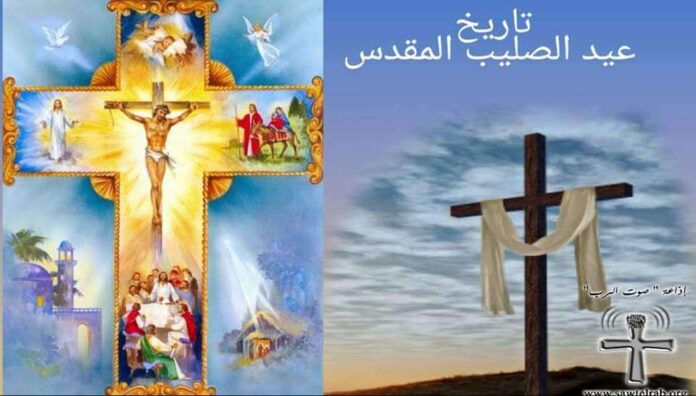
The story of the finding of the wood of the holy Cross: the feast of the Exaltation of the holy Cross is linked to the memory of recovering the wood of the cross on which the Lord Jesus Christ hung, which became a symbol of redemption, resurrection and glory.
The Gospels tell us that the Jews asked Pilate to crucify Jesus, and that Christ went out carrying his cross to the place called Golgotha. It is certain that Jesus died on the cross, and that after his death Joseph of Arimathea, with the permission of the governor Pontius Pilate, saw to taking down Christ’s body and laying it in his own new tomb.
But what happened to Christ’s cross? It was buried in the ground together with the two other crosses, and because of the persecution Christians suffered in the first three centuries, no one dared to mention it or look for it.
When war broke out between Emperor Constantine and his rival Maxentius in 312, Constantine asked for help from the God of the Christians, and a cross appeared to him in the sky surrounded by the words: “In this sign you will conquer.”
† Then Constantine believed in Christ, had the cross painted on his soldiers’ shields and won the war. He then issued the Edict of Milan in 313, which recognized Christianity’s right to exist and permitted the Christian religion.
After this appearance of the cross, Constantine’s mother, Saint Helena, went to Jerusalem to search for the cross of Christ. When she asked about it, she was told that the cross was buried near the temple of Venus built by Emperor Hadrian. She had the place excavated and found three crosses. Since she did not know which was the true cross of Christ, Bishop Macarius suggested placing them one after another on the body of a dead man whose funeral was passing by at that moment. When the first and second crosses were laid on him, nothing happened; when the third was laid on him, the dead man miraculously came back to life. After that the cross was laid on a sick woman, who was healed at once.
Then Bishop Macarius raised the wood of the cross so that everyone present could see it, and they sang “Kyrie eleison” with tears of joy streaming from their eyes.
Saint Helena set up the holy Cross on Golgotha and built over it the church still known today as the Church of the Resurrection (the Holy Sepulchre), which was dedicated in 335.
To confirm this account we should mention Saint John Chrysostom, in a homily given around 390-395, who said that when Helena found the crosses, the true cross was clearly distinguished from the other two by the inscription written on Pilate’s orders, which was still attached to it.
Saint Ambrose, bishop of Milan (374-397), says the same, and adds that it was indeed Helena, Constantine’s mother, who discovered the wood of the holy Cross.
In 614 Khosrow, king of the Persians, overran Jerusalem and carried off thousands of Christians into captivity in his own country, led by Patriarch Zacharias, and he took the relic of the wood of the precious Cross as booty; it remained in his possession for fourteen years.
In 628 the Byzantine Emperor Heraclius defeated the Persians, and his chief conditions were the release of the Christians and the return of the relic of the holy Cross.
Khosrow had died and his son Kavad (Siroes) was reigning in his place. He accepted the conditions and freed the captives safe and sound, together with Patriarch Zacharias, after fourteen years in captivity, and handed the relic of the Cross over to Emperor Heraclius. Heraclius took it to Constantinople, where the whole city came out to meet him with lamps and songs of victory and rejoicing.
Then, around 630, Emperor Heraclius brought it back to Jerusalem to set the wood of the Cross again in its place on Golgotha. The people, led by Patriarch Zacharias, came out to meet him and welcomed him with the greatest signs of joy, with torches and hymns, and they walked as far as the road to Golgotha. There, according to tradition, the emperor was suddenly stopped by an unseen force and could not take another step.
The patriarch came forward and said to the emperor: “The Lord Christ walked this road carrying his cross, crowned with thorns, wearing the robe of mockery and humiliation, while you are wearing your purple robes with a crown set with jewels on your head. You must become like Christ in his humility and poverty.” The emperor listened to the patriarch, put on a poor garment and continued bareheaded and barefoot to Golgotha, where he raised up the venerable wood of the Cross. The faithful fell to the ground singing: “Before your Cross we bow down, O Master, and your holy Resurrection we glorify.”
Joy filled the whole Christian East, and people came to receive blessing from the wood of the holy Cross on which the mystery of redemption was accomplished. The feast of 14 September itself goes back to the dedication of the Church of the Holy Sepulchre in 335; the return of the Cross under Heraclius added to its splendour.
Ever since, the Church has celebrated this great feast of the Exaltation of the holy Cross every year on 14 September. †
Among the popular customs connected with this feast: †
Lighting fires on mountaintops or in public squares. According to tradition, this custom goes back to the fires Saint Helena ordered to be lit from one mountaintop to the next, to send the news that she had found the Cross to her son, Emperor Constantine, in Constantinople, since fire was the fastest means of communication at that time.