



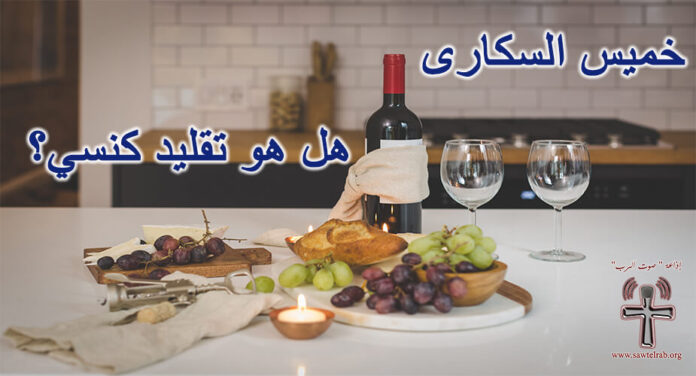
“Drunkards’ Thursday”: is it a Church tradition?
“Drunkards’ Thursday” (Khamis al-Sakara) is a pagan idea and tradition, a prelude to entering the Christian fast. When paganism entered the Church, especially in the Empire of Constantine, customs and traditions that were not their own left their mark on Christians. When Christianity became, under Constantine, both religion and state, “anything and everything” came into it, including “Drunkards’ Thursday”.
According to this custom, as Lent approached, people were urged to eat meat, then to finish off all dairy products and cheese, and to get drunk before beginning the Church’s fast in earnest.
The word “Thursday of Remembrance” (dhakara) does not exist; it is an inaccurate expression. The Church is not against families gathering joyfully, as long as the customs are not taken to the point of drunkenness and losing oneself: “and wine to gladden the heart of man, oil to make his face shine, and bread to strengthen man’s heart” (Psalm 104:15).
Far from pagan customs, the meaning of fasting is to affirm that my attachment to the Lord is stronger than my attachment to anything else. Scripture also says: “Man shall not live by bread alone, but by every word that proceeds from the mouth of God” (Matthew 4:4).
Before the start of the fast, the Maronite Church dedicated the seventh week after Epiphany to “the faithful departed”, for all who have left us for the other life, and for our prayers and petitions that they may have eternal rest, for all the care they gave us when we were young and all they suffered alongside us in this passing life. May God receive them in his abundant mercy. As Christians, we do not welcome the fast with drunkenness, because this is not acceptable to the Church; the spirituality of fasting calls us to welcome it with repentance, prayer and a contrite heart.
Amen.
Prepared by Fr. Milad Salloum


 is a pagan idea and tradition, a prelude to entering the…)