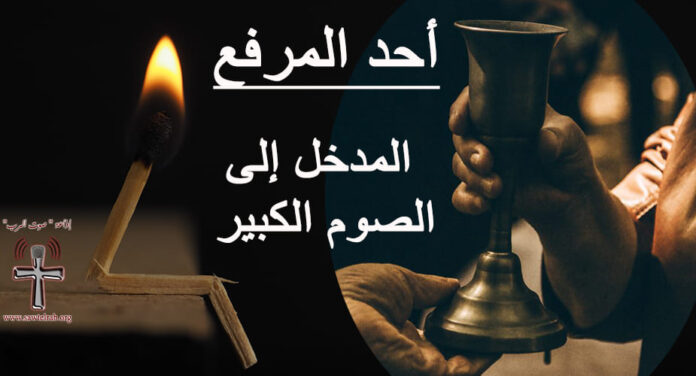
Meditation for the Sunday of the Last Judgment (Meatfare Sunday)
Matthew 25:31-46
“Then the King will say to those at his right hand, ‘Come, O blessed of my Father…’ Then he will say to those at his left hand, ‘Depart from me, you cursed…'”
Here Jesus gives us a picture of what will happen on the day of the Last Judgment: how he will sit on his throne, and “before him will be gathered all the nations, and he will separate them one from another as a shepherd separates the sheep from the goats”. Three basic truths emerge from this passage and deserve our deep reflection: first, the reality of the day of Judgment; second, its universal, worldwide scope; and finally, the criterion of judgment, which is love. God’s judgment is first of all a universal human principle, written in the conscience. For God’s justice and love promise to put right what is crooked in this life: he will make amends to the oppressed and will judge each according to his works. The truth of the general judgment is fundamental to our faith. Christ’s first coming (his Incarnation) brought the Old Testament to a close, and his second coming (his return) will close the time of the New Testament, which prepares us and keeps us watchful and waiting for the awesome day of the Lord.
The book of Psalms calls on God with longing to bring justice on earth. And the book of Revelation, the prophetic book of the New Testament, speaks of the day of Judgment, of God’s final victory and of the fate of humankind. And in the Creed we proclaim that we look for the resurrection of the dead and the life of the world to come.
In the Christian understanding, judgment is not a punishment God inflicts on those who have offended him: it is the moment when God establishes justice. This judgment comes with frightening scenes and terrifying images, to stress vigilance on the one hand, and on the other to depict the extent of the suffering that awaits the careless.
Today we fall into error by feeling that the Lord “is delayed”. Generations go by; the first millennium ended, then the second. And here we are in the third millennium! So the feeling grows that the Master is delayed, if not the feeling that the day of Judgment is only a teaching device and not a real event that will happen.
To guard against this danger, Jesus told us not to fall asleep saying, “My master is delayed.” The long time that has passed before the second coming should not lull us into thinking he will be delayed further; rather, we want to keep watch, because a long time has passed and so what remains is shorter. The Lord’s delay makes us more alert. “He is delayed” means for us “waiting” with more eagerness and watchfulness, not “putting off”.
“Watch”: this is the word that should ring in our ears every time time passes. And this is what the Church wants on this Sunday, as she reminds us of the awesome day of Judgment.
The Lord’s judgment is universal on the day he judges “the nations”. For he will gather all nations, not the followers of one religion rather than another, or the children of one nation rather than another… But does God show partiality? And how will he judge those outside our religion? What common criterion will the Lord use to bring justice to all? Love is what is common to the lives of all human beings. People differ in religion, in race, geography, circumstances, civilization and language… Everything about people differs; the only thing common to all is their humanity, that is, their love and the good they do. That is why Jesus makes clear that judgment will be based on “works”, and on no other consideration, not even religion! So when he separates the sheep from the goats, placing them on his right and on his left, he asks about no criterion other than real deeds, love in action. On this basis the day of Judgment can be universal.
When love is the criterion of judgment, when the Judge identifies himself with those in need – “as you did it to one of the least of these (the weak), you did it to me!” – and when John the beloved affirms that we cannot love God whom we do not see if we do not love the neighbour whom we see, all this means that religion, as a relationship of love and worship of God, is not established directly between creature and Creator! A person proves his love for his Creator by caring for his creation! It is our practical love of neighbour that builds love with God. And conversely, it is our neglect of our neighbour that determines our judgment. External “piety” is dangerous when it multiplies “devotions” towards the Creator and neglects serving people. That is a degraded religiosity.
Making love the criterion of judgment means a shared responsibility among people: God will judge on the basis of a life of communion lived out, not an individual life. Divine justice does not accept an answer like, “Am I my brother’s keeper?” Yes, I am responsible for my brother, if I believe in the existence of God and the day of just Judgment.
Love of neighbour takes on a religious character, not merely a social one. Our responsibility towards our neighbour is not a matter of “charity” but lies at the very heart of “faith”: it is its measure. Religion is not a private matter between an individual and his God. The Christian faith is a matter of communion. The question on the day of Judgment will not be about what we did with God, for that has no measure but a few outward appearances! The question will be: what of our religion did we put into practice with others? This is the new commandment that Jesus insisted we live, so that people would know we are his disciples. Religion is commandments directed towards the other, and what we want with God, we prove through our neighbour.
Communion with the other is not an ideal level of religion; it is its very essence; and its absence does not mean one virtue is missing, but that religion itself is missing altogether.
Yes, we will truly be judged one day, so let us keep watch! And the judgment is universal, for everyone: not religion, nor race, nor any affiliation, but only works! We will be asked then only about love. The Sunday of Judgment prepares us for a fast that seeks to ready us for judgment through vigilance, because time is short; it teaches us that God will separate all people, sheep and goats, according to their works and not their affiliation, and that religion is an act of love towards the other. Amen.
Fr. Gerard Abi Saab