Meditation for the Second Sunday after the Cross
Gospel: Luke 5:1-11
Several times Jesus used particular symbols with Peter to tell him something deeper. Here, from his very first call, Jesus told him, “I will make you a fisher of men”, because his trade was fishing. Another time he would say to him, since he is Peter (the rock): “On this rock I will build my Church”… Of course, Jesus does not use these images exclusively. He calls everyone from their trade, whatever it may be, to become apostles wherever they are. In any case, it is a faith like Peter’s that will build his Church, even though, in Peter’s case, the image of his faith matched his name.
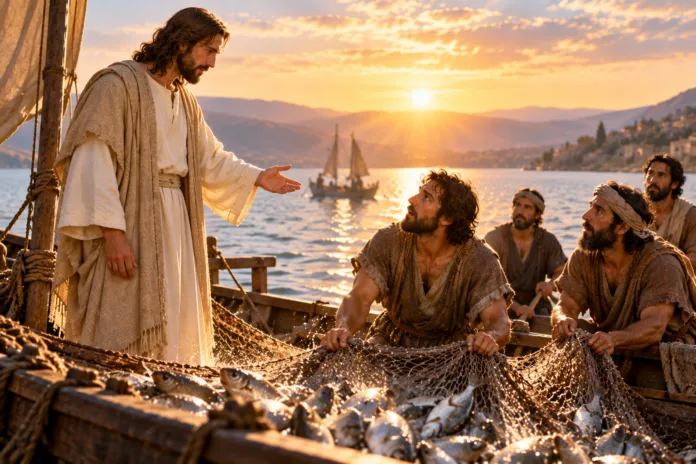
There are two stages of Peter’s faith in this Gospel passage. First, the stage of the faith of a devout Jewish fisherman, who discusses things, accepts some and may reject others, and in the end takes a small risk of faith if he is willing to, even if it goes beyond logic for a while. Here, at the start, Peter receives Jesus’ words as those of a Jewish teacher; he offers him his boat to use as a pulpit for preaching and listens to his words. Then Jesus asks him to fish in the deep, away from the shore, and in daytime rather than at night. He had caught nothing in the right place at the right time, so what chance now, in conditions unfavourable for fishing? Jesus asks him to let down the nets in conditions that go against logic. But Peter’s faith, after listening to Jesus’ words, had brought him to the conviction that this Jesus is a good teacher. On his word, then, he can build a certain hope and let down the net; and so came the first miraculous catch: the net filled until it was breaking.
In the second stage, after this “miraculous catch”, Peter’s faith becomes much stronger. We see him no longer listening to Jesus or thinking of him as a teacher, but falling down before him and calling him “Lord”. Before, Jesus was his teacher; now he has become his Lord. Before, he reasoned with him logically and took a risk of faith; now he is overcome with amazement and gratitude, feels unworthy and cries out: “Depart from me, for I am a sinful man, O Lord.”
The first kind of faith places religion among the data of reason and places Christ among the figures of teachers. The second kind of faith goes beyond reason into the realm of existence and being. The second faith does not know religion on one side and work on the other, one day for us and one day for our Lord, nor does it see religion as a science or a body of information. Faith here is not a mere bet on a hope that may or may not come true. It is the faith of the fisher of men, at a new, second level, built on knowing Jesus beyond the language of religions, so to speak: knowing Jesus as Lord and Master of life. Then the Christian’s trade becomes one and the same: as Saint Gregory of Nyssa says, to become a Christian, that is, another Christ, or an apostle and ambassador of Christ in the world, whatever his trade.
The faith of the “fisher of men” makes a person leave everything and follow Jesus, not because faith requires giving up work, far from it, but because the person finds the lost coin and the hidden treasure, and sells everything to buy it. Peter’s fishing gave way to Jesus’ call to make him a fisher of men, but from a new position and a new perspective, as an ambassador of Christ: he lives in his activities, but turns towards his true work. For him, Jesus is the Lord of his life and not just a guide or teacher: he is the one in whom we live and move.
What kind of faith do we have: rational faith in religions, or existential faith in Jesus as Lord, goal, way and life?
The first level is good when it is, as it is, a threshold to the second. Let us not look at Christianity as a teaching, new or old. Instead, let us drink from Christianity the new wine of the vine, where Jesus is the bread of life and we are his ambassadors, carrying him to the whole world, leaving everything in the midst of everything, and following him. Amen.
Fr. Gerard Abi Saab