The Life of Saint Ephrem the Syrian
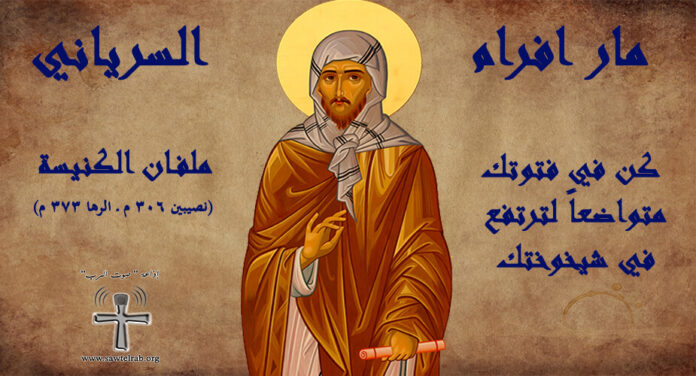
Saint Ephrem the Syrian,
called “Doctor of the Church” and “Harp of the Holy Spirit”
(Feast day: January 28)
Saint Ephrem was born around 306 in Nisibis, in Mesopotamia, to Christian parents who raised him in the fear of the Lord and told him how much his ancestors had suffered to keep the faith and the love of Christ.
He became a disciple of Saint Jacob, Bishop of Nisibis, who baptized him at the age of eighteen. The bishop loved him dearly and made him both his disciple and his secretary. He ordained him a deacon, clothed him in the monastic habit and, according to tradition, took him in 325 to the Council of Nicaea. On their return, Saint Jacob founded a school in Nisibis and entrusted its teaching to his disciple Ephrem. After Saint Jacob’s death, Ephrem took over the running of the school. There he composed his beautiful poems and moving hymns known as the Nisibene Hymns, which give a remarkable picture of life in that region at the time. In them he describes what his city suffered in sieges and wars: lying on the border between the Persian and Roman empires, it endured fierce wars, falling sometimes under Persian rule and sometimes under Roman. Ephrem lived through these tragedies, and his writings show the faith in God and trust in him that filled his great heart and the heart of every good citizen. He also praises the honourable stand of churchmen who encouraged their people in wartime to defend the city bravely, even at the cost of their lives.
Syriac was the official language of instruction at the school of Nisibis, for in the fourth century Nisibis was a thoroughly Syriac city in language and culture. In philosophy the school followed the method of the school of Antioch, which relied more on Aristotle than on Plato; its principles required simplicity of method, completeness of explanation and understanding in teaching the faith in every subject.
Outstanding scholars came out of this school, and no wonder, since its director and first teacher was Ephrem, the giant of Syriac literature, who from a young age spent his days and nights studying, immersed in reading Holy Scripture; he went deep into its learning and mastered the Syriac language.
Ephrem always lived austerely and fasted continually. Saint Gregory of Nyssa describes him this way: “He ate nothing but barley bread and dried vegetables and drank only water, until he looked like a skeleton, or rather a clay statue. As for his clothes, they were a worn-out garment, or rather rags.”
For him monastic life was not only mysticism, withdrawal from the world, fasting and prayer; it was also service to humanity and a way of preserving his people’s heritage. So he made the monasteries important centres of learning and knowledge, where sciences and letters flourished in his day. Following his example, his disciples, and after them most Syriac monks, devoted themselves to study, research and writing, and left us valuable literary works.
When Nisibis was handed over to the Persians in 363, Ephrem left it with a select group of the school’s teachers and students, and they came to Edessa. There Ephrem sometimes lived as a hermit in a cave on its holy mountain, and sometimes devoted himself to teaching in its famous school, founded at the dawn of Christianity. Ephrem and his companions renewed the school and it flourished under them, lasting until 489. Its students received lessons in the interpretation of both Testaments of the Bible, based on Ephrem’s commentary; he was the earliest Syriac commentator on the Bible. They also learned theology from him, to establish the truths of the faith and to refute the teachings of Tatian, Marcion, Bardaisan, Mani and Arius and their harmful heresies. His writings thus became the model of theological teaching in the Syriac Church.
It is said that Ephrem visited Abba Bishoy and other ascetics in Egypt, and later Saint Basil, Bishop of Caesarea in Cappadocia.
In Edessa, Ephrem formed the first choir of young Syriac women, teaching them the melodies he had composed or adapted, and the spiritual poems and moving hymns he had written, in which he set out the doctrines and the true faith. To Ephrem goes the credit for organizing the liturgical life of the Syriac Church and for founding church choirs.
When famine struck Edessa in the winter of 372-373 and many of its people died, Ephrem went round the houses of the rich urging them to works of mercy, collecting their alms and distributing them to the poor. He also set up houses with three hundred beds (some say thirteen hundred) as a refuge for the infirm, and he personally oversaw their care. The famine was followed by an epidemic, and Ephrem devoted himself to treating and comforting the sick until he caught the disease himself. He bore his severe pain patiently and gave up his pure soul on June 9, 373. According to his wishes, he was buried in the strangers’ cemetery outside Edessa, and a monastery known as the “Lower Monastery” was built over his tomb. His holy relics were later moved to the bishops’ burial place in the great church of Edessa, and it is said that in 1145 they were taken to Europe along with the relics of other saints. The Church, East and West, celebrates him.
In the last hours of his life, as he lay dying, he dictated his last testament in verse to his disciples, who immediately wrote it down. It was translated into Greek shortly after his death, and Saint Gregory of Nyssa quoted it five times. In this testament Ephrem confessed his faith, showed his attachment to Christian doctrine and urged his disciples to imitate him.
Because of their importance, Ephrem’s works were translated into Greek during his lifetime or in the decade after his death, and later into many languages, including Arabic, Latin, English, French, German and Italian.
Some of his sayings
The wise man hates no one; if he hates anyone, it is the fool. But the fool loves no one except his fellow fool.
Acquire gold in moderation, but knowledge without limit, for gold multiplies troubles, while knowledge brings rest and happiness.
Be humble in your youth, so that you may be raised up in your old age.
Wisdom is better than adornment, knowledge is better than riches, and a wise young man is better than an old and foolish king.
Envy is a sharp arrow that kills the one who shoots it.
Whoever owns pure gold does not fear its being tested in fire.
It is not many children that give life to parents.
If the Lord of creation wills it, one child is worth many.
What others said of Saint Ephrem
“Ephrem, God’s vine rich in fruit… The light of his life and learning has enlightened the world. Ephrem is known to all on whom the sun rises, and only someone who does not know Basil the Great, the shining star of the Church, could be ignorant of him.” — Saint Gregory of Nyssa
“Ephrem, harp of the Holy Spirit, treasury of virtues, comforter of the sorrowful, guide of the young, leader of those who have strayed; he was like a two-edged sword against the heretics.” — Saint John Chrysostom
“He is above all praise. He adorned the whole Church with the finest ornament and surpassed the Greek writers in the brilliance of his words, the originality of his thought and the soundness of his arguments.” — Sozomen, the Greek historian
“Ephrem, deacon of the Church of Edessa, wrote many works in the Syriac language, and became so famous and so revered that in some churches his writings are read publicly after the readings from Holy Scripture. I have read in Greek his book on the Holy Spirit, translated from Syriac, and recognized even in translation the height of his genius.” — Saint Jerome
“Mar Ephrem, the abundant spring whose waters watered the land of faith, the aged wine that took its qualities from the blood of Golgotha… the eagle standing among gentle doves… who, like Moses and his sister Miriam, taught virgins, young women and the whole assembly of the faithful skilful melodies through which he spread the teaching of the true Church, and by which he won the crown of victory over its enemies… the inspired poet whose heart surged like the vast sea with countless homilies and innumerable hymns… He is the mystical crown of our nation.” — Saint Jacob of Serugh