



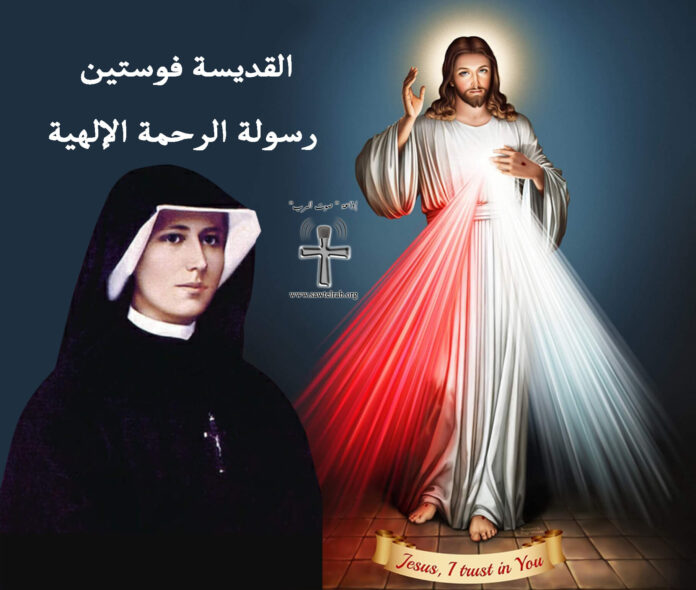
Saint Faustina, Apostle of Divine Mercy
(1905-1938)
Helena Kowalska was born in Poland into a humble family; she was the third of ten children.
The Virgin Mary was present in her life from childhood.
Sister Faustina tells of a dream she had at the age of five, in which she walked through paradise hand in hand with the Virgin Mary. But no one paid attention to this dream because she was so young.
She went to school for only two years, because her parents could not afford more, and then she helped them with the farm work and the animals.
At her First Communion she discovered the greatness of prayer, and she often said: “I think it is my guardian angel who wakes me during the night to pray.”
She spent a lot of time in the fields meditating and praying. One day she decided to enter the convent, but her parents strongly opposed it because they could not afford the dowry a religious congregation required. She was saddened,
and this refusal made her downcast; she tried to silence the voice calling her to consecrate her life to the Lord by turning to the vanities of life.
Helena tells what happened to her:
“One evening I was at a dance with one of my sisters. While everyone was enjoying themselves, I felt a great unrest inside me. As I began to dance, I suddenly saw Jesus beside me, suffering, stripped of his clothes and covered with wounds, and he said to me:
How long shall I put up with you, and how long will you keep putting me off?
At that moment the pleasant music stopped for me, the whole company vanished from my sight, and there remained only Jesus and I.”
Helena then slipped away from her friends and went to the Cathedral of Saint Stanislaus Kostka. Before the Blessed Sacrament she asked the Lord to show her his will, and suddenly she heard these words: “Go at once to Warsaw; there you will enter a convent.”
She left her parents’ home and said to the Virgin: “Mary, my Mother, guide my steps.”
At first she worked as a housemaid, until she knocked at the door of the Congregation of the Sisters of Our Lady of Mercy, where she later made her perpetual vows and took her new name, “Maria Faustina”.
In the convent she worked first as a cook, and then, because of her health, she moved between work in the convent garden and duty as porter at the entrance.
She always kept her calm, her cheerfulness and her simplicity; balanced and hard-working, she set an example for everyone
by her zeal and boundless devotion. Despite her frail health, her obedience, humility and charity were exemplary.
Jesus appeared to her for the first time in a radiant white garment and a brilliant light, and asked her to have what she saw painted, with the words written on the image: “Jesus, I trust in You.”
With the help of her confessor, Fr. Michael Sopoćko, she had the image painted by an artist as Jesus had asked,
and presented it to her superiors.
After that she began to make the Divine Mercy known to the world.
The fourteen years of her religious life were an unbroken dialogue with the Lord Jesus, and a long physical and spiritual martyrdom that she accepted and offered for the salvation of the world.
She contracted tuberculosis and was confined to bed in hospital; according to her Diary, she received Holy Communion every day from the hand of a seraph (an angel) who visited her for this purpose.
She entered the heavenly dwellings
on 5 October 1938, in the convent in Kraków, her eyes fixed on the image of Christ and the image of the Immaculate Conception,
at the age of Christ, thirty-three.
In her visions she had seen paradise and purgatory, and she had understood that holiness does not consist in apparitions or visions, but in practising the virtues together with devotion to the Divine Mercy. Among the most important virtues are true humility, purity of heart and love of God.
Jesus said to her: “Know, my daughter, that my Heart is mercy itself. From this sea of mercy graces flow out upon the whole world. No soul that has approached me has gone away without consolation. All misery is buried in the depths of my mercy, and every saving and sanctifying grace flows from this fountain.”
Her cause for beatification was opened in 1965-1966. The healing of an American woman, Maureen Digan, in March 1981 was investigated and recognized as a miracle in 1992.
In 1993 Pope John Paul II declared her Blessed, on the Feast of Divine Mercy, and on 30 April 2000 he canonized her.
Prepared by Rita of the Sawt el Rab team


 Helena Kowalska was born in Poland into a humble family; she was the third of ten children.)