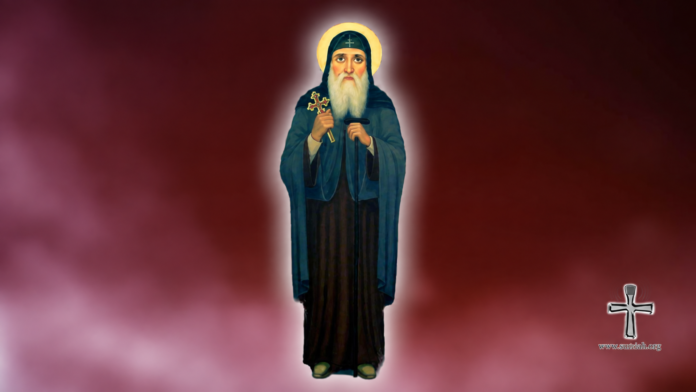
Thascius Caecilius Cyprianus was born between 200 and 210 AD into a noble pagan family. His father was one of the city’s most distinguished magistrates.
He received the high level of education expected in his time and social position, and gained a wide knowledge of the sciences, especially logic, philosophy and rhetoric. Some accounts say he married and had children.
As a young man he became an eloquent orator and a teacher of rhetoric, and his fame spread. Like most young men of his time, he lived immersed in vice. He was converted to Christianity through an elderly priest in Carthage named Caecilianus (Caecilius), around the year 246, and joined the ranks of the catechumens. As divine grace touched his heart, he was appalled by the corruption that had overtaken humanity at every level, individuals, communities and governments alike, and he embraced the Christian faith.
He was baptized by that priest, and out of love for him he was called “Caecilius Cyprianus”, adding the priest’s name to his own. His life changed radically, as he himself says:
“After I was baptized, the stains of my past life were washed away by the regenerating water, and a light from above poured into my repentant heart, scattering doubts, opening the windows and driving away the darkness.
What I had once thought difficult, I now found easy.
What I had thought impossible became a reality.
My former life appeared earthly to me, born of the flesh; now I was born of water and the Spirit. This is the work of God.”
After his baptism, Cyprian took four important steps in his life:
- He sold most of his property and gave the proceeds to the poor and needy.
- He vowed a life of chastity; according to some accounts, this was with his wife’s consent, and he entrusted her and their children to the elderly priest Caecilianus.
- He gave up worldly studies and devoted himself to the daily study of Holy Scripture, taking a keen interest in the writings of the great Tertullian. The saint said of himself that after his baptism he scorned human eloquence and despised ornate speech and the embellishment of words.
- He dedicated his gifts to the service of the Kingdom of God.
Soon afterwards he was ordained a priest, and around 248 he was chosen bishop of Carthage. Less than a year into his episcopate, a fierce storm of persecution broke out under the Emperor Decius, who in 250 issued an imperial edict aimed at wiping out Christianity. It was the first general persecution to sweep the whole Roman Empire. Many won the crown of martyrdom; some weakened and fell away; some fled; and others were counted as confessors. Some denied the faith and burned incense to the idols, while others obtained false certificates stating that they had sacrificed to the idols, so as to escape torture and death.
Saint Cyprian wrote that God had allowed this severe persecution because of the faithful’s slackness in worship: during the peaceful years under the Emperor Philip and his son, who had left the Christians in peace, the people had become absorbed in worldly gain, the clergy had grown lax in their holy calling, and women had come to love luxurious clothes and easy living. So God raised the rod of their enemies against them, to plunder them so that they might repent.
Cyprian then decided to go into hiding, not out of fear of death, but “so that his great boldness would not provoke the anger of the rulers”, for he feared that those weak in faith might collapse.
It seems he did this by divine instruction. He shepherded his people from his hiding place: as a good shepherd he sent letters to the faithful to support them and to urge them to love their persecutors. From his hiding place he wrote many letters to strengthen the confessors in the prisons and mines, to show the glory of martyrdom, and to charge the ministers and clergy to care for the confessors and martyrs materially, emotionally and spiritually. He also sent people out at night to take care of the martyrs’ bodies and bury them, and he looked after the spiritual, emotional and material needs of their families.
Some schismatics tried to attack the saint for fleeing, but, as his disciple says, he was advancing with swift steps toward the crown prepared for him, and his master had been preserved at that time “by the command of the Lord”.
The persecution lasted fifteen months, during the reign of Decius; after his death the Church had rest, and the saint returned to his see.
Saint Cyprian honoured the martyrs and gathered around him the confessors who had suffered for the faith. His letters show a blend of great joy over the martyrs and confessors, and over those who had fled so as not to deny the faith, together with bitter sorrow over those who had apostatized.
He called on the lapsed to do penance humbly, confessing their sins, for they had trampled the crown of martyrdom underfoot. He left the door of repentance open to all, but without laxity. He was careful to stress the motherhood of the Church, who gives birth to the faithful, raises them, corrects them and offers them her loving embrace.
In 251 the bishops of Africa held a council on this matter, known as the Council of Carthage, to examine the case of the lapsed who wished to return. The council dealt with the problem in all its aspects.
Some had openly abandoned the faith, while others had bribed pagan magistrates and obtained certificates stating that they had offered sacrifice to the gods. The saint made clear to them that such a certificate was a form of hypocrisy, and many regretted what they had done.
The strictness of the penitential rules kept some from returning to the Church, so some turned to the confessors imprisoned for the faith and asked for their intercession, so that the Church would pardon them, readmit them to communion and relax the rules for them; this gave rise to a certain laxity.
The council was strict with clergy who had denied the faith: they were readmitted among the laity but not restored to their priestly ministry. As for those who had obtained pagan certificates, the council received them back after laying down rules they had to observe.
The council excommunicated Felicissimus and his followers, required the lapsed to undergo penance, and allowed none of them to be readmitted to the Church unless they were at the point of death.
Barbarians invaded the province of Numidia and took many Christians captive. The saint then stirred the hearts of the faithful to ransom their captive brothers and sisters with their alms. He did in fact collect a great sum of money and freed the faithful from captivity.
Around 251 a plague broke out in Ethiopia, Egypt and Carthage, and it went on threatening the Empire for about twenty years. As his own disciple Pontius says, he was the Tobit of his time, caring for the sick and the dying without distinguishing between believer and unbeliever. He insisted to his people on the need to serve everyone without distinction and to give alms to all, and he urged them to be generous and self-giving so as to pass into heaven through the Church, the house of faith.
Despite how dangerous the disease was at that time, the Christians understood their mission as witnesses that they are children of God, and cared for the afflicted without fear of catching the disease and dying.
Persecution broke out again in 257, under Valerian. Cyprian was summoned before the Roman proconsul of Africa in accordance with the emperor’s decree. When asked whether he persisted in refusing to follow the religion of Rome, he answered that he was a Christian and a bishop, and that he worshipped only the one God, Creator of heaven and earth.
Aspasius Paternus, then proconsul at Carthage, did not dare to kill Saint Cyprian because of the great esteem in which the people held him, so he ordered him into exile.
The saint spent a year in exile, about fifty miles from Carthage, where he wrote much about martyrdom. When Paternus was removed from office and succeeded by Galerius Maximus, the saint returned to Carthage, longing for the crown of martyrdom in his own city among his own people, and God granted his wish.
Saint Cyprian is regarded as the second great Western theologian after Tertullian. Saint Jerome says of him in his book On Illustrious Men: “He was accustomed never to let a day pass without reading Tertullian.”
His deacon Pontius, who shared his life and accompanied him to the day of his martyrdom, recorded his life, writing it immediately after his martyrdom.
This martyred bishop is sometimes confused with the martyr Cyprian the former magician, mentioned in the life of the martyr Justina.
On the day of his arrest, everyone came to bid him farewell, while he stood calm and composed, filled with hope and faith. He heard the sentence of death by the sword in the governor’s court, and he repeated: “Thanks be to God; I thank God and bless Him.”
The crowds followed him to the place of martyrdom outside the city. There he took off his outer garment and handed it to his deacon, spoke a few words to comfort his people, then knelt in prayer. Seeing that the executioner was trembling, he had twenty-five gold pieces given to him to encourage him.
Some of his flock came forward and spread their clothes beneath him to catch his blood. Then he bound his own eyes with his hands, to surrender himself into the hands of his Saviour. It was 14 September 258, and he received the crown of martyrdom.
The faithful carried his body by night, with candles and prayers, in a triumphal procession to its final resting place.
A well-known spiritual text
(The following passage, often quoted with Saint Cyprian’s writings, is in fact from Saint Gregory of Nyssa’s treatise On Virginity.)
“The eyes of swine, always turned downward, cannot see the wonders of the sky. In the same way, the soul whose body drags it downward cannot lift its gaze to behold the beauty above.
It turns toward low, animal things. The soul that wants to fix its gaze on heavenly delights puts earthly things behind it and takes no part in what would entangle it in worldly life.
It transfers all its power of love from material things to the spiritual contemplation of immaterial beauty.
Virginity of the body serves such a soul. Virginity aims to create in the soul a complete forgetfulness of natural passions and to prevent it from constantly stooping down to satisfy bodily desires. Once the soul has been set free from such things, it does not risk becoming ignorant of and indifferent to the pure delights of heaven, and it abstains from the habits that seem, to some degree, to be allowed by the law of nature…
Purity of heart ruling over one’s life is the only thing that captivates the soul.”
From Saint Cyprian
“By death we reach the harbour of our heavenly homeland, eternal rest, and through it we receive immortality. This is our peace and tranquillity born of faith, our firm and everlasting rest.”
Prepared by Rita of the Sawt el Rab team