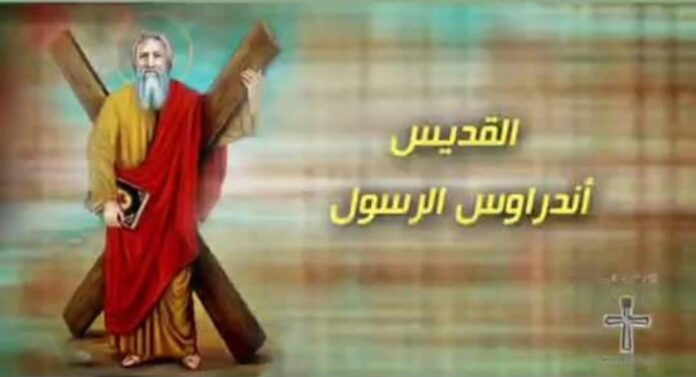
Saint Andrew
He was the brother of Saint Simon Peter and one of the twelve apostles.
What follows is his story according to the Coptic tradition (the Synaxarium). According to the more widely known tradition, Saint Andrew died by crucifixion at Patras in Greece.
He was chosen to go to the city of Lydda and to the land of the Kurds. He entered Lydda, most of whose people had already believed through Peter. With him was his disciple Philemon, who had a beautiful voice, and Andrew told him to go up to the lectern and read. When the pagan priests heard that the Apostle Andrew had arrived, they took their spears and came to the church, and stood there to hear whether he would blaspheme against their gods. They heard him reading the words of the prophet David: “Their idols are silver and gold, the work of men’s hands. They have mouths, but do not speak; eyes, but do not see. They have ears, but do not hear; noses, but do not smell. They have hands, but do not feel; feet, but do not walk; and they do not make a sound in their throat. Those who make them are like them; so are all who trust in them” (Psalm 115:4-8). Their hearts were delighted by the beauty of his voice and their feelings softened; they entered the church and fell at the feet of the Apostle Andrew. He taught them, and they believed in the Lord Christ, and he baptized them and all the idol worshippers who remained.
Then he came to the land of the Kurds and to the cities of Axis, Argenas and Asifos. Before that he had gone with Bartholomew to the city of Azarinos, whose people were wicked and did not know God. They kept preaching and teaching them until a great many came to know God because of the signs and wonders they worked before them. Those who did not believe plotted against him and sent messengers to summon him, so that when he came they could fall on him and kill him. But when the messengers reached him and heard his good teaching and saw the radiant joy of his face, they believed in the Lord Christ and did not go back to those who had sent them. Then the unbelievers decided to go and burn him. When they gathered around him to carry out their plan, the apostle prayed to the Lord, and they saw fire falling on them from heaven; they were afraid and believed.
The apostle’s fame spread throughout that land, and many believed in the Lord. Even so, the pagan priests did not stop pursuing Andrew. They came to him, tied him up and beat him severely, and after parading him naked around the city, they threw him into prison to crucify him the next day. It was their custom, when they put someone to death by crucifixion, to stone him as well. The apostle spent the night praying to God. The Lord Christ appeared to him, strengthened him and said to him: “Do not be troubled or weary, for your departure from this world is near.” He gave him peace and disappeared, and Andrew’s soul rejoiced at what he had seen. The next day they took him, crucified him on a wooden cross and stoned him until he died. Some of the faithful came and took his holy body and buried it. Many signs and wonders were worked through him.
His feast is November 30 each year.
Prepared by Rita, of the Sawt el Rab team