



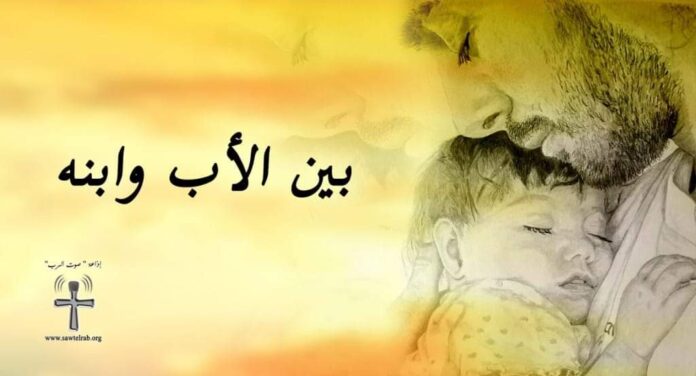
Between a father and his son
(Words I dedicate to fathers on their day, from my book “The God in the Basement”)
Your child has a world of his own. He has his needs, what makes him happy and what makes him sad, what makes him angry and what he likes. His world is different from yours. True upbringing means listening to your child and his needs, and paying attention to his world.
Many people say, “My child is different from me; I don’t know where he got this temperament!” Of course your child is different from you. You grew up in a time and place different from his. You have your mind and your logic, and your child has his. Your parents are not his parents. So listen to your child and respect his needs.
True upbringing does not happen by imposing, by commanding, by handing things down from above. Your son is not below you. He is like you, your equal in nature and dignity. The wonder of the Trinity for us Christians is that it is both order and equality at once. The Father is the source of everything, the first; from him the Son is begotten, yet he and the Son are one in dignity, nature and sovereignty. Light from light. True sonship for true fatherhood. No enslavement or subordination, but an order in love. “God is love,” and your dealings with your son should be modelled on him: love for love.
Do you want to win your son? Come down to him. Your son is different from you; lend him your ear, your heart, your very insides. Come down to him to raise him up to you, and not only to you, but to something higher than you. That is how Jesus acted. To win the sinner, he presented himself as a sinner, though there was no fault or sin in him. He stood in the line of people coming to the Jordan to receive from John the Baptist “a baptism of repentance for the forgiveness of sins” (Mark 1:4). He became one of the people, just as he had done thirty years earlier when he became flesh among sinners. He lined up among them, but without “confessing his sins” as the others did. There among the people he heard their groaning, listened to their pain and their joy, understood how they get drawn into sin and why they long for repentance… So should you: make time for your child, listen to his stories even if they are worn out and don’t interest you. Listen to his nonsense and his adventures, his exploits with his friends that may seem worthless to you… Ask him about his studies, and let him tell you his new theories, even if it seems he looks down on you. Let his pride show; it is part of your own pride.
And after you have listened, smile. Show him the glow in your eyes, the joy, your tear if it falls. Don’t give in straight away to the temptation of handing out advice, of playing the big man, the one who knows, the one in control. That is a temptation! God doesn’t treat you like that. God listens, and very often he is content… with a smile. A smile that holds everything, worth more than words, more than a thousand pieces of advice. Your child needs only the ears of your heart, nothing more. Your listening may be the best medicine for his pain.
And if he asks your opinion or advice, give it. His ground will then be ready to receive your planting, fertile for your seeds, thirsty for your voice. Who said that children reject authority and refuse to obey? Whoever claimed that is wrong. Jesus obeyed his Father and delighted in obedience. He said it clearly: “My food is to do the will of him who sent me” (John 4:34). Elsewhere he said, “I have come down from heaven not to do my own will but the will of him who sent me” (John 6:38). And he also said, “I have kept my Father’s commandments and abide in his love” (John 15:10).
If your authority over your son is exercised in love, it falls on him more gently than the morning dew. Don’t forget that all authority comes from above, from God on high. Love does not cancel authority; it supports it. And authority does not contradict love; it keeps it from sliding into permissiveness. Authority without love is tyranny, and love without authority is permissiveness.
The Gospel has a powerful lesson on how to be a father: a father had two sons. The younger wanted to inherit from his father while the father was still alive, and leave. The father let him go without objecting. Why did he agree? Why didn’t he object or stop him from leaving? Because he respected his son’s freedom and did not immediately give in to the pleasure of exercising authority and the urge to give advice. He let his son express himself, even though he knew his son was on the road to ruin. He let him travel and began waiting for his return. He went on being a father in a different way: in waiting, in painful silence, in consuming longing. Why such a hard choice? Because he knows his son; he knows there is a spark of himself in his son, something of his fatherhood. Before the son leaves, the text says, “He divided his property between them.” What he divided was not his money but his “life” (bios), according to the original Greek text. When a father gives, he passes on life to his son, a piece of his heart, a part of his very being. This inheritance, if it doesn’t ripen right away, here and now, is bound to bear fruit one day. Remember: raising children tests your patience; it is a long Calvary.
In Arabic there is a difference between “walad” (child) and “ibn” (son). The child is the one you beget in the flesh; the son is the one who comes from your fatherhood. There is something higher in sonship than in begetting. Raise your child so that he becomes your son, after the example of the first “Son,” Jesus Christ. And as for you, train yourself to become a father, not just a parent.
Bishop Milad Jawish




 Your child has a world of his own.)