



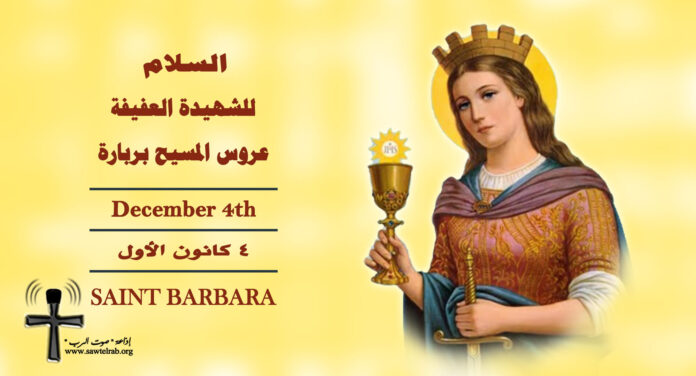
Saint Barbara, Great Martyr
(Feast day: December 4)
Saint Barbara became extremely well known in both East and West. She suffered much for her faith, and it was because of her steadfastness that Saint Juliana came to believe in Christ and also went to martyrdom. Barbara was born in a village belonging to the city of Heliopolis, identified today with Baalbek, early in the third century, in the reign of the Emperor Maximinus, who came to the throne in 235. Her father, Dioscorus, was fiercely attached to paganism and hated Christians. As Barbara grew up, her father feared the corruption of the age for her because of her great beauty, so he shut her in a palace guarded by soldiers, filled it with idols and provided every kind of entertainment.
Barbara received the finest education and loved contemplation. She used to lift her eyes to the sky to contemplate the sun, the moon and the stars, speaking with the Creator who made the earth and everything on it for humanity. Some of her Christian servants told her about the scholar Origen, and she longed to meet him. When he visited the region she did meet him, and he spoke to her about the Gospel. Her heart was won by Christ, and she received baptism without telling her father. Her heart burned with love for God; she vowed her life to him and wanted to live as a virgin devoted to prayer. Many suitors asked for her hand, among them a rich young man, son of one of the region’s princes. Her father raised the matter with her, thinking the happy news would delight her, but she wisely declined to marry.
Since her father had to travel on business, he put the matter off until his return, hoping she would have settled her mind by then. She asked him to build her a bathhouse before he left. He agreed, and had two windows put in to let in more light. But she turned the bathhouse into a house of prayer, worshipping God with unceasing prayers, vigils and fasts. She smashed all the idols, set up a cross on the bathhouse and at the top of the palace, and had a third window opened. As her doxology says: “The light of the Holy Trinity shone on this holy virgin Barbara, bride of Christ.”
When her father returned, he noticed this obvious change and asked her the reason. She began to preach to him the faith in the Trinity: how we must believe in one God in three Persons. He flew into a rage and rebuked her harshly, but she paid no attention and spoke to him frankly and clearly about her faith and her virginity. The father, beside himself, pounced on her, seized her by the hair and was about to strike her with his sword. She fled from him and ran out through the palace gate, with her father running after her. It is said that a rock blocked her path, but it split open at once to let her through, and then closed again. Her father saw this, but his heart of stone was not softened; he went around the rock until he found her hiding in a cave. He fell on her like a wolf on a lamb, beat her savagely and dragged her home. There he locked her in a dark cellar as if in a prison.
Dioscorus told the governor what had happened and asked him to torture her. But when the governor Marcian saw her, he was deeply moved. He rebuked her father for his harshness, spoke kindly to her and promised her many honours if she obeyed the emperor’s order and worshipped the idols. She courageously spoke to him about her faith in Christ. Saint Barbara was flogged until she bled, and they tore her body with sharp awls while she prayed in silence. They put a rough sackcloth on her wounded body and threw her into a dark prison. As she felt the weight of her suffering, Christ himself appeared to her, comforted her and healed her wounds, and her soul rejoiced and was glad.
The next day the governor summoned her and was astonished to find her joyful and radiant, with no trace of wounds on her body. He grew even more violent and ordered the executioners to torture her: they raked her body with iron combs, held burning torches to her sides and cut off her breasts. Then the governor basely ordered that she be led naked through the streets. She cried out to the Lord to cover her body and protect her modesty, and the Lord heard her and clothed her in a garment of light.
Juliana saw her enduring the pain in the midst of her torments and began to weep bitterly. When the governor noticed her, he ordered her to be tortured with Saint Barbara and thrown into prison, and the two of them praised God all night long. The governor Marcian ordered them beheaded. They were taken to the mountain outside the city, praying on the way. When they reached the place of their martyrdom, Dioscorus asked to strike off his daughter’s head with his own sword, and he was allowed to do so. Together with Saint Juliana, she received the crown of martyrdom. Saint Barbara’s body is now in a church bearing her name in Old Cairo.


 Saint Barbara became extremely well known in both East and West. She suffered much for her faith, and it was because of her…)