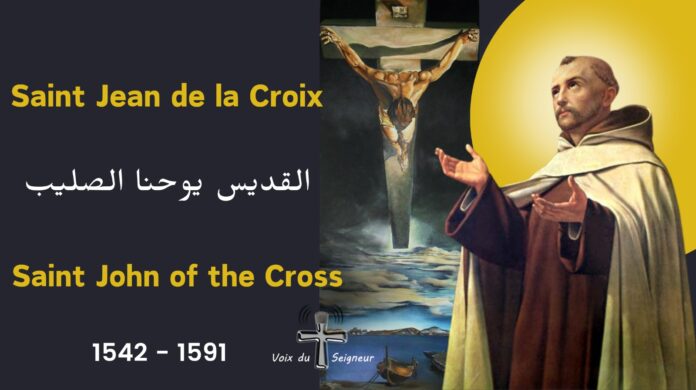
Feast: 14 December.
A spiritual master for Saint Thérèse of the Child Jesus and Pope John Paul II, he is a Doctor of the universal Church. His writings help us to know the way of union with God.
His life:
Juan de Yepes was born in 1542 (on 24 June, according to tradition) in Fontiveros, near Ávila.
When he was two, his father died after an illness that had kept him bedridden for two years. He moved with his mother and brothers to Arévalo and then to Medina del Campo in search of a living, and there he worked as a nurse in a hospital. He took his humanities studies at the Jesuit college in Medina
from 1559 to 1563. In 1563 he entered the Carmelite friary in Medina and began his novitiate under the name John of Saint Matthias. He studied philosophy and theology at the University of Salamanca, was ordained a priest in 1567 and celebrated his first Mass in Medina. There, that same year, he met Mother Teresa of Ávila, the reformer of Carmel, who won him over to the cause of reforming the Carmelite friars.
When he finished his studies in Salamanca, he returned to Medina. On 9 August 1568 he accompanied Mother Teresa of Ávila to found the convent in Valladolid, where he stayed until the end of September; then he went to Duruelo to prepare the friars’ house.
In November he founded the friary at Duruelo, the beginning of the Carmelite reform for men. He then took the name John of the Cross (Juan de la Cruz). He served as novice master from 1568 to 1571. On 25 January 1571 he was present with Saint Teresa of Ávila at the founding of the convent of Alba de Tormes, and in April of that year he was appointed rector of the theological college of Alcalá, the first college of the reform. In 1572 Teresa called him to the Convent of the Incarnation, whose nuns still followed the old observance. On the night of 2-3 December 1577 Father John was kidnapped and taken to Toledo by the Carmelites of the old observance, where he was imprisoned for nine months as a rebel; it was in prison that he wrote his great poems.
In August 1578 John escaped from his prison and attended the chapter of Almodóvar. In October he was appointed prior of the friary of El Calvario near Jaén. On 14 June 1579 he founded the college at Baeza and became its rector; he was then made third definitor of the reformed province. In November he visited Saint Teresa in Ávila to prepare with her the foundation in Granada.
In 1582 he opened the convent of Granada with Mother Anne of Jesus (Blessed). That same year he was appointed prior of the friars’ house in Granada, and in May he was elected prior of Granada again. He attended the chapter of Pastrana and was elected vicar provincial of Andalusia. In 1584 he wrote the commentary on the Spiritual Canticle (first redaction); in 1585, the Ascent of Mount Carmel, the Dark Night and the Living Flame (first redaction).
In 1586 he founded the friary in Córdoba;
on 12 October, the friary of La Peñuela (Jaén);
on 18 December, the friary of Caravaca (Murcia).
He was elected prior of Granada for the third time in 1587.
He attended the first general chapter in Madrid in 1588 and was elected first definitor, councillor of the Consulta
and prior of Segovia.
He attended the second general chapter in 1590,
and the third general chapter in 1591, where he was stripped of all his offices for opposing the conduct of the vicar general, Fr. Nicolás Doria.
Ill, he was moved to the friary of Úbeda, where he died at midnight on 14 December 1591, surrounded by his brother friars.
In May 1593 his body was moved to Segovia, as he had foretold.
The first edition of his writings, without the Spiritual Canticle, appeared in 1618;
in 1622 his Spiritual Canticle was published for the first time in Paris, in French translation;
the first edition of the Spiritual Canticle in Castilian Spanish appeared in 1627.
On 25 January 1675 Pope Clement X beatified him. Pope Benedict XIII canonized him in 1726, and his feast began to be celebrated on 24 November 1732. Pope Pius XI proclaimed him “Doctor of the universal Church” in 1926; he was declared patron of Spanish poets in 1952, and with the calendar reform of 1969 his feast was moved to the day of his death, 14 December.
Among his most important sayings:
– O people, O Christians: you were created for God. Why then do you amuse yourselves with base things and possessions? (after the Spiritual Canticle 39).
- Only love of the Cross leads to the throne of God; and in the evening of life, we will be judged on love.
- Where there is no love, put love, and you will draw out love.
Prayer:
Blessed are you, great Saint John of the Cross, in whom the life of Christ was reproduced, so that your life became like his holy life in its sorrows, sufferings and persecution. But you triumphed and reached the goal. Rejoice now in your endless happiness, and remember us in your prayers and supplications, so that one day we may obtain what you have obtained in the Kingdom of your Lord. Amen.
Prepared by Rita of the Sawt el Rab team