In the early centuries, Christians counted their devotions, their prayers, prostrations and mortifications, in one of two ways:
1. Either they put a number of seeds or small pebbles in one pocket and moved them one by one to the other pocket;
2. Or they held a cord with a set number of knots and moved their thumb from one knot to the next. Also, when monasteries and religious orders were founded from the fourth century onward, the monks prayed the Office in common; this Office included chanting the Psalms, of which there are one hundred and fifty as we know, along with prayers such as the Our Father.
Tradition says that the monks who could not read, and who were entrusted with working the land, were excused from chanting the Psalms and prayed the Lord’s Prayer instead.
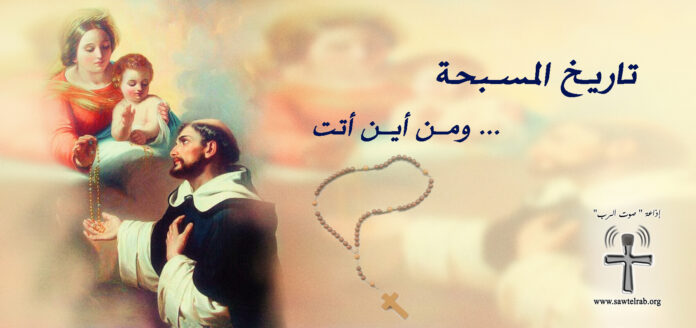
At the beginning of the thirteenth century the Church knew a holy priest from Spain, Saint Dominic, founder of the Dominicans, famous for his learning and eloquence, and still more for his holiness and especially his devotion to the Virgin Mary. In his devotion to her he used the cord we mentioned. At that time the Albigensians in southern France had gone down the path of heresy, and missionaries and preachers had failed to bring them back to the faith. The Church finally sent Father Dominic to convert them. According to Dominican tradition, the Virgin Mary appeared to their founder around 1213 with a rosary in her hand and said to him: “You will not succeed by skilful speech, but by this rosary in your hand. I am with you, and when you have converted them, teach them to pray it…” And so it happened.
In 1216 Father Dominic founded his Order. Later, in the fifteenth century, the Dominican Alan de la Roche was the first to think that the rosary prayer in its early form was a dry prayer, and that there was wide scope for meditating on the deep mysteries that join the life of the Virgin Mary and the life of her Son Jesus. So it was through this friar that the Rosary was organized as it has come down to us. He called it the “Rosary” because it is like a bouquet of roses that we offer to the Virgin. It was arranged as follows:
- Since the life of Jesus Christ and the life of his mother the Virgin Mary, who shared with him in the mysteries of the Incarnation and the Redemption, passed through three stages, joy, sorrow and glory, the Rosary was divided into three parts, each made up of five “decades” or “mysteries”, and each decade consists of ten beads.
The first part is called the “Joyful Mysteries”: the angel’s Annunciation to the Virgin, the Virgin’s Visitation to her kinswoman Elizabeth, the Nativity of Jesus in Bethlehem, his Presentation in the Temple, and his Finding in the Temple. The second part is called the “Sorrowful Mysteries”: Jesus’ Agony in the Garden, the Scourging at the Pillar, the Crowning with Thorns, the Carrying of the Cross, and his Death on the Cross.
The third part is called the “Glorious Mysteries”: the Resurrection of Jesus, his Ascension into heaven, the Descent of the Holy Spirit, the Assumption of the Virgin into heaven, and her Coronation by the Holy Trinity as Queen of heaven and earth. Between one decade and the next is a single large bead for the “Glory Be” and the “Lord’s Prayer”, which the Lord Christ taught the apostles in the Gospel (Matthew 6:9-13).
To this rosary were added:
– the cross, because a Christian begins every action, especially prayer, with the sign of the cross;
- a single large bead for praying the Creed (“I believe in God”);
three beads for three “Hail Marys”, meditating on the three titles that belong to the Virgin Mary alone: “Daughter of the Father, Mother of the Son and Spouse of the Holy Spirit”.
And finally the three-cornered centrepiece that joins the rosary, recalling the one the Virgin Mary held when she appeared to Saint Dominic.
Since it was difficult for the faithful to pray the whole Rosary, that is, fifteen decades, every day, the Church later saw fit to settle for praying a third of it, that is, five decades. Traditionally Monday and Thursday were given to the Joyful Mysteries, Tuesday and Friday to the Sorrowful Mysteries, and Wednesday and Saturday to the Glorious Mysteries, with Sunday given to the Joyful Mysteries from Advent to the start of Lent, the Sorrowful Mysteries throughout Lent, and the Glorious Mysteries from Easter to Advent.
In October 2002, Pope Saint John Paul II proclaimed the “Year of the Rosary”, which lasted from October 2002 to October 2003, and he added to the Rosary the “Luminous Mysteries”, which direct our meditation to some events of Jesus’ public life that carry deep meaning: the Baptism, the Wedding at Cana, the Proclamation of the Kingdom of God and the call to conversion, the Transfiguration and the Institution of the Eucharist. Since then the usual arrangement has been: the Joyful Mysteries on Monday and Saturday, the Sorrowful Mysteries on Tuesday and Friday, the Glorious Mysteries on Wednesday and Sunday, and the Luminous Mysteries on Thursday.
The Virgin’s Care to Spread the Rosary
If we stop at this history, the Rosary seems to be a human creation. But if we follow the Virgin Mary’s direct interventions in her wonderful apparitions, it becomes clear that the rosary is a very precious gift from the Virgin herself, and a treasure with heavenly power for all who carry it in their pocket, hang it around their neck or put it under their pillow, and pray it faithfully and devoutly. Besides her apparition to Saint Dominic, as we have seen, the Virgin Mary has appeared on earth many times. She would mention the rosary and encourage the faithful to pray it every day. In some of her apparitions she even appeared holding a rosary in her hand. For example:
1. In 1535, according to tradition, she appeared to Saint Angela Merici, foundress of the Ursulines, a congregation devoted to educating the young and serving the sick and the elderly. Among other things she told her: “Get the children used to praying the rosary. Put the rosary under the pillow of a sick person, and he will repent and die a good death…”
2. In 1830 she appeared in Paris to Sister Catherine Labouré, asked her about her rosary, and urged her to pray it every day with the sisters.
3. In 1858 she appeared in the grotto at Lourdes to Saint Bernadette Soubirous, holding in her joined hands a rosary that hung down to her feet, and she asked her always to pray the rosary and to pray it with the crowds at the grotto. As the saint prayed the rosary in the Virgin’s sight, the heavenly visitor made the sign of the cross with her, murmured the “Our Father” with her, and smiled at her at every “Hail Mary”.
4. In 1874 she appeared to Mother Marie-Alphonsine, foundress of the Congregation of the Rosary Sisters of Jerusalem, with a cross on her breast from which hung a large rosary that passed through her outstretched hands and fell to the hem of her gown, and she said to her: “The Rosary is your treasure; rely on my mercy and trust in divine generosity, and I will help you. I want the perpetual Rosary to be prayed in the convent by the sisters and the girls.” Then she threw the rosary from her hand to her and vanished.
5. In 1917 she appeared at Fatima, Portugal, to three shepherd children, with a rosary hanging from her hands down to her feet. She asked the little shepherds where their rosaries were, and they answered, “At home.” She said: “No, you must not leave the rosary at home; you must carry it with you as a precious treasure. And why not pray it here in the field?”
The rosary has wonderful effects on the souls of those who pray it with fervour and faith, whether they are priests, monks or nuns, young men or young women, great leaders or famous preachers.
Let us recall here a great event in history: the victory of the European states over the Turks at the Battle of Lepanto on 7 October 1571, under Pope Pius V. According to tradition, the faithful had gathered in Saint Peter’s Square weeping and lamenting, afraid their armies would be defeated. The Pope asked them to pray the Rosary; then he went into his room, knelt before the crucifix and prayed the Rosary and the Litany of the Virgin; then he came back out onto the balcony and cried out to the crowd: “I announce to you the end of the war and the victory of Christendom.” Pope Pius V is often credited with adding “Help of Christians” to the Litany after this victory. The holy Pope died the following year, and his successor, Gregory XIII, fixed 7 October as the Feast of the Rosary. Much later, in 1883, Pope Leo XIII added “Queen of the Most Holy Rosary” to the Litany.
A little over a century after that battle, the Turks attacked again, this time invading central Europe by land, and besieged Vienna for about two months. John Sobieski, King of Poland, led the Christian relief army. It is said that before the battle he turned to the Virgin, rosary in hand, to beg her help, while the Christians besieged in the city prayed the Rosary. On 12 September 1683 the Ottoman army was defeated, the siege was lifted and the war came to an end. In thanksgiving, Pope Innocent XI extended the Feast of the Holy Name of Mary (12 September) to the whole Church. Later, Pope Leo XIII dedicated the whole month of October to the Rosary (1883).
If we look at the teaching of the popes who have succeeded one another on the Apostolic See and led the Church of Christ, we do not know of a single one who failed to mention the Rosary or neglected to pray it, keep it, recommend it and honour it. Among them we recall the late Pope Saint John Paul II, who never let the rosary out of his hand wherever he went.
Prepared by Rita of the Sawt el Rab team