The Life of Saint Cyril of Jerusalem
Saint Cyril was born in Jerusalem around 315 to devout parents of sound faith, who passed that faith on to him from the cradle.
He only left his home to pray with the faithful, devoting his days and nights to solitude with Christ. He came to know the life of vigils and the struggle of prayer, together with reading and meditation, in order to learn heavenly wisdom.
Bishop Macarius of Jerusalem ordained him a deacon.
After the death of Macarius, Maximus the Confessor succeeded him as Bishop of Jerusalem. He loved Cyril dearly and trusted him, ordained him a priest around 343 and entrusted him with the instruction of catechumens.
At the end of 350 Cyril was consecrated Bishop of Jerusalem, with the support of Acacius, Bishop of Caesarea in Palestine, and Patrophilus, who had Arian leanings and disliked Bishop Maximus.
His time as bishop began with a joyful event. On May 7, 351, at about nine in the morning on a clear, sunny day, a shining cross appeared in the sky, brighter than the sun. It hung over Golgotha and stretched as far as the Mount of Olives. It remained for many hours, so that all the people of Jerusalem saw it: citizens and strangers, Christians, Jews and pagans, old and young. Everyone flocked to the church, praising and glorifying God, and many were convinced of the truth of the Christian religion. The whole city was shaken by the sight. Bishop Cyril hastened to write a letter to the emperor describing what had happened; his letter suggests that it took place at the beginning of his episcopate.
A famine struck Jerusalem and the surrounding regions. The poor crowded into the bishop’s house, starving, looking to their bishop, who was full of love. Since the shepherd lived an ascetic life and owned nothing, he had no choice but to sell some of the church’s vessels and give the proceeds to his poor children.
A conflict broke out between Cyril and Acacius, perhaps because Acacius wanted Cyril to submit to his Arian views, which led Cyril to oppose him openly, refuting and condemning the Arian positions.
Since the Emperor Constantius favoured the Arians, Acacius quickly called a synod at which he accused Cyril of squandering Church funds. To strengthen his case, he added a theological charge, claiming that Cyril confused the three divine Persons. On this basis Cyril was deposed and exiled.
Cyril was not discouraged, and appealed to a synod to clear him of the charges. But Acacius, who was close to the emperor, arrived with a band of soldiers; they drove Cyril out and installed an Arian bishop in his place.
Cyril was exiled to Antioch and then to Tarsus, where Bishop Silvanus welcomed him as a colleague and shared his episcopal duties with him. Unfortunately, this bishop belonged to the Homoiousian party, which exposed Cyril to criticism.
Acacius quickly warned Silvanus not to let Cyril share in his ministry, but Silvanus paid no attention because of his affection for Cyril; besides, the people had grown fond of the new bishop and become attached to him.
In 359 a council met at Seleucia in Isauria. When the question of Cyril’s exile was raised, a split occurred; some tried to persuade him to withdraw, but thanks to the Homoiousians he stayed, and Acacius withdrew instead. By withdrawing, Acacius and his followers were able to meet leading men of Constantinople connected with the imperial palace, and through them they reached the emperor and stirred up his anger against the Council of Seleucia. They presented Acacius’ complaint against Cyril, which boiled down to accusing him of selling to a dancer the sacred gold-woven robe that Constantine had given to Bishop Macarius of Jerusalem in honour of the Church of Jerusalem, to be worn when celebrating Holy Baptism, and which was then said to have been used in the theatres.
This accusation was offered to the emperor as a sample to turn him against all the members of the council.
The courtiers persuaded the emperor not to summon the whole council, but only ten of its leaders, among them Eustathius of Armenia, Basil of Galatia, Silvanus of Tarsus and Eleusius.
In 360 a synod met in Constantinople, where Cyril was accused and condemned for his communion with Eustathius of Armenia, Basil of Ancyra and George of Laodicea. These three did not share the same position or the same background; what they had in common was that Acacius, himself an Arian, hated them for personal reasons, especially after they had welcomed Cyril, his enemy.
The synod ended by sentencing Cyril to exile for the second time.
Cyril did not remain in exile for more than two years, for on November 3, 361, Constantius died while preparing to fight his cousin Julian. Once Julian came to power, he ordered all exiled bishops to return to their sees. The historian Sozomen says that this was not out of pity or love for them, but because he enjoyed seeing the Church divided and fighting within itself.
In 363 Julian the Apostate drew close to the Jews and allowed them to rebuild the Temple in Jerusalem, not out of love for them but to provoke and anger the Christians.
Three wonders then took place:
1. A very violent earthquake struck during the night, terrifying the Jewish workers.
2. Fire broke out and burned the building materials; it lasted from morning until evening.
3. The following night, shining crosses appeared imprinted on their clothes, and they tried in vain to get rid of them. Even so, their darkened hearts could not believe.
As for Julian, he was killed that same year, 363, in his war against the Persians, saying, according to tradition: “You have conquered, O Galilean!” It was the very year in which he had tried to rebuild the Jewish Temple.
Julian was succeeded by Jovian, a man of sound faith, under whom the Church enjoyed peace, but he reigned only a few months and died in February 364. He was succeeded in March by Valentinian, who was orthodox, and who handed the eastern provinces to his brother Valens, a supporter of Arianism. In 366 Acacius died, and a dispute broke out between Cyril and the Arians over his successor. It ended with Cyril being exiled for the third time, with the support of the Arian emperor.
Cyril remained in exile for eleven years, then returned to his see to find his Church suffering and wounded by the Arians and the followers of Apollinaris.
In any case, the shepherd returned to his flock, visiting it and caring for its needs, and he took part in the Council of Constantinople held in 381 at the order of the Emperor Theodosius.
Saint Cyril fell asleep in the Lord in 386, after some thirty-five years as Bishop of Jerusalem.
His main works
His catecheses for those preparing for baptism.
His mystagogical catecheses on the sacraments for the newly baptized.
A homily on the paralytic at the pool of Bethesda.
Excerpts from homilies on the miracle of the water changed into wine.
A discourse on the Presentation of Christ in the Temple and his meeting with Simeon.
A letter to the Emperor Constantius on the miraculous appearance of a huge cross of light:
“It was not seen by one or two people only, but the whole crowd of the city saw it very clearly, not for a few moments but for several hours, and its light outshone the sun. Suddenly the crowds rushed to the church in fear mingled with joy, praising our Lord Jesus Christ.”
One of his sayings
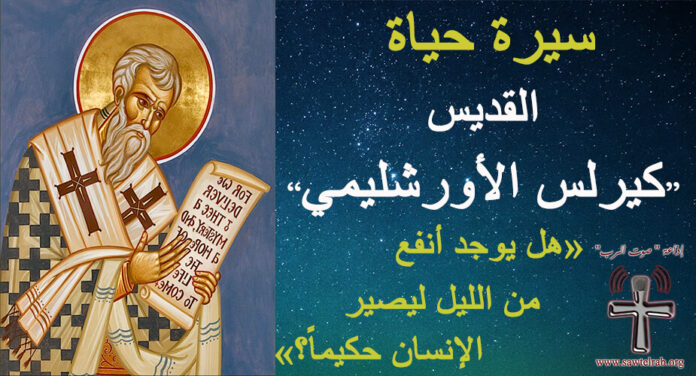
“Is there anything more useful than the night for a person to grow wise?”