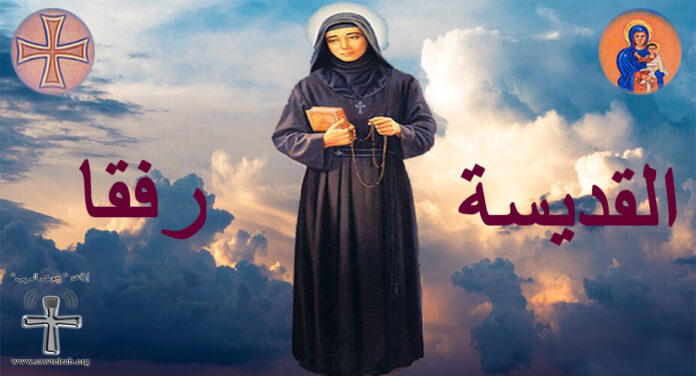
Saint Rafqa
Feast: 23 March
A brief account of the life of Saint Rafqa:
Saint Rafqa was born in Himlaya, a village in the Northern Metn near Bikfaya, on 29 June 1832, the feast of Saints Peter and Paul. She was the only child of her parents, Mourad Saber al-Shabaq al-Rayes and Rafqa Gemayel.
She was baptized on 7 July 1832 and given the name Boutrossiyeh.
Her parents raised her in the love of God and faithfulness to prayer. Her mother, whom she loved dearly, died in 1839, when Rafqa was only seven.
Her father fell into hardship and poverty, and in 1843 he sent her to Damascus to work as a servant in the house of Assaad al-Badawi, a man of Lebanese origin, for four years.
Rafqa returned to her father’s house in 1847 and was saddened to find that her father had remarried in her absence.
Rafqa was beautiful, pleasant company, light-hearted, sweet-voiced, pious and gentle. Her maternal aunt wanted her to marry her son, and her stepmother wanted her to marry her own brother, which led to a quarrel between the two women.
Saddened by this conflict, Rafqa chose to embrace religious life. She asked God to help her fulfil her desire and went to the convent of Our Lady of Deliverance in Bikfaya to become a religious in the Mariamettes congregation, founded by Father Joseph Gemayel. As she entered the convent church she felt indescribable joy.
She looked at the icon of Our Lady of Deliverance and heard the voice calling her to consecrate herself to God: “You will become a nun.” The superior accepted her without questioning her.
So she entered the convent, and afterwards refused to go home when her father and stepmother came to talk her out of it. After her postulancy, Rafqa received the novice’s habit on 19 March 1861, the feast of Saint Joseph, and on the same feast in 1862 she made her temporary vows. The newly professed sister went to the seminary at Ghazir, where she was put in charge of the kitchen. Among the seminarians were the future Patriarch Elias Hoayek and the future Bishop Boutros al-Zoghbi.
She used her free time to learn Arabic, handwriting and arithmetic. Around 1860 Rafqa was sent to Deir el-Qamar to teach catechism to girls. During the bloody events that swept Lebanon at that time, Rafqa saw many people martyred before her eyes; showing strength and courage, she took pity on a little boy, hid him under her cloak and saved him from certain death. She spent about a year in Deir el-Qamar and then returned to Ghazir.
In 1863, at her superiors’ command, Rafqa went to her congregation’s school in Byblos, where she stayed for a year teaching girls and forming them in the principles of the faith.
At the beginning of 1864 she was moved from the Byblos school to the village of Maad, at the request of the great benefactor Antoun Issa. She stayed there for seven years,
during which she founded a school for girls with the help of another sister.
While she was in Maad, following a crisis that struck the Mariamettes around 1871, Rafqa went into the church of Saint George and asked the Lord Jesus to help her make a decision, and she heard a voice calling her: “You will become a nun.” Rafqa prayed, and in a dream Saint George, Saint Simeon the Stylite and Saint Anthony the Great, father of monks, appeared to her, and Saint Anthony said to her: “Become a nun in the Lebanese Maronite Order.” Mr Antoun Issa made it easy for her to move from Maad to the monastery of Saint Simeon al-Qarn in Aitou.
She was accepted at once, received the novice’s habit on 12 July 1871 and made her solemn vows on 25 August 1872, taking the name Sister Rafqa after her mother. Rafqa spent twenty-six years at the monastery of Saint Simeon al-Qarn in Aitou, and she was a living example to her sisters in keeping the rule, in prayer, austerity, sacrifice and silent work.
On the first Sunday of October 1885, Rafqa went into the monastery church and began to pray, asking the Lord Jesus to let her share in his saving sufferings. Her prayer was answered at once: painful aches began in her head and then spread to her eyes. Every attempt to treat her failed. It was then decided to send her to Beirut for treatment. On the way she stopped at the residence of Saint John Mark in Byblos, where she was seen by an American doctor, who ordered an immediate operation on her right eye. She refused anaesthesia to ease the pain, and during the operation the doctor mistakenly removed her whole eye. She said: “In union with the sufferings of Christ. Bless your hands; may God reward you.” Then the disease moved to her left eye, and the doctors judged that treatment would do no good. The bitter pain in her eyes stayed with her for more than twelve years, while she remained patient, silent, prayerful and joyful, repeating: “In union with the sufferings of Christ.”
When the Lebanese Maronite Order decided in 1897 to found the monastery of Saint Joseph al-Dahr in Jrabta, in the Batroun region, six nuns were moved from the monastery of Saint Simeon to the new monastery under Mother Ursula Doumit of Maad.
Rafqa was among them, because the nuns insisted she come with them, so much did they love her and hope that their new monastery would flourish through her prayers.
In 1899 the light went out for good in her left eye; she became blind, and a new stage of her sufferings began.
Rafqa lived the last stage of her life blind and paralysed: total blindness, sharp pain in her side, and weakness throughout her body, except for her face, which stayed bright and radiant to her last breath. Her right hip came out of its socket, and so did her other leg; her shoulder bone sank into her neck and was dislocated; the vertebrae of her back stuck out so that they could easily be counted one by one; her whole body became dry and light, her skin parched, so that she looked like a skeleton wrapped in skin. The only healthy part of her body was her hands, with which she knitted socks, bearing her pains and sufferings with patience and joy, praising God and thanking the Lord Jesus for the grace of sharing in his saving sufferings.
Rafqa died in the odour of sanctity on 23 March 1914, at the monastery of Saint Joseph in Jrabta, after a life spent in prayer, service and carrying the cross, strengthened by the Blessed Sacrament, trusting in the intercession of Mary, Mother of God, and Saint Joseph, and repeating the name of Jesus. She was buried in the monastery cemetery. A light shone from her grave for three days in a row. Through her intercession the Lord worked many miracles and graces. On 10 July 1927 her remains were moved to a new tomb in a corner of the monastery church, after her cause for beatification had been opened on 23 December 1925 and the inquiry into her reputation for holiness had begun on 16 May 1926.
Papal declarations concerning Rafqa:
Pope John Paul II declared her Venerable on 11 February 1982, then Blessed on 17 November 1985, and a model of Eucharistic devotion for the Eucharistic Jubilee of the year 2000. The same Pope raised her to the altars of the universal Church as a saint on 10 June 2001, together with four Blesseds:
- Luigi Scrosoppi (1804-1884), Friuli, Italy.
- Agostino Roscelli (1818-1902), Italy.
- Bernardo da Corleone (1605-1667), Corleone, Sicily, Italy.
- Teresa Eustochio Verzeri (1801-1852), Bergamo, Italy.
- Rafqa Boutrossiyeh Shabaq al-Rayes (1832-1914), Himlaya, Metn, Lebanon.