



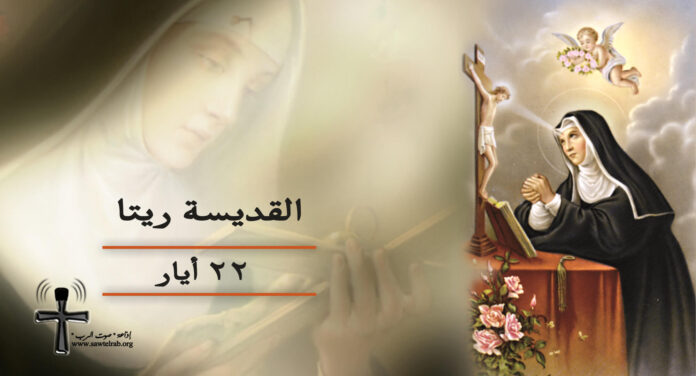
The Life of Saint Rita, Patroness of Impossible and Desperate Causes
Saint Rita was born in Roccaporena, in the province of Umbria (Italy). Her parents, Antonio Lotti (Mancini) and Amata Ferri, were devout and virtuous; in them shone the holiness of great generosity, fervent piety and open-hearted charity.
They had been married a long time and had grown old without God giving them a child. One day, as her mother was deep in meditation, she saw an angel who assured her that her prayer had reached the throne of the Most High: she would have a daughter who would be great before the Lord. The angel appeared to her a second time and asked her to name her daughter Margherita, which was shortened to Rita.
Rita was born on May 22, 1381, and was baptized the same day. A few days after her baptism, her parents began carrying her with them to the fields in a wicker basket and setting her down in the shade of the trees. One day a large swarm of bees came down and surrounded her; many bees went into her mouth and left honey there without ever stinging her, as if they had no stings. The baby did not cry, but made little sounds of delight. At that very moment one of the harvesters badly cut his right hand with his sickle and ran off to find a doctor. As he passed the baby he saw the swarm buzzing around her head; he stopped and tried to drive the bees away with his hands to protect her, and at once the bleeding stopped and his wound closed. He cried out in amazement; the baby’s parents rushed over and saw what had happened, and they regarded these white bees as a wonder like the one surrounding her birth. Seeing her as a heavenly gift granted to their faith and prayers, they took great care to raise her in the principles of religion, which were impressed on her soul as on wax. As soon as she reached the age of reason, virtue shone from her: she stood out for her docility and prompt obedience, her tender modesty and an unquenchable thirst to know God and our Lord Jesus Christ.
What had been impressed on her imagination from her earliest years she now tried to know and love, and she learned about divine things as far as her young age allowed. It is certain that, like Saint Catherine of Siena, she could not read or write; and just as Saint Catherine, when she had to deal with the Pope about the affairs of the Church, was taught by the tender Virgin to write in the gentle language of her homeland, so Rita chose to read in one book only: the Crucifix.
Rita heard about what had happened to Saint Francis of Assisi, who had lived in the same region, and she wished she could be crucified with Jesus, or at least share his sufferings. We will see how Jesus answered her. For now, her study of the Crucified awakened in her a desire for penance; her soul burned with love of God and longed with all its strength for religious life. But God wanted her first to climb the steps of Calvary.
While Rita thought only of God and of her elderly parents, who did not understand the secrets of her virgin soul, her parents were thinking of her marriage. They forced her to marry a young man who had none of her noble character, seriousness, modesty, grace or detachment from the world. She did not want to give a man her heart, which she had consecrated to God since childhood; she was twelve years old. On the other hand, she was not used to disobeying her elderly parents in even the smallest thing.
From childhood she had longed for the life of perfection. Since she could not leave her parents, she would withdraw to a secluded room in the family home, where the divine Bridegroom looked upon her heart and spoke to it. She thought she would go on conversing with the Lord until he took her parents, and then she would be free to offer him the sacrifice of her life.
How troubled she was when her parents raised the subject of marriage! She did not refuse them harshly, for she was used to obeying them completely and did not want to grieve them in any way; but she begged them, more with tears than with words, to let her follow her religious vocation.
Perhaps they would have allowed the religious life if the young man they had promised her to had been different from what he was. In those days little account was taken of poor families, and might trampled on the rights of the weak.
Paolo Mancini, who sought Rita’s hand, was not a gentle or peace-loving young man; he was dissolute and harsh, and sometimes took part in brawls. So he could cause serious trouble if Rita and her family did not agree to the marriage.
Seeing herself in unavoidable danger, the poor girl multiplied her prayers, mortifications and almsgiving, that God might deliver her from this scoundrel. But God knows his ways better than we do: he did not listen to her prayers, or rather he did not want to lift this cross from her, because his plans for her were known to him alone. In return for this suffering he gave her other graces, especially the conversion of her husband and the salvation of his soul. In this she followed the example of Saint Monica, mother of Saint Augustine, imitating her so as to become a model of heroic patience. Once she entered her husband’s home, she bore his violent temper, insults and cruelty with beautiful patience and in silence, and she kept her house orderly and elegant so that her husband would find there everything to please him.
Rita’s husband had many enemies because of his quarrelsome nature. When he was insulted, he watched for a chance to take revenge, and if he could not satisfy his grudge, his anger fell like lightning on his poor wife, in shameful blasphemies, coarse words and harsh blows. One day she very nearly did not escape death, had divine Providence not brought her father in time to prevent disaster. Through all this she was like a gentle lamb, bearing it patiently without opening her mouth, until the day came when the lamb conquered the wolf and brought her husband’s soul back to God.
From this marriage God gave her twin sons, Giangiacomo and Paolo. She received them as a precious treasure to be guarded with the greatest care. She looked to their souls before their bodies; there is no doubt that she consecrated them to God and prayed much for them. Afraid that her sons would inherit their father’s inclinations, she increased her fasting and penance and worked to sow the seeds of virtue in their hearts. While Rita was raising her sons, her virtuous parents died. She was surely saddened, but she redoubled her fervent prayers for them. So, by fulfilling her duties as daughter, wife and mother, Rita grew ever more worthy of heaven. What consoled her for the loss of her parents was that she had never opposed them in life, and that their long life had been a thoroughly Christian one.
Since her husband had returned to God and was living as a Christian, Rita’s family was completely happy. But here below roses grow and bloom only among many thorns. Our saint, who had longed to imitate the crucified Christ, was soon pierced by the sharp spear of sorrow: one evening, as her husband was returning from Cascia, his old enemies ambushed him and killed him without difficulty. Rita’s heart broke on hearing this terrible news, and she dreaded with all her heart the effect this tragedy would have on her sons. She saw to it that her husband received a Christian burial and redoubled her prayers and mortifications for the repose of his soul.
Once her first shock at losing her husband had passed, she devoted herself to raising her sons, on whom her good example and wise words had a great influence. But the power of evil sometimes smothers the power of good: they heard other examples than hers, and some people urged them to avenge their father. They began to go against her wishes and no longer listened to her as before, and the instinct for blood was going to lead them into evil. Since she valued their eternal salvation above their earthly life, she took a heroic step: she asked Jesus crucified to take her sons rather than let them one day be led into evil.
Her sons fell ill one after the other. She nursed them with the greatest care, watching over them day and night so that they lacked none of the treatment needed to save their lives, whatever sacrifices it cost her. Someone may ask: “Hadn’t she asked Jesus to take her sons?” Yes, but that did not mean she had to let them die. She did her duty toward them in the most perfect way and with incomparable dignity. Since they were not as good as she wished, she preferred to offer them to Jesus if necessary, but purified by repentance. And so it happened: during their illness the desire for revenge died down in them; they repented of their sin and were reconciled with God. The two young men died one after the other, a year after their father’s death. So the ties that bound her to the earth were broken: she was left alone in the world, united with her Lord. Yes, she was left alone, but she had become free.
Then Rita said goodbye to this wretched world and, relying on God’s help, went to knock at the door of the Augustinian nuns of Saint Mary Magdalene, telling them of her ardent desire to join their community. Her request was refused because she had been married. She went home without despairing of God’s mercy, but kept up her prayers, mortifications and works of charity. Twice more she went and knocked at the door of the same monastery, and both times she was not accepted. So she surrendered herself to God’s holy will and entrusted her cause to the saints who were her patrons. She was nearing forty, and although she lived in the world, she led a thoroughly religious life, faithfully practising the evangelical counsels. When God saw her complete submission to his holy will and her great trust in his eternal mercy, he took pity on her. One night, as she was deep in meditation, she heard a voice repeating: “Rita, Rita!”
She went to the window to see who was calling her and what they wanted, but she saw no one. She thought she had been mistaken and went straight back to her meditation. But before long the voice called again: “Rita, Rita!” She got up, opened the door and went out into the street, where she saw an old man with two other people, and she understood by inspiration that they were her patron saints:
John the Baptist, Augustine and Nicholas of Tolentino. They asked her to follow them, and she followed, quietly, as if in a dream. In a short time they reached the church of the monastery of Saint Mary Magdalene. Although the doors were shut and locked and the nuns were fast asleep, the saints whom God had sent to accompany her brought her into the monastery and then vanished.
When the nuns came down in the morning for the Office, they were astonished to find there this holy woman whom they had turned away several times, and wondered how she could have got into the monastery at night. Rita simply told them of the heavenly wonder; they accepted the truth of what she said and admitted her among the novices. Before long her virtues flourished and the perfection of her religious life shone brightly. The special gifts God had given her became the target of misunderstanding, humiliation and suffering, which perfect souls. Having been formed in the school of the Crucified, our saint faced the greatest difficulties, trained herself in the hardest virtues, stifled self-love and took on the lowliest and most exhausting work in the monastery.
But this strong woman would answer temptation: “I have consecrated myself to God for eternity, and I will stay faithful to my vows, whatever it costs me.” She scourged herself three times a day and always wore a hair shirt of pig’s bristles with spikes that tore her flesh. Wanting to test her obedience, the superior ordered her to water a dry stick every morning and evening; it was a vine branch meant for the fire. She obeyed the superior and watered it morning and evening with astonishing simplicity. She kept this up for a whole year, while the nuns looked on smiling, perhaps edified, perhaps mocking.
One day the nuns were amazed and bewildered to see life stirring in the dry stick, which grew into a marvellous vine that in due season gave ripe, delicious grapes. It is still in the garden of the monastery of Cascia today, a witness to Sister Rita’s obedience. Priests bless its leaves and ground-up shoots, which the faithful use with prayer in honour of the saint, and they receive great graces, especially miraculous healings. From her earliest childhood Rita had felt strongly drawn to the Passion of the Saviour, which was always the subject of her meditations. Cascia is not far from Assisi, and Rita knew that Saint Francis of Assisi had received in his body the stigmata of Jesus crucified: the wounds of Jesus were imprinted on his hands, feet and side, and so he shared in his redemptive work. She too wanted to be marked with the Saviour’s cross, but she did not consider herself worthy of this unique grace, so she contented herself with meditating on it, so deeply that she lost consciousness and the nuns thought she was dead. Once, kneeling before an image of the Crucified, she begged the divine Master fervently to let her share in his sufferings. At once a thorn flew from the Crucified’s crown and lodged in her forehead; it caused her such intense pain that she fainted and nearly died.
Rita’s wound became infected and gave off a foul smell. So as not to disturb the other nuns with the odour, she had to withdraw to a distant cell, where a sister brought her the food she needed. She bore this painful wound for fifteen years, and the pain did not ease even in her sleep. She endured it all not only with patience but with deep gratitude to the One who had made her worthy to share in his redemptive sufferings.
After Rita made her solemn vows, while deep in contemplation she saw a ladder rising from earth to heaven, with our Lord Jesus Christ at the top inviting her to climb it.
Word spread of her intercession with God and her power over his heart, and people hurried to her from near and far; through her prayers she obtained wonderful conversions and miraculous healings.
Her greatest consolation came when the superior allowed her to go to Rome for the jubilee of the Holy Year 1450, to gain its indulgences, further purify her soul, receive the papal blessing and above all venerate the relics of Christ’s Passion. She obtained that the wound on her forehead would disappear until she returned from Rome, though without taking away the pain: the wound vanished but the pain remained. When she returned to Cascia, Jesus allowed the wound on her forehead to open again. The weight of years and all her sufferings and penances wore down the strength of the holy nun and confined her to her poor, hard bed. Her stomach could no longer tolerate even a little food, and her only nourishment became the Eucharist.
She remained in this state for four years, enduring indescribable suffering. Three days before her death, the Lord Christ appeared to her with his Mother, the Virgin Mary, and told her that in three days she would be with him in heaven. She received Viaticum and the holy anointing, and on May 22, 1457, her pure and beautiful soul left this deceptive world and soared to heaven.
The saint had barely breathed her last when God glorified her with many miracles. The angels rang the monastery bell, and the nuns hurried to her cell, thinking of the smell of her wound. But how astonished they were when they approached the body and found the wound closed and giving off a sweet fragrance, and Rita’s face beautiful, beaming and smiling! One of the nuns, whose hand was paralysed, came forward to embrace the saint, and as soon as she did so she felt her hand completely healed.
Her body was carried into the monastery church, where it lay in state for several days at the request of the crowds. A brilliant light shone in her cell, a heavenly fragrance spread throughout the monastery, and the wound on her forehead turned into a ruby sparkling like a diamond. Because of the huge crowd that gathered on the day of her funeral, the nuns had to carry her body to the outer church in a triumphal procession in which the religious and civil authorities took part.
Because of the many miracles God granted to those who sought her intercession, the people proclaimed her a saint before the Church confirmed her holiness. As wonders multiplied after her death, the church and civil authorities together decided to place her body in a fitting place, displayed uncovered in a cypress coffin. God had preserved it from all corruption, and it gave off a delightful fragrance. So it was placed in the oratory inside the monastery, under the altar of Our Lady, and was venerated there until 1595, when it was moved into the church. Some years later that coffin caught fire from a lit candle that fell on it, but the fire did the saint’s body no harm.
Even more remarkable, it is reported that this body moves from time to time in various ways; the processes for her beatification and canonization record this with evidence and testimonies gathered between 1626 and 1900. In 1627 Pope Urban VIII granted Rita the honour of beatification, and in 1900 Pope Leo XIII declared her a saint. After a very careful examination of the miracles, a proper Mass and many prayers were composed in her honour, and May 22 was set as her feast each year.


. Her parents, Antonio Lotti (Mancini) and Amata Ferri, were devout and virtuous; in…)