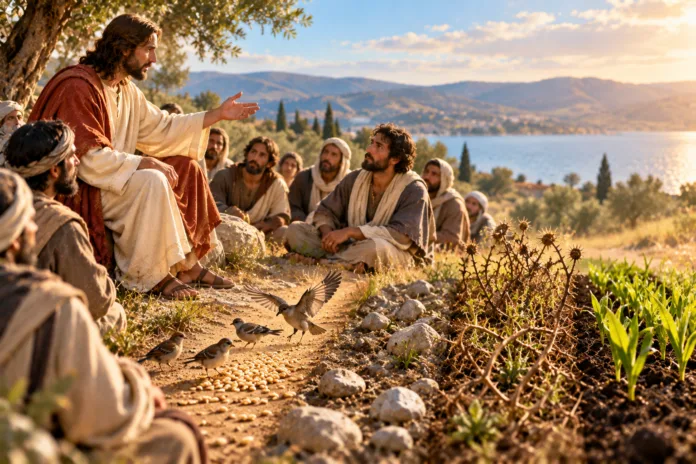
Meditation for the Twentieth Sunday after Pentecost – Gospel according to Saint Luke 8:5-15
The parable of the sower is one of the Gospel texts dearest to our hearts and clearest to us. The disciples asked the Lord Jesus about the parable, and he explained it to them, as we heard in today’s passage.
The sower is God, the seed is the Word, and the various kinds of ground are the various kinds of people.
It is clear from the start that Christ is speaking not about how hard it is to bear fruit, but about its conditions – contrary to the first impression we get on hearing this text, which speaks of the path, the rock and the ground full of thorns, and of the fruit dying there. Every ground – every kind of person – is good, as long as we do not turn it into a path, harden it like rock, or let thorns fill it.
So the problem does not lie in the nature of the ground. The path is by nature the same as the good soil, but it has been turned into a walkway trampled by everyone, so it bears no fruit. Likewise, the rock is made of the same stuff as good soil, but only on the surface.
In giving this parable the Lord Jesus expresses exactly how he sees our human attitudes to his sowing of the Word,
and so he expresses the reasons that kill everything he sows in us, leaving us fruitless.
The first question that comes to each of us on hearing or reading this text is: how can I be good soil, and not like the path, the rock or the thorny ground?
The first condition for this is not to be like the path that everyone tramples, that is, not to be a passage for every foot without any restraint or control, open ground for every passer-by, where all the birds of the air swoop down and snatch away the divine Word.
How many Christians are a path for every foreign ideology, good or bad! They lay themselves out as a passage for every passing current. And the reverse question is clearer still: which Christians keep watch over what comes in and goes out, what passes over them and what swoops down on them in the way of politics, ideas, curricula and media?
Watch how Christians follow the media! They soak up every idea without any examination or filtering, instead of judging them in the light of the Gospel! Which of us examines the educational programmes or school curricula offered to us? Who examines every party, political or cultural idea in the light of the Gospel? We are cheap goods sold to every passer-by and every ideology being promoted, as if we had no basic ground of faith.
The Christian does not shut himself in, reading only his own faith and stopping there – far from it! But he passes every idea under the light of the divine Word and reads every ideology in that light, guiding, straightening and correcting. The Christian shines the light of the Gospel on what is in his heart and mind.
Christian literature calls this very movement “vigilance” or “watchfulness”: keeping watch over the Word sown in his heart and examining in its light everything offered to him or that he is exposed to. The divine Word has been thrown into our soil, and the soil belongs to the Word, to this Word alone. This Word is not an easy morsel for anyone who fancies passing through us or swooping down on us. So we must hold on to the seed against the birds and passers-by, because the grain thrown into our soil is more precious than the feet of passers-by and the beaks of every bird or stranger.
We must stay “watchful” over it. The second condition is not to be like rock, that is, not to treat the sowing of the Word superficially, take religion without its essence, worship out of habit and keep only the husk of Christianity: seeing in the Gospel stories and commandments, stopping prayer at duty if it does not sink into Pharisaism, practising rites and liturgy without depth or life, or living superficially in the Church.
In fact, any Christian practice or virtue in which we do not reach the depth, which is Christ, remains a superficial practice: fruit sprouts on it, but dies after a while.
Many Christians love Christianity without the slightest feeling or reverence towards Christ. Christianity differs from all religions in that it is not a “religion”: it is not a law or a book, it is the Christian life, whose centre is the Lord Jesus. The Christian life, in one word, is meeting the Lord Jesus. The prophet David says: “I have set the Lord always before me”, and the Apostle Paul: “It is no longer I who live, but Christ who lives in me.” Behind every Christian virtue, every practice and act of worship, at every moment, we must meet Christ. In the Gospel I do not read a story but meet Christ; in charity I do not give alms but share Christ’s need; in prayer too I do not recite or sing but speak to Christ.
The depth of Christianity is “prayer”, that is, meeting the Lord Jesus. That is why the Christian life is a “life of prayer”, since prayer is not recitations in churches or corners of the house…, but “the mind of Christ” in me always, at every event, from every text and after every action. The Christian and Christ are in a constant living encounter, in every place and at every time. If we do not reach this depth, we are superficial even in our prayer.
If meeting Christ – that is, prayer – is not the goal of every movement in our lives, we will inevitably treat life superficially. Christianity as a religious theory is not worth sacrificing any interest for; but when I live with the living Christ, as the Apostle Paul knew him – not as the dead founder of a sect but as the One alive for ever and coming – then the Christian finds no difficulty in parting with any interest and fears no loss in order to gain him. When the love of Christ fills him, he pays no attention to any fear.
Then he knows how to read the times in depth and face life realistically, and he gives the seed in his life roots that the noonday sun cannot scorch and the wind of self-interest cannot uproot; his seed grows and bears much fruit. So the criterion of depth is that everything moves from superficiality to “prayer”.
The third condition is not to let the seed get mixed with thorns, that is, not to merge the world with religion – with due caution in these words – and not to put the Lord and the world on an equal footing. The third ground, full of thorns, is like Christians who love God very much, love the Word very much, love the Church very much, and love worldly things very much: they have in them many loves for contradictory things.
The seed does not grow among thorns, and (worldly) pleasures are not fit for keeping the Word. We cannot serve two masters, and religion is hypocrisy if we love two opposites.
The ideology of the modern age is the conviction that we can reconcile the love of God with, say, gluttony; the love of the Word with greed; love of the poor with love of self; and keep in step at once with the loftiness of the mission and the baseness of self-interest and materialism.
The thinking of our time tells us we can be a ground for thorns alongside the Word. The philosophy of this age is a diabolical trick that says to the Lord: “We can serve two masters”; it knows how to deal with God by giving him his due while giving other masters their rights. But our Lord is a consuming fire who does not coexist with the masters of this age.
It is a matter of the heart and its inner desire: is the heart God’s, and are its desires noble, or are we ground for thorns? This is where fasting plays its part in the Christian’s life. Fasting directs desires. Fasting corrects human “taste” and straightens human “thirst”. For the heart cannot be split in two, and the Lord says: “My son, give me your heart.” So the third condition is “fasting”.
The Church sings to the saints, drawing on this parable: “By vigils, fasting and prayers you received heavenly gifts (the seed), and by your labours you bore fruit a hundredfold.” These three arts are the true tilling that makes our ground good instead of a path, breaks up the rock of hardness and uproots the thorns from the Christian life.
And the most beautiful words are those that close the Gospel text: “He who has ears to hear, let him hear!”
Amen.
Fr. Gerard Abi Saab