Meditation for the Fifth Sunday of Lent (Sunday of Saint Mary of Egypt) – Mark 10:32-45
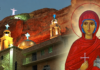
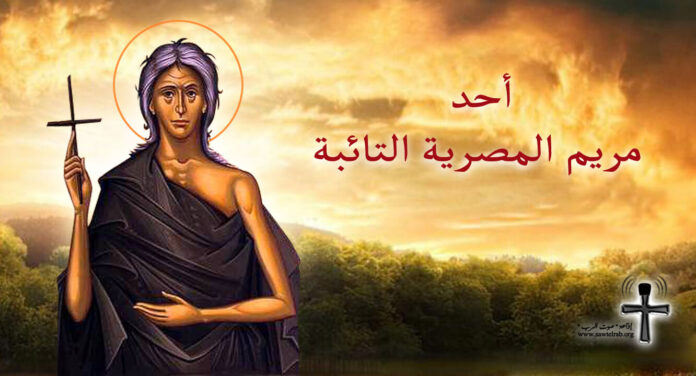
Since the eleventh century, the Church has dedicated this Sunday to the memory of Saint Mary of Egypt, to urge us to repentance and return to God after the example of this saint,
one of the heroines of Christian repentance. We read the passage from the Gospel of Saint Mark in which the Lord foretells his betrayal, death and resurrection, so that we too may prepare for the Passion and the Resurrection, and celebrate Saint Mary of Egypt, a model of repentance and a towering figure of asceticism in the Church.
Our saint spent forty-seven years in the wilderness beyond the Jordan, in the company of angels and wild animals.
In 1998 the monastery where she is said to have lived was found near the Baptism Site on the east bank of the Jordan River.
She was helped in her spiritual life by holy monks who lived as ascetics in that region, such as Saint Zosimas.
The life of our venerable mother Mary of Egypt reveals a profound truth about the human being. How is it that “she who was first sunk in filth… afterwards rivalled the life of the angels”? A human being, by virtue of freedom, can become an angel or end up a wild beast.
As Saint Augustine says, a person can become carnal even in his spirit, or spiritual even in his flesh. Two loves that took turns in a single heart! What is this struggle between them? How do they trade places? Which is truer and stronger? Mary of Egypt gives us the answer.
The Bible rejects the ontological, philosophical opposition between spirit and body. It does not accept the philosophical claim that the body is the prison of the soul. The struggle between spirit and flesh is moral: it is the opposition between “desiring the creature” and “desiring the Creator.” The human heart is open to love of the Creator as well as love of the creature.
Choosing the Creator as the heart’s beloved makes a person spiritual, using creation chastely; choosing the creature as the heart’s beloved is spiritual adultery.
“Where your treasure is, there your heart will be also.” A person’s worth equals the worth of the desires in his heart, and his dignity is measured by the dignity of what he loves.
The human being is dynamic and developing; he becomes what is in his heart. If he chooses the fruits of the Spirit as his desires, he sets his body on fire with the Spirit; if he chooses worldly things, he “quenches the Spirit” with them.
“Holiness” means becoming like the Holy One, so that what is in our heart matches what is in God’s heart; that God becomes the only longing of the human heart and only one desire remains in the heart: “Thy kingdom come, thy will be done.” Holiness is the unity of human longing in God.
It doesn’t matter merely that you exist; what matters is how you exist! What matters is not where a person comes from, even if from an ape that evolved! What matters is “Where is the person going?”
The goal is to become god by grace: that is the noble love.
The most important thing about the Christian spiritual life is that it locates the cause of sin in conduct and not in creation, that is, in freedom and not in nature.
Sin begins in the spirit, not in the body. The first fall happened in the world of the angels, who have no bodies. Sin starts in the mind and acts in the body, not the other way round. The body is acted upon rather than acting, according to Saint John Chrysostom. Sin is a wrong done by the spirit to the body, not the reverse. Adam did not sin because his body forced him, but because his spirit grew slack in divine love, when it desired the world instead of its Creator. The body is a servant both of the wrong spiritual choice and of the right one. The exchange of longings takes place in the spirit.
That is why the beginning of true spiritual life is “Know yourself,” that is, recognize the longings in your heart and decide for this heart what it should love or reject. Our faith is that the true, original love of the human heart is for the things of God, not the things of the world.
According to Saint Gregory of Nyssa, the heart is naturally drawn to its origin, that is, to God. The proof is that cases in which spiritual people turned from divine love to the world are rare, while cases like Mary of Egypt are many: human beings who, after sinking terribly into the mire, threw off all the demands and desires of the flesh and then “took flight in divine love” with no return.
That is why hope does not waver even for the greatest sinner! Because sin is a twisted state of the heart, not a natural one. Sin is violence done to the heart, which will keep longing for its freedom until it finds it by embracing divine love as its beloved. The human heart does not live on “bread” alone; it needs above all the “Word of God.” The human being is not merely a consumer of the world but a second creator within it, in the sense of “creator and artist.” And his art is to make the world spiritual. His basic “sin” is to deal with the world in a worldly way, and his “life” is to converse with God through the world in a spiritual way. This is the true inclination of the human heart. That is why, in every state of sin, we expect a return.
Mary of Egypt dealt in a worldly way not only with the world but even with holy things. The force of debauchery in her was so strong that she sought pleasure on a spiritual pilgrimage for the feast of the Cross. But what is the dark force of debauchery before the radiance of the Spirit? It is bound to scatter! While she was deceiving her heart, her heart clung to its true love before the wood of the Cross. Yes, however much violence we do to our hearts with worldly desires, they remain drawn to and longing for the things of God.
Then the force of debauchery was transformed into the energy of repentance. Mary of Egypt spent seventeen years misleading her heart with pleasures that could not satisfy it, but she quenched its thirst in forty-seven years of asceticism, fasting and prayer. “O your noble transformation and your passage to what is better, venerable one! O your divine longing that hated the pleasures of the flesh! O your fervent, divine faith, all-praised Mary…” say the hymns (from the eighth ode of Sunday Matins).
Let us free our hearts and give them what they truly love. “Pay attention to yourself,” says Saint Basil the Great. Give it its true food. Repentance is not a move from rest to toil; quite the opposite! The moment of repentance can be hard, in proportion to the depth of the mire, but it is the rest of the lover meeting the beloved.
The human heart can be the stage of many loves, chosen by human freedom. Two beloveds passed through the heart of this Egyptian woman: the world and God. But her heart found rest only in its Creator, its Maker and its true Beloved.
Amen.
Father Gerard Abi Saab