Meditation for Thomas Sunday – Gospel (John 20:19-31)
Thomas’s hesitation and our steadfastness
“Blessed are those who will believe (through you) without having seen”
On the second Sunday of Easter, the Lord Jesus appears to the disciples a second time in the Upper Room, but this time Thomas is there too. Thomas’s faith was not weaker than that of the other disciples.
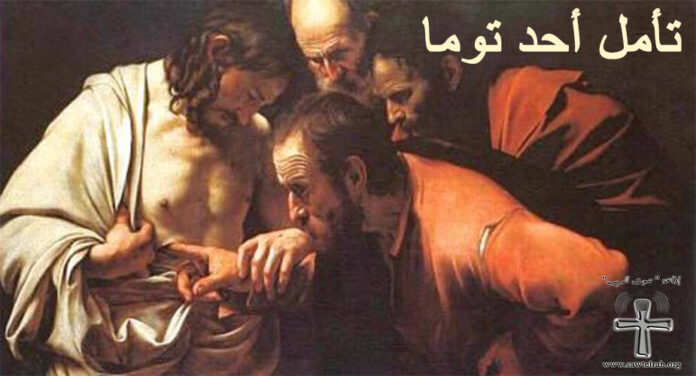
The ten disciples had believed at that time, when Jesus appeared to them on the evening of Easter Sunday. But because Thomas longed to see what they had seen and to touch what they had touched, Jesus came on the following Sunday, though the doors were locked, and appeared to them with Thomas among them, and said to him, “See” and “touch,” and “do not be unbelieving, but believe.”
There are three degrees of faith:
The first degree is faith in tangible things. These may be natural realities, everything within our grasp in the universe, such as the sun, water, the moon, medical science, and the properties and functions of the body. We have vast and varied knowledge and believe in its reliability and its results. They may also be moral realities: for example, we believe in the importance of tenderness in raising children,
in the importance of peace among the world’s societies, in the necessity of social justice, and so on… These things are within the reach of our understanding even if they are not within the reach of our senses. And we believe all of this.
But none of this is “faith” yet; it is only its first degree, what we call “knowledge.” The difference between knowledge and faith is that the first deals with certainties and self-evident truths, while the second must carry an element of risk that rests on two foundations. The first is the “eye of faith,” which has a certain vision thanks to spiritual experiences and prior knowledge. The second is personal freedom, desire and inclination, which move us from knowing natural and moral realities to knowing their causes and purposes: to set out from creation toward the Creator, and to read the Creator’s love in creation.
It was on the threshold of this degree of faith that Thomas stood. For, as Saint Gregory of Nyssa says, when Thomas saw Christ and touched his side and the place of the nails, he did not cry out “Teacher,” nor did he merely believe in a risen body; he cried out, “My Lord and my God.” Having grasped with hand and eye, he leapt to faith in the Lord and God. Thomas relied on reason and the senses, and from them he rose to faith in the Master’s divinity and lordship. Thomas did not merely touch a side and believe in a living body; he touched the wounds and cried out, “My God.” This is the common degree of faith for most Christians: we generally want to understand and be convinced, and then “believe” in the second sense of the word.
The third degree is the one Jesus called blessed: “Blessed are those who have not seen and yet believe.” We may believe in the Lord’s miracles after some explanations, and accept his resurrection after all the accounts of his appearances and the Church’s two thousand years of experience. But there is a degree of faith that has lived the second degree for a time, and this personal experience of faith over years gives the one who carries it confidence, perfect faith, so that the “eye of the mind” no longer asks to examine or touch, but only for more. As we grow in faith we need explanation, and our trust in what, or whom, we believe still needs the support of reason, interpretations, explanations and proofs. But personal experience raises faith to the maturity of “the absolute.” Didn’t Peter ask Jesus for proof during one of his miracles?
He said to him, “If it is you, command me to come to you on the water” (Matthew 14:28). And didn’t the Jews ask for a “sign” in order to believe? All these episodes are expressions of a middle, second-degree faith, a faith that still rests on satisfying knowledge, the touch of the senses and the grasp of reason. Third-degree faith, “without seeing,” is a faith that has already seen enough, has quenched the thirst for knowledge and ended the hesitations of trust. It is like Peter’s faith after the resurrection, when Jesus asked him, “Peter, do you love me?” and he answered, “You know everything” (John 21:17).
The faith of the ten apostles, like Thomas’s, only reached this third, perfect and blessed degree after the Lord’s appearances; and if Thomas had not doubted, our doubt would have remained too. Thomas’s absence on the evening of Easter Sunday, when the Lord appeared to the disciples, was part of God’s plan, so that through Thomas’s doubt, Jesus’ appearance to him, the touching and the cry “My Lord and my God,” the Master might remove our own doubts.
Most of us, after reading and hearing of the Lord’s appearances and his resurrection from the dead, repeat Thomas’s same demand: we want to see and touch. And so, when Thomas touched and saw, he touched for us and cried out for us, “My Lord and my God.”
The first degree of faith is “knowledge”; the second is “wisdom,” which possesses the “eye of faith” and sees more through it than through the eye of the senses; and the third is “perfect faith,” through which a person becomes a person of prayer and a righteous one who “lives by faith.” Then heart and mind are united in knowledge, and the long experience of faith’s successes at the second degree becomes the foundation of an absolute trust that raises faith to its perfect degree, where it no longer asks for proofs but for grace, no longer demands reasons but keeps drawing more.
And since most of us waver on the threshold of the middle faith, at its second degree, this Sunday comes to answer our hesitation, steady our wavering and strengthen our faith, as the hymns say: “How fine was the unbelief of Thomas, for it brought the hearts of the faithful to knowledge, and he cried out in fear, ‘My Lord and my God'” (perfect faith). “O wonder! Unbelief became the strengthening of faith. The Master appeared to wipe away Thomas’s doubt, and we cry out with him: My Lord and my God, glory to you.”
Amen.
Father Gerard Abi Saab