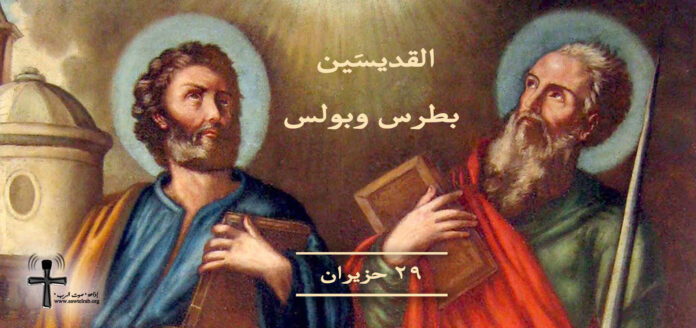
Saints Peter and Paul
Saint Peter
“You are Peter, and on this rock I will build my church, and the powers of death shall not prevail against it” (Matthew 16:18).
His life appears clearly in the books of the New Testament and in the Acts of the Apostles. His original name was Simon son of Jonah; his mother is never mentioned in the Gospels. He was born in Bethsaida, a town on the Lake of Gennesaret, and it was his brother Andrew who first called him to follow Jesus. Jesus gave Simon the name Peter (the rock), to show that Peter would be like the rock foundation on which the Church would be built. Peter was married.
Peter and Andrew were fishermen, and Jesus called them to be his disciples at the same time as James and John, the sons of Zebedee. Peter’s great standing clearly comes from his being a witness to important events in Jesus’ mission: when Peter confessed that Jesus is the Christ, the Son of God, and Jesus said to him, “On this rock I will build my church”; when he was chosen with James and John to witness the Transfiguration. After the Last Supper, Peter again witnessed, with James and John, Jesus’ agony in the Garden of Olives. When Jesus was betrayed, Peter drew his sword to defend him, but later that same night he denied him, as Jesus had foretold. After the Resurrection, Jesus appeared by the Sea of Galilee and entrusted Peter with the charge: “Feed my sheep.”
Saint Peter was martyred on the orders of the Emperor Nero. According to tradition he was crucified around the year 64, upside down, because he said he was not worthy to die as Christ had died. His body was buried on the Vatican hill, where excavations in the twentieth century uncovered his tomb on the site of Saint Peter’s Basilica. According to tradition, Saint Peter is the first Bishop of Rome.
Saint Paul
The second great figure is Paul of Tarsus, originally called Saul of Tarsus, and also known as the thirteenth apostle. Saint Paul was born at about the same time as Christ and calls himself the apostle to the Gentiles (the nations). Paul did not meet Jesus during his earthly life, but he was converted to Christianity through a miraculous event known as “the road to Damascus”. Saul the Jew hated and persecuted the Christians as heretics, and he also took part in the stoning of Saint Stephen the martyr.
While he was on his way to Damascus to arrest another group of Christians, the most famous conversion in the history of Christianity took place. Saul fell to the ground; a light from heaven flashed around him, and he heard the voice of Jesus Christ: “Saul, Saul, why do you persecute me?” The man who had hated Christ and all Christians surrendered before the living God. Jesus then told him to go into Damascus, where he would be told what he must do. Paul was blinded, and for three days he neither ate nor drank. In Damascus, the Lord sent him a disciple named Ananias, who restored his sight; he was filled with the Holy Spirit and baptized.
From then on he was known by his Roman name, Paul, and he began travelling and preaching Jesus in the synagogues of Damascus. The Jews wanted to kill him, but he escaped with the help of some Christians who let him down over the city wall in a basket. He spread Christianity, especially west of Jerusalem. Many Christians regard him as a major interpreter of Jesus’ teaching, and as Christ’s most important disciple, second only to Jesus in the growth and development of Christianity. Three years after his conversion, Paul went to Jerusalem to meet Peter and stayed with him fifteen days.
The Apostle Paul was executed in Rome during the persecution of Christians by the Emperor Nero, which lasted four years, from 64 to 68; the Apostle Peter was put to death in the same period. As a Roman citizen, Paul was granted a quick death: he was beheaded with a sword near Rome, probably on a June 29, around the year 67. Together with Saint Peter, Paul was the foremost missionary of the early Church. According to tradition, his body was laid with Saint Peter’s in the catacombs near the Appian Way, where it remained until Lucina and Pope Cornelius moved it to the cemetery of Lucina.