Saint Joan of Arc
Who is Saint Joan of Arc?
She was a young saint who lived at the end of the Middle Ages; she died in 1431 at the age of nineteen.
This French saint, quoted several times in the Catechism of the Catholic Church, was a young woman of the people, a laywoman consecrated in virginity; a mystic committed not in the cloister but in the midst of the most dramatic realities of the Church and the world of her time. She is one of the most typical of those “strong women” who, at the end of the Middle Ages, fearlessly carried the great light of the Gospel into the complex events of history.
At that time the Church was living through the great crisis of the Great Western Schism, which lasted almost forty years.
When Joan was born in 1412, there was a Pope and two antipopes. Alongside this division within the Church, there were continual fratricidal wars among the Christian peoples of Europe, the most dramatic of which was the long Hundred Years’ War between France and England.
Joan was born in Domrémy, a small village on the border between France and Lorraine. Her parents were well-off farmers, known to all as good Christians. From them she received a good religious upbringing, strongly influenced by the spirituality of the Name of Jesus taught by Saint Bernardine of Siena and spread in Europe by the Franciscans. The Name of Mary was always joined to the Name of Jesus, and so, in the context of popular piety, Joan’s spirituality was deeply centred on Christ and Mary. From childhood she showed great love and compassion for the poorest, the sick and all who suffered in the tragic context of the war.
Joan’s religious life matured as a mystical experience from the age of thirteen. Through the “voice” of Saint Michael the Archangel, she felt called by the Lord to deepen her Christian life and to commit herself personally to the liberation of her people. Her immediate response, her “yes”, was a vow of virginity, with a new commitment to sacramental life and prayer: daily Mass, frequent confession and Communion, and long periods of silent prayer before the Crucified or the image of Our Lady. The young French peasant girl’s compassion and commitment to her people’s suffering were made even stronger by her mystical relationship with God. One of the most original aspects of this young woman’s holiness is precisely this link between mystical experience and political mission. After the years of hidden life and inner growth came the brief but intense two years of her public life: one year of action and one year of passion.
At the beginning of 1429, Joan began her work of liberation.
The many testimonies show us this young woman of only seventeen as a very strong and determined person, able to convince men who were fearful and discouraged. Overcoming every obstacle, she met the Dauphin Charles, who in Poitiers had her examined by theologians of the university. Their verdict was positive: they found no evil in her, only a good Christian.
On March 22, 1429, Joan dictated an important letter to the King of England and his men who were besieging the city of Orléans. Her letter was a true proposal of peace with justice between the two Christian peoples, in the light of the names of Jesus and Mary; but it was rejected, and Joan had to commit herself to the fight to free the city. The other high point of her political action was the coronation of King Charles VII at Reims on July 17, 1429. For a whole year Joan lived with the soldiers, carrying out a true mission of evangelization among them. Joan saw Jesus as the “King of heaven and earth”, and on her banner she had painted the image of “Our Lord holding the world”, the icon of her political mission. There are many testimonies to her goodness, her courage and her extraordinary purity.
Everyone called her, and she called herself, “la Pucelle”, that is, the Maid, the virgin.
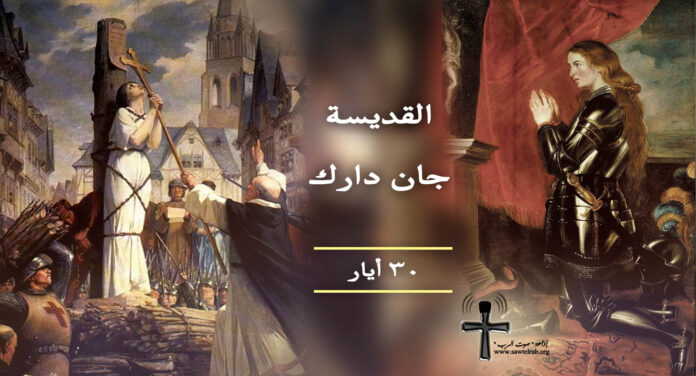
Joan’s passion began on May 23, 1430, when she was taken prisoner by her enemies. On December 23 she was brought to Rouen. There the long and dramatic trial of condemnation took place, ending on May 30, 1431, with her burning at the stake. It was a large and solemn trial, presided over by two ecclesiastical judges, Bishop Pierre Cauchon and the inquisitor Jean Le Maistre, but in fact conducted by a large group of theologians from the famous University of Paris, who took part as assessors. They were French churchmen whose political choices were opposed to Joan’s, and they judged her person and her mission negatively. This trial is a moving page in the history of holiness, and also an illuminating page on the mystery of the Church, which, in the words of the Second Vatican Council, is “at once holy and always in need of purification” (Lumen Gentium, 8). It is the dramatic encounter between this saint and her judges, who were clergy. Joan was accused and judged by them, to the point of being condemned as a heretic and sent to the terrible death of the stake. Unlike the holy theologians who had enlightened the University of Paris, such as Saint Bonaventure, Saint Thomas Aquinas and Blessed Duns Scotus,
these judges were theologians who lacked the love and humility to see God’s action in this young woman. Jesus’ words come to mind, that God’s mysteries are revealed to those with the heart of a child and hidden from the learned and the wise who have no humility (cf. Luke 10:21). Joan’s judges were completely unable to understand her or to see the beauty of her soul: they did not know they were condemning a saint. On May 24 the court rejected Joan’s appeal to the judgment of the Pope. On the morning of May 30 she received Holy Communion in prison for the last time, and was then immediately led to her execution in the Old Market Square.
She asked one of the priests to hold a processional cross in front of the stake. So she died looking at Jesus crucified and saying the name of Jesus aloud several times. About twenty-five years later, the nullity trial opened under the authority of Pope Callixtus III ended with a solemn verdict declaring the condemnation null and void. This long trial, which gathered the testimony of witnesses and the judgments of many theologians, all favourable to Joan, brings out her innocence and her perfect faithfulness to the Church. Joan of Arc was canonized by Benedict XV in 1920.
With love, and out of love for Jesus, Joan worked for the liberation of her people and for human justice. Her work is a beautiful example of holiness for lay people engaged in political life, especially in the most difficult situations. Faith is the light that guides every choice.
Saint Joan of Arc had a deep influence on a young saint of modern times, Thérèse of the Child Jesus. In a completely different life, spent in the cloister, the Carmelite of Lisieux felt very close to Joan, living at the heart of the Church and sharing in Christ’s sufferings for the salvation of the world. She expressed the desire to die like Joan, saying the name of Jesus, and she drew her strength from the same love for Jesus and for her neighbour, lived in consecrated virginity.
Her feast is May 30.