Meditation for Holy Pentecost Sunday
(John 7:37-52 and 8:12)
“If anyone thirsts, let him come to me and drink”
Christians received the feast of Pentecost from the Jews, from the time of the apostles. At first it was an agricultural feast, the feast of the “Harvest,” when the “firstfruits” of the crops were offered. Then, between the fifth and third centuries before Christ, it took on a more religious character and became a feast commemorating salvation and the covenant. It was held seven weeks after Passover, since according to tradition Moses received the commandments on Sinai fifty days after Passover (Exodus 19:1). Today’s Gospel, however, takes place during another great Jewish feast, the Feast of Tabernacles: it commemorated the pillar of fire that led the people in the wilderness by lighting great lampstands, and the water that came from the rock through Moses by pouring out water. On the last day of the feast, Christ stands in the middle of these celebrations and cries out, “If anyone thirsts, let him come to me and drink,” and from whoever believes in him “rivers of living water will flow from within him,” as John the Evangelist reports. The water Jesus will give is the Holy Spirit: “Now this he said about the Spirit, whom those who believed in him were to receive.”
Our patristic tradition makes it quite clear that the events of the Old Testament came about through the not-yet-incarnate “Word,” just as those of the New Testament came about through the incarnate “Word,” Jesus. The apostle Paul states openly in explaining the event
of the water flowing from the rock that “the Rock was Christ” (1 Corinthians 10:4). Yes, the rock is Christ, and the water that came from it then corresponds now to the Holy Spirit whom the Son will send into the world. Whoever receives him will become a spiritual person, living by the Spirit, and from within him too “rivers of living water” will overflow for others.
At first sight the scene seems simple, but deep down it holds great mysteries. Jesus enters the feast and declares to the Jews that everything they are doing points to him and leads to him, just as he said to the Samaritan woman, “I am he”! Here is a whole established world with its history, Judaism, which believes in its own way of defining “where life comes from” and “what life is,” and which has built up its learning, its traditions and its rites. And in the middle of this world, Jesus suddenly comes and says, “I am” the light of the world, and whoever thirsts for life, “let him come to me.”
What will happen in the face of this challenge? Exactly what the text reports: “division.” Some believed he was the Christ; others denied it. Such a challenge is always present in the midst of our world, and it is up to us Christians to prove it or disprove it. Our world today is made of civilizations, each trying to prove to the others that “it” has the best way of “living.” And in the middle of all these worldwide intellectual, material, political and economic forces, in the middle of all the claims to guarantee and give “life,” Christians stand like their Master and cry out: “Jesus is the light of the world,” and whoever thirsts, “let him come to him and drink”!
Christianity was never a “religion” in the philosophical, intellectual and cultural sense, as though religions dealt with explaining “metaphysics” while the sciences dealt with “life.” For Christianity it is exactly the opposite. Christianity is the answer to the true human thirst. That is why Christianity has always been wary of being labelled a “religion,” in the sense in which religions have shaped the identity and meaning of that word. A Christian can boldly declare that if all the sciences and all good things vanished from human life, a person would feel something missing; but if Christianity alone vanished, all of “life” would collapse for him. Everything other than Christianity is a framework and a precaution for “life”; but it was Jesus who proclaimed the quenching of the human thirst for life, crying out, “Let him come to me and drink.”
Is this truth just a religious philosophy? Can the world today believe it or feel its truth? And how will Christians give life to those who believe it?
To answer this existential challenge about life, we first need to define the true human thirst, and second, to know the living water that Jesus gave to the world.
There are many, many necessities in life. But it is easy for anyone to put them in order of priority, sorting them into essentials and luxuries. However much we reduce the essentials, we are left with the most necessary of them: food and drink. Between the two, a person can bear being deprived of food for a long time, while water is his harshest need for life. That is why thirst has always been harder than hunger. If water and food are ultimately the highest expression of the need for life, Jesus states plainly that man does not live by bread and water alone, but “by every word that comes from the mouth of God.” Water secures life’s necessities, but once they are secured, life begins, and it comes from “every word that comes from the mouth of God.” That is why Psalm 21 (22) sings: “The poor shall eat and be satisfied; their hearts shall live; those who seek the Lord shall praise him…” Needs are necessities, but life comes from praise. We eat and are satisfied in order to praise, and so we live.
Man’s deep thirst was neither to till paradise nor to eat its fruits, but deification, that is, for the “Word of God” to dwell in man. The devil knew this deep human thirst perfectly well. That is why he did not tempt Adam and Eve with small dreams or by meeting the needs of life; he promised them, deceitfully, life itself, saying, “You will be like God.” He knew full well that man’s ultimate desire and the quest of his heart is deification. And what Adam was cheated of in paradise by the devil’s temptation is given to us today as life in the Church by Jesus, who sent the Holy Spirit.
Don’t today’s various ideologies and many civilizations, with their politics and structures, become a new diabolical temptation when they lose from their substance the truth that Christianity came to bring to life? That is why, when Saint Gregory of Nyssa wanted to portray the ideal human being, in whom life is found in its fullness, he wrote the life of “Moses,” who “entered the divine cloud, beheld the One who Is and gained the knowledge of the Spirit”; and when he came down from the mountain his face shone: these are the signs of deification. And as the priest prays in the silent prayers of the Liturgy for all the faithful, asking God, “Grant us in this age the knowledge of your truth, and in the age to come life everlasting.” This is how we understand the profound expressions of our saints, like that of Saint Gregory Palamas: “Christ is the love, the ultimate thirst, of the human being,” that is, the most beautiful image toward which the human heart, deep down, is striving. Are we not “in his image and likeness”?
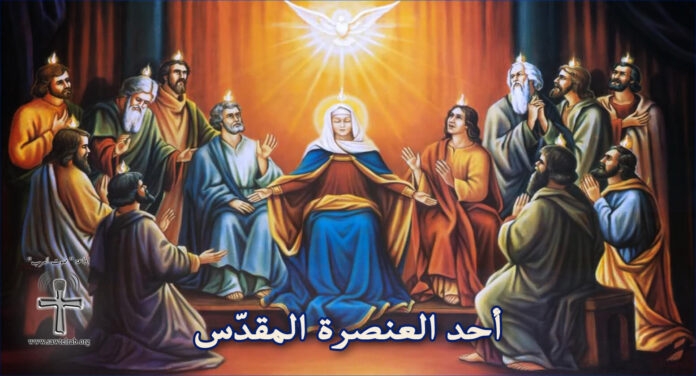
If the image of Jesus is the deep human thirst, we must next define the living water for this thirst. Jesus Christ sent the Holy Spirit after his Ascension, as he had promised, on the day of Pentecost, the fiftieth day. Jesus sends the Spirit, and the Spirit forms Christ in us. That is why Jesus said plainly that the living water those who believe in him would receive is the Holy Spirit he was about to send.
Pentecost is the birthday of the Church, not as a historical institution but as “the descent of the Holy Spirit.” The Church is the setting, in space and time, where the Spirit is poured out, transfigures our lives, forms Jesus in us and shapes us into his image, and so we live.
Yes, today, at this great moment of every age, we must stand in the middle of the world and say: “The Church is the light of the world,” and “whoever thirsts, let him come to her and drink” the grace of the Comforter Spirit. Amen.
Father Gerard Abi Saab
Note: in John’s Gospel (chapter 7) the scene takes place during the Feast of Tabernacles; the water and light rites mentioned here belong to that feast, which the liturgical tradition links to Pentecost through the gift of the Spirit.