Saint Simeon of Emesa, the Fool for Christ, and His Companion in Asceticism, John
Saint Simeon of Emesa (Homs), the Fool for Christ, and his companion in asceticism, John (6th century)
A strange and rare life that is well worth reading.
Saints Simeon and John were Syrian by origin and lived at the time of the Byzantine Emperor Justinian. John was twenty-two and newly married; Simeon, two years older, had an elderly mother. The two became friends while on pilgrimage to the Holy Places, and there they continued the journey of their lives by going to the monastery of Saint Gerasimus, whose abbot had been told of their coming by a divine sign. After he clothed them in the monastic habit… fearing for their divine zeal, they set out for the Dead Sea and stopped in a barren place called Arnonas, where they began their ascetic struggle.
… Difficulties began with thoughts of their families. When boredom overcame them and they were about to give up the fight, their spiritual father appeared to them in a dream to encourage them. So they persevered, each in his own cell, for thirty years. At the end of that time, Simeon reached blessed dispassion by the grace of the Holy Spirit. He then proposed to his companion that he go out into the world, making a fool of himself in order to help others. John, having made sure that this came from God, agreed with Simeon that they would meet again before they departed to their Lord.
The life of Simeon: Simeon embraced foolishness for Christ as a way of hiding his virtue: “If any one among you thinks that he is wise in this age, let him become a fool that he may become wise” (1 Corinthians 3:18).
Miracles he worked under the cover of mockery:
He put mustard on the eyes of a farmer who had gone blind after stealing his neighbour’s goat, and healed him. (He also used to smear mustard on the mouths of those who mocked him.)
He struck the columns of a school with a whip, predicting an earthquake in 588; when the earthquake came, not one of the columns he had struck fell.
He exposed some people’s crimes and others’ thefts, so that he managed to put an end to habitual sin in Emesa.
His death and his friend: Simeon spoke sensibly to no one except the deacon John, whose son he had healed and whom he had saved from a false charge of murder. One day, knowing that he would die two days later, the saint crawled under a pile of firewood. When people noticed he was missing, they thought he had died in an accident. They did not bother to wash his body, and went to bury him, without candles or hymns, in the strangers’ cemetery. As they passed the house of a Jewish glassmaker whom Simeon had led to Christ, the man heard singing such as could never be heard on earth, sung by a great multitude. Looking out of the window, he saw two men carrying the body of the man of God and cried out: “Blessed are you, O fool, for though you were denied human singing, the heavenly powers are singing for you!” Then he went down and buried him with his own hands… When the deacon learned of the saint’s death, he went to the tomb and opened it, and found it empty. He concluded that the Lord had glorified his servant and taken him into glory in the body before the resurrection. Then the people of Emesa understood that a new apostle had lived among them, secretly working for their salvation.
The meeting of the two friends: two days before his death, Simeon told the deacon John the story of his life. And in keeping with the promise made to his companion John, Simeon saw him in a vision wearing a crown on his head that bore the words “Crown of patience in the desert”. John answered that Simeon himself would wear the crown of all the souls he had saved through his jests.
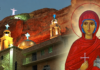
(In the centre of the icon, Saint Parthenius, with Saint Simeon and his friend Saint John on either side.)
Fr. Boutros El Zein