Palm Sunday
The feast of Palm Sunday holds a great place in the heart of the Catholic Church. Let us begin with the names of the feast.
1. Palm Sunday (“Sha’nineh” in Arabic): the name comes from “Hoshanna,” which corresponds to the Greek “Hosanna” and means “save us.” For Christ is the true lamb slain for us: he was “set apart” when he entered Jerusalem, like the Passover lamb kept from the tenth to the fourteenth day, as the Law says (Exodus 12:3-6).
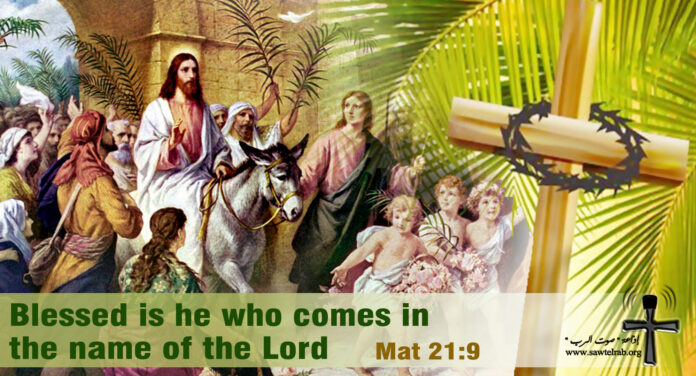
2. The Sunday of Palms, of Branches or of Hosanna, when the priests and deacons process around the church carrying palms, in memory of what happened at the gates of Jerusalem.
So why palms and branches? The palm is a symbol of victory, as John saw in Revelation (Revelation 7:9): the victorious carry palms. Branches are a symbol of peace, security and everlasting life (as with Noah).
The Lord Christ’s foreknowledge: he said to his disciples, “Go into the village in front of you, and immediately you will find a donkey tied, and a colt with her. Untie them and bring them to me. If anyone says anything to you, you shall say, ‘The Lord needs them,’ and he will send them at once” (Matthew 21:2-3). In other words, God knows the future, so to speak, because God is beyond time: for him there is no past, present or future; all of time lies before him as on a single page.
The fulfilment of the prophecies about this day: the prophecy of Zechariah 9:9: “Rejoice greatly, O daughter of Zion! Shout aloud, O daughter of Jerusalem! Behold, your king is coming to you; righteous and having salvation is he, humble and mounted on a donkey, on a colt, the foal of a donkey.”
The witness of the children, the apostles and the people: “Hosanna to the Son of David! Hosanna in the highest! Blessed is he who comes in the name of the Lord! Blessed is the coming kingdom of our father David!” (Matthew 21:9; Mark 11:9-10). We asked ourselves: what moved the children and the people to cheer like this for someone coming to them in utter simplicity, riding a donkey and a colt? And those who cried “Hosanna” are the same ones who later cried “Crucify him!” The answer is that they did not understand it; it was God who spoke through their mouths, so much so that the Lord said that if they were silent, the stones would cry out (Luke 19:40). God wanted to show that the one coming to Jerusalem was the King of Israel, fulfilling the prophecies, as we said.
A question: how did the Lord Christ enter riding on a donkey and a colt, the foal of a donkey? What did he ride? Both? Or what?
The answer: the Lord Christ rode the donkey and travelled on it until he reached Jerusalem, because Jerusalem is a city built on a mountain; the donkey knows the road well and is good on difficult paths. This points to the children of Israel, because they knew the Scriptures and the prophecies, yet they did not rise even to the level of the donkey that knows its master: they did not recognize the Lord, of whom the Theologian says, “He came to his own, and his own people did not receive him” (John 1:11). At the gates of Jerusalem, Christ stopped, dismounted, rode the young colt and entered Jerusalem on it. The colt points to the nations, who did not know much but accepted salvation, and God gave them the power to become children of God.
The signs of the feast
Spreading cloaks on the road: this signifies stripping off outward appearances so that life with God may come from the depths (Psalm 129 [130]:1), “taking every thought captive to obey Christ” (2 Corinthians 10:5); “my soul clings to the dust” (Psalm 118 [119]:25).
Holding branches: proclaiming an inner life that is living, white and pure, receiving from the Lord a life without end… and pointing to the true fruit produced by the work of the Holy Spirit within (the fruit of the Spirit, Galatians 5:22).
The whole city stirred: a sense of the power of the Saviour, who reigned from the wood of the cross, victorious over death.
We end our message by saying to Christ: “Hosanna, Son of David! Blessed are you who come in the name of the Lord. Come, O Lord, and reign over the Jerusalem of my mind and heart. May your work be to free my spirit from the chains of my body, to free my mind from my impure thoughts, and to free my whole self from everything that keeps me from being with you.
Come, O Lord: I am holding olive branches, I have palm fronds with me, and I sing out:
Hosanna in the highest! Hosanna to the King of Israel!”
Deacon Youssef Katta