My people are destroyed for lack of knowledge
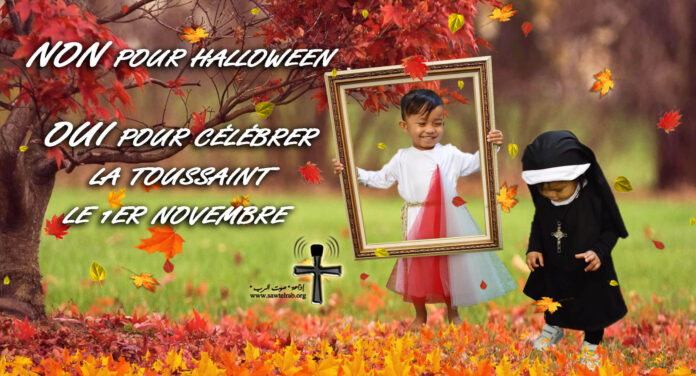
Let us teach our children about holiness and guide them to the road that leads them to heaven; let us teach them to wear clothes worthy of Christ, whom they put on at baptism, not to acquire the costumes of the devil and of witches and get so used to them that they become familiar and ordinary.
What is this contradiction we are living today?
How can a Christian committed to his Church celebrate the feast of the devil, which they call Halloween, and which many of us think is the same as All Saints’ Day or the feast of Saint Barbara? It is a feast of ugliness, darkness and terror, of sorcery and witchcraft, and Christ, the God of light, came to save us from all this darkness.
“My people are destroyed for lack of knowledge; because you have rejected knowledge, I reject you from being a priest to me” (Hosea 4:6).
Emigration has taught us customs and traditions that offend God.
God loves light: the first thing God created was light. On the first day, “God said, ‘Let there be light,’ and there was light. And God saw that the light was good. And God separated the light from the darkness” (Genesis 1:3-4).
God himself is light: “I am the light of the world. Whoever follows me will not walk in darkness” (John 8:12). And we say that he is “the true light,” as the first chapter of John’s Gospel says.
“The light is among you for a little while longer. Walk while you have the light, so that darkness may not overtake you” (John 12:35). And in the book of Revelation it is said of the Lord Christ, when he appeared to Saint John the beloved after the resurrection: “His face was like the sun shining in full strength” (Revelation 1:16). Is there any greater light than that?
The angels too are beings of light; that is exactly why Saint Paul warns that Satan himself disguises himself as an angel of light (2 Corinthians 11:14).
The Gospel also says that we are children of light: “Let your light shine before others, so that they may see your good works” (Matthew 5:16). And Christ said to his disciples, “You are the light of the world” (Matthew 5:14).
The end of the Bible, too, speaks of the radiant heavenly Jerusalem, of which it says: “The glory of God gives it light, and its lamp is the Lamb” (Revelation 21:23).
Darkness is the symbol of evil; that is why it is said of the wicked that they love darkness: “People loved the darkness rather than the light because their works were evil” (John 3:19).
And in the book of Proverbs: “The way of the wicked is like deep darkness” (Proverbs 4:19).
One of the most profound things said about darkness are the words of the Lord Christ to those who wanted to accuse and crucify him: “This is your hour, and the power of darkness” (Luke 22:53).
Darkness also symbolizes ignorance; Ecclesiastes says: “The wise person has his eyes in his head, but the fool walks in darkness” (Ecclesiastes 2:14).
And the hardest thing said about darkness is that the wicked “will be thrown into the outer darkness” (Matthew 8:12; 22:13; 25:30). Why is it called the outer darkness? It is called darkness because it is far from God, who is light; far from the angels, who are light; far from the righteous, who are light; and far from the heavenly Jerusalem, which is light.
And “outer” means outside the kingdom of God. The worst that can await people is the outer darkness.
That is why we hate darkness and love light. Darkness is the result of evil.
That is why Scripture says of the one God punishes: “The lamp of the wicked will be put out” (Proverbs 24:20), “How often is the lamp of the wicked put out?” (Job 21:17), and “Let their eyes be darkened so that they cannot see” (Psalm 69:23).
Whoever celebrates Halloween helps spread a culture of evil and fear without realizing it and corrupts the innocence of children.
All Saints’ Day is heaven’s call to us: a call to every believer to look up to heaven and to make holiness the first and last goal of his life.
Prepared by Rita of the Sawt El Rab team