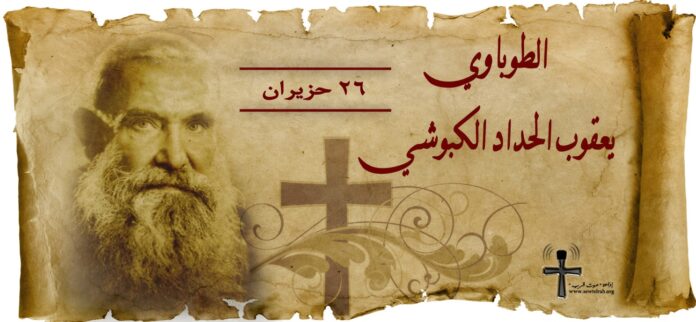
The Life of Blessed Abouna Yaacoub El-Haddad, Capuchin
Khalil was born on February 1, 1875, in Ghazir, to good parents full of piety and Christian virtue. He used to say: “My mother taught me: ‘My son, in hard times, pray your Mother’s rosary.'”
He grew up in Ghazir and studied at the parish school of Saint Francis, then at the Saint Louis school, known as the “Mazar school”, before entering the Collège de la Sagesse in Beirut, from which he graduated in 1891. In 1892 he went to Alexandria to teach, in order to help his parents raise his brothers and sisters. There he heard the call to leave the world, carry the cross and follow Christ. He said: “I will become a priest.” He returned to Ghazir and entered the Capuchin friary of Saint Anthony in Khashbau on August 25, 1893.
On March 26, 1894, the superior of the friary clothed him in the novice’s habit, and he took the name Brother Yaacoub (James). On April 24, 1895, he made his simple vows, and three years later, on April 24, 1898, his perpetual vows.
Brother Yaacoub then moved to the friary of Qrayyé to complete his studies for the priesthood. He was ordained subdeacon in 1899 and deacon in 1900, and on November 1, 1901, Monsignor Duval, a French Dominican and Apostolic Delegate in Lebanon and Syria, ordained him a priest. He celebrated his first Mass at the Church of Saint Louis in Beirut (Bab Idriss).
“Abouna Yaacoub” (Father James) lived at the Beirut friary and worked tirelessly, with energy and burning apostolic zeal. His superior directed him to missionary work, and he began founding primary schools for boys and girls in the villages of Lebanon. His fatherly, apostolic zeal drove him to prepare children for their First Communion, teaching them himself. Alongside his schools, in 1906 Abouna Yaacoub founded the Franciscan Third Order for men and women, following the example of his father Saint Francis of Assisi, and spread its principles and rule through the towns and villages.
Abouna Yaacoub’s apostolic concern was not limited to his own country but extended to Palestine, Syria and Baghdad. He longed to visit the holy places of France and Italy, and his superiors made this possible: he travelled to France and then to Rome, where he had the privilege of meeting Pope Saint Pius X in 1910.
In 1914 the First World War broke out, and his fellow French priests had to leave Lebanon. His superior, Father Jerome, entrusted him with all the affairs of the mission, including the spiritual and material care of the convents of European sisters. In the midst of his constant work and labours, Abouna Yaacoub dreamed of raising a giant cross on a hilltop, to pray for all those who had died in the war and for emigrants.
He laid the foundation stone on a hill in Jal el-Dib, known as “the hill of the jinn”, on January 19, 1921. The building rose; the church was completed first, dedicated to Our Lady of the Sea, and inaugurated on May 3, 1923, in the presence of a large number of tertiaries. A statue of the Virgin holding the Child Jesus was put up, with a boat of travellers at her feet. Finally a large cross was raised on the west side of the church, and Abouna Yaacoub’s dream came true.
He believed that the priest is God’s ambassador and minister on earth. So after the inauguration, on October 4, 1926, he took in the first priest, whom he had found neglected and abandoned in a hospital, so that he could end his life with dignity in prayer and holiness. Other priests followed, as well as sick and disabled people of different religions and denominations. When the place became too small, he opened other centres for them. Abouna Yaacoub then felt deeply the urgent need to found a religious congregation dedicated especially to caring for these priests and patients. Relying on divine Providence, he began his great project with a small group of young tertiaries, whose formation he entrusted to the Franciscan Sisters of Lons-le-Saunier; they later became the congregation of the Franciscan Sisters of the Cross of Lebanon.
In 1951 Abouna Yaacoub celebrated the fiftieth anniversary of his priestly ordination (1901). In that same year the Convent of the Cross was turned from a shelter into a hospital for mental and psychiatric illness, after its official recognition by the Lebanese government. The jubilee celebration was therefore a double one, and on this occasion he was awarded the National Order of the Cedar.
After this life full of continuous labour, Abouna Yaacoub’s body declined; he battled illness and failing eyesight. When his illness grew worse, he said to the Superior General: “I am going to heaven, and I will keep on helping you… don’t be afraid… I entrust the sisters to you.” Then he blessed his daughters, the sisters, and urged them to love and obedience.
On the morning of Saturday, June 26, 1954, he said: “This is the last day.” After his agony, amid the tears of his daughters, the sisters, and prayers and praises to Jesus, Mary and Joseph, he gave up his soul embracing the cross of the Lord, the beloved of his heart. It was three o’clock in the afternoon.
Abouna Yaacoub’s beatification was celebrated in Martyrs’ Square in Beirut on June 22, 2008.