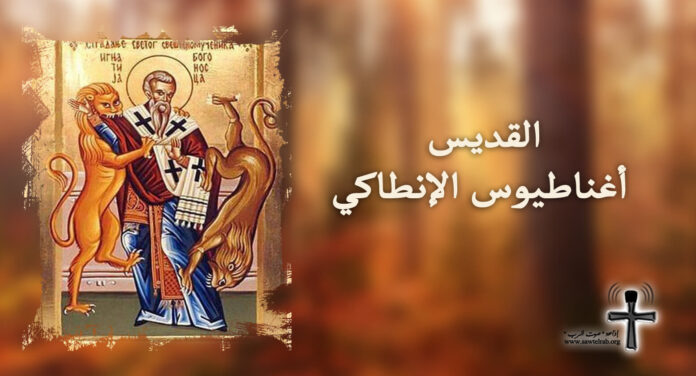
The name Ignatius is linked to the Latin ignis, meaning fire. This was indeed his defining trait: he was filled with the fire of the Holy Spirit and burned with love for God. He knew the apostles and was a disciple of Saint John, the beloved disciple. According to tradition, he was the child whom the Lord Jesus took in his arms, saying: “Whoever receives one such child in my name receives me.” Saint Ignatius was given the name “Theophorus”, meaning “God-bearer”.
He succeeded Evodius as bishop of the great city of Antioch. The Emperor Trajan wanted to revive the worship of the gods and force Christians to offer sacrifice to idols. Saint Ignatius confronted the emperor boldly, realizing that the hour
he had long awaited had come. After hours of debate, Trajan condemned him to be put in chains and taken to Rome to be devoured by wild beasts for the people’s entertainment.
Ignatius cried out with joy: “I thank you, Lord, for counting me worthy of this honour, granting me to be bound for your sake with chains of iron, like your apostle Paul.” On the way, the man of God was able to stop for short periods, and representatives of the local Churches came to comfort him and receive his blessing, among them Saint Polycarp, bishop of Smyrna, and the bishop of Ephesus. He was also able to write to several Churches of Asia Minor.
Seven of these letters have come down to us; they are counted among the treasures of the writings of the Fathers, so full are they of the Spirit of the Lord, of unshakeable faith in Jesus Christ and of zeal for the Church.
The most remarkable of them, the most transparent, fiery and spiritually overflowing, is his letter to the Romans. Saint Ignatius wrote his letters after he had fully and joyfully accepted to be a martyr by blood for the Lord Jesus. So his words are an extension of the Gospel, and especially of the letters of Saint Paul whom he loved, through the Spirit who filled him and in whom he spoke.
At last the soldiers reached the outskirts of Rome with the saint. The magistrate ordered the man of God to be led into the arena of the amphitheatre as food for the beasts. The saint entered with steadfastness and joy: this was the chance of a lifetime to become a true disciple of Christ. He went forward to face the beasts as if stepping over the threshold of the Kingdom,
and spoke his famous words: “Allow me to be food for the wild beasts, through whom I may attain to God. I am the wheat of God, and I am ground by the teeth of the wild beasts, that I may be found the pure bread of Christ.” The beasts fell upon him and devoured him. Afterwards the faithful came, gathered his remains and took them back to Antioch, where they were laid in a tomb.
His relics were later moved to the cathedral of Antioch. In 637, according to tradition, they were taken to Rome and placed in the Basilica of San Clemente.
Among his sayings:
“Allow me to be food for the wild beasts, through whom I may attain to God. I am the wheat of God, and I am ground by the teeth of the wild beasts, that I may be found the pure bread of Christ.”